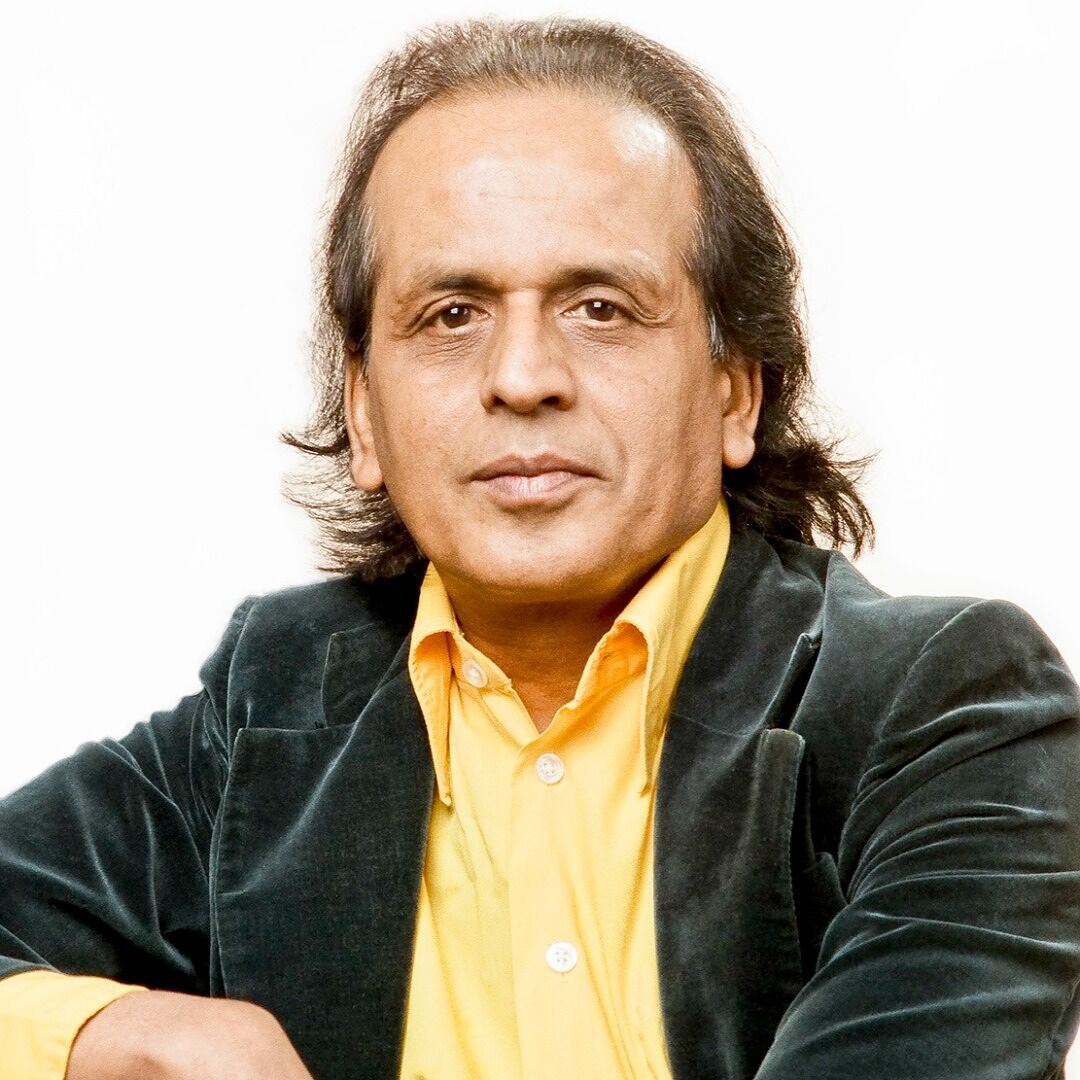
Anarchist Revolution
Professor Iyer traces how anarchist thinkers envisioned individual transformation as the seed of social revolution. He examines Godwin's slow, rational path of individuation and universal justice, then turns to Tolstoy and Gandhi, who sought to release the spiritual will through unconditional moral affirmations rather than reasoned argument, arguing that true change requires courageous self-testing rather than institutional reform.
Transcript ~ Anarchist Revolution
A Lecture by Professor Raghavan Iyer
Evil lies not in error or in so-called sins and mistakes; evil lies in the pollution of consciousness through rationalization.
Raghavan Iyer
From the Series: Anarchist Thought Lectures
University of California, Santa Barbara, 1981
How to bring about an anarchist society, if we agree with the different anarchists about their view of the golden promise in human nature, which is obscured, repressed, frustrated by the institutional superstructure of government, of external authority, and of large-scale economic capitalism? How could we release what is potentially present in human beings?
Now for Godwin, as you would have already guessed, this is going to be a slow and difficult process. Anything which ignores the fact that most people, alas, are creatures of habit and prejudice, and whatever the structure, that they are not ready to individuate, ready to take full responsibility; so for Godwin, this is simply a patent fact about human beings. And it's not a case of blaming human beings, because he's very concerned to point out that there are laws of nature which work as laws of mind, through psychological associations of human beings, making them very suggestible to the environment. And as long as the environment caters to habit and prejudice on the part of the majority, that environment will only reinforce again and again, generation after generation, civility, uncritical attitudes, and therefore you cannot really make a revolution unless it begins at the individual level. The individual must negate, must stand apart, must recognize that he does not want to go or she does not want to go with the multitude in the direction of mindless conformity. This is painful, but it is inescapable. And therefore, for Godwin, because of the extraordinary importance and difficulty of making the start in individuation, those who do so are truly, you might say, heroes of the mind. They are pioneers in a revolution in consciousness. And the work that they do will prevail. Truth will win. But the process of displacement of error by truth will be a slow and protracted and repeated process. And these individuals in turn, instead of becoming isolated and remaining merely apart from the multitude, rather stand apart from the pressures of a local neighborhood, a particular society, and universalize through a concept of justice.
It would be, if you apply it today, very few individuals in different countries saying, what does it mean to belong to The City of Man that does not visibly exist? What does it mean to disengage from all the pseudo-cities, the so-called communities organized around the state? What does it mean to desist from the patriotic pressures and the mechanical ideologies, the rhetoric of self-justification of politicians involved in power? So, once you start asking questions like this, we're really talking about political disengagement. And universalization through justice is indeed also very difficult, because it involves a heightening of the very faculty of imagination. The capacity to put oneself in the position of deprived and depressed peoples all over the world, people in very different social situations. And also for Godwin this requires study, this requires meditation, this requires the gathering of actual knowledge, information, facts. So, clearly, this then is a very slow process, and there is nothing here that is exciting. And those who are acted upon by an extraordinarily fragmenting structure in which there is so much fragmentation of consciousness cannot really release the will merely through the rational appeal of Godwin.
At the same time, it is very useful to periodically think of what Godwin is saying, because it gives that kind of patience and that concern with self-testing, which is so crucial if there is to be any validity and integrity and continuity to the anarchist revolt. And what, of course, in the late 18th century looked to be something that could come to very few, and which under the faVade of a facile liberalism in the 19th century looked like the actions of many, we saw by the middle of the 20th century really belonged to very few people who, in times of terror and times of trouble and in times of war, could really take a critical distance from institutions and events and political propaganda and really address themselves to a self-chosen path of self-transformation. On the other hand, we have seen in the United States of America since the ‘60s that out of the very immensity of the challenge, out of the very intensity of pressures, out of the extreme meaninglessness of human life under the system, that itself has led people, even by simple gestures, by a few moves, whether it be just dabbling a little bit in classical meditation or in certain protest movements or by merely traveling and moving around, has at least helped to loosen up the human mind, create a condition where there could be a change in consciousness.
So clearly then, while individuation is rare and difficult and this kind of revolutionary transformation at the individual level will always be exceptional, it must have some relationship to what is potentially possible in human consciousness, even though there will be repeated disappointments when people expect that changes in consciousness will be accompanied by appropriate changes in structure. And this is, you might say, the learning experience of generations since the ‘60s in different parts of the world. They have moments of anticipation of what society and life could be like. They have a certain thrill of release from illusion and hypnotism and deception when they break away from the mold of the system and of mere habit and conformity. But at the same time, they know that to the extent to which you can only maintain support by extravagant promises that you're really running against not just the current of history but against that essential truth about human nature, that it cannot change except by self-direction. And therefore, you can take any number of horses to the water but you cannot force them to drink. You can persuade, you can exhort, you can reason with people, but to get people to make the breakthrough involves pain and suffering. It involves a kind of preliminary courage. So just as in the time of Plato and Socrates it was known that the very initial steps towards individuation are so tough, which is also why Thoreau said only one out of a thousand people typically is truly an individual.
We know today also nothing changes in regard to the courage involved in individuating. And therefore, year after year we find so many people on campus very responsive to creative and indeed you might say revolutionary ideas, very much agreed upon the blasted nature of the system but unable really to themselves make a change. How many times have I not experienced a poignancy of students who have tried to take vows, make resolves, tried to rearrange their lives, tried to see beyond the system, tried to release some inner faith in themselves, a true inner confidence and then one meets them a few months later, a year or two later and they have a sense of defeat. In other words, it is as if the initial step is the hardest and therefore only those who really go all the way through at the beginning can make that breakthrough into individuation. It is rather like what is said in the Gospel According to Thomas Jesus, “blessed is he who stands at the very beginning for he shall overcome death”. It is the very beginning moment of resolve, of recognition, must not be aborted. It must not be converted merely through talk into mere rhetoric. It must be a matter of deep and repeated inner renewal.
So this requires really the courage to be alone. It requires the courage to set oneself, one's own standards without any reference to social opinion and clearly this is not easy. But though not easy it is important to state this goal because there will always be those rare individuals who by persistence or through pain or under pressure if not at the beginning but at certain moments in their lives when everything is empty, if not at 20, at 35 or 40, they come to a point where they see that they should really not evade the fundamental task of individuating. So this is you might say what reason supports within the Godwinian framework. It is a revolutionary standpoint. It should not be mistaken for wishy-washy liberalism because Godwin had a certain guts in his conception of the struggle between truth and error which cannot really be equated with liberalism of the later Victorian kind. He had no faith in institutions. He was not advocating mere gradualism for its own sake. He had the courage totally to reject all institutions, the very basic machinery of socialization. So it is a revolutionary standpoint but an extremely difficult one.
Now naturally when you see this you can then understand coming all the way down towards Tolstoy and Gandhi that here were two individuals who were much more concerned with releasing the spiritual will and therefore tried to look beyond reason. They wanted to actually make real in a human being's life the sense of being an immortal soul. Their appeal was frankly spiritual though they were very careful to distinguish their spiritual appeal which is based also upon self-testing and self-validation from organized religions and external dogmas and creeds. And for Tolstoy the lever of change lay in the fact that as long as there is conscription, as long as there is taxation, as long as there are certain simple devices by which governments gain control, and at the least as long as there is propaganda on behalf of supposed patriotism, on behalf of wars, on behalf of one's nation or government right or wrong, individuals can refuse to go along. And to him this refusal was a spiritual act, it was a Christian act. It was extremely profound and it was that which addressed itself to what everyone else knew inwardly. That is because of Tolstoy's theory about double standards, about hypocrisy, about the moral contradictions within civilization.
So therefore, just as for Hegel or Marx if there are certain philosophical or economic contradictions in society, society is inwardly vulnerable and society will one day break up and even though one may repeatedly postpone by various ingenious methods the moment of breakdown, the breakdown is unavoidable. For Tolstoy this follows simply from moral premises. Human beings cannot indefinitely live on the basis of moral hypocrisy. And the reason why most people do is because they are hypnotized into thinking that there is no alternative. And they also haven't laid the blame where it really belongs, which is beyond politics in the realm of religion itself. Unless you can really see how religion got perverted and prostituted by priestcraft, what Tolstoy calls pseudo-Christianity and there is its equivalent in every other religion; unless you can see how a religion that apologizes for the establishment that speaks in the name of nationalism, patriotism, in the name of law and order, has nothing to do with a revolutionary message of the prophets, you will not be able to take your stand with the prophets. So Tolstoy then has a very profound spiritual appeal and those who are deeply moved by that appeal certainly find that their lives are altered and transformed. In Tolstoy's own case, he came rather late at life at the age of 40 because of reaching a point of extreme suffering and hopelessness and then after a long protracted inner search and crisis, he turned to the spiritual sources of inspiration that were in his hands, Christian, Buddhist and elsewhere, and found that there was some hidden truth here about the will.
In other words, he understood that the will cannot be released unless you make unconditional affirmations. What characterizes and becomes the criterion of pseudo-religion is the fact of making exceptions to unqualified and absolute commandments. The moment you say Thou Shalt Not Kill ‘except’ and you start to focus on exceptions and reservations, you have taken the very kernel out of a great affirmation. And he saw how this works with the rationalizing human mind and this is how politics works, this is how institutions work and this is how human beings really reduce themselves to pale, oculated shadow, emasculated versions of their true manhood or true womanhood. So unless one can make an unconditional affirmation, an absolute allegiance to some value or standard, you will not be able to make also the disengagement from forms, from institutions, from external authorities. And what Tolstoy said very late in life and before he died, very pointedly put down as not only true but as in line with what was ahead in the 20th century because he felt there was this latent awakening in vast masses of humanity which will make the spiritual revolution work, though he was too modest to set any dateline or he had no historical agenda for this, but he was convinced that the forces were there. He experienced them in Russia. So though he could not have anticipated the Russian Revolution, indeed who could have, even as late as the turn of the century. But he certainly saw that there would be a series of revolutions, a series of radical changes in the 20th century, but that eventually people must come back to this unpolluted consciousness.
Evil lies not in error or in so-called sins and mistakes, evil lies in the pollution of consciousness through rationalization. The moment you rationalize weakness, you consolidate cowardice, you cripple the spiritual will. The spiritual will can only be released by a courageous refusal to rationalize, even though your actual conduct will fall repeatedly, well below, far below, far short of your affirmations. This is rather like also what Kropotkin was saying about the ideal, because to him there is a certain potency and power, a strength, you might even put a magical energy released by ideals. And it is very important repeatedly to refine, renew, restate, reframe one's ideals. And it is a very nature of ideals that they can never be fully realized in practice, that they transcend the facts and therefore cannot be either confirmed or falsified by reference to the facts. And when these ideals, especially Kropotkin felt, become meaningful to people who are young, meaning people under a certain age before they have really defined their life patterns, if they can then release a courage to work towards these ideals among the masses, they will participate in a very mighty preparation for the future. So this we can certainly appreciate at some point because it seems to refer to a certain dynamic of the will which is somehow missing at one level in any appeal to reason.
And with Gandhi of course we find this goes all the way to the most extreme position because he felt that, as was very well pointed out last time, by the taking of vows, and especially unconditional vows in favor of unconditional non-violence in thought, word, feeling and deed, it is as if you have defined yourself and you in fact precipitate, you precipitate difficulties. It is like putting yourself in a fire. It is like burning out impurities out of metal. And burning out in the moral life means setting yourself the same unconditional standards which are proclaimed by the prophets and making them immediately relevant. So that instead of meditating upon your imperfections, instead of brooding constantly upon your weaknesses, you are always concerned by this repeated reaffirmation to purge and purify the mind of rationalization. So therefore, you change your evaluations. Many things which otherwise you would think are great are in fact signs of weakness. They really are signs of latent violence. And when you really look at your life typically, and it's true just about every human being, one is aghast and appalled by how much fear, how much weakness, how much insecurity, how much mental violence there is. And it is a tremendous distraction only to focus upon physical violence, whether in the form of the ghastly events of war or in the form of crimes, because the roots of violence are in the mind. And all human beings in their minds engender and generate in multitudinous ways through insincere, harsh, cruel speech, they generate conditions of hostility and violence which are bound then to precipitate on the physical plane. And therefore, Gandhi had his extraordinary guts or temerity to point out that sometimes violence on the physical plane is actually cleaner than violence in the mind. And therefore, while he certainly was against all physical violence, but he was concerned with causes, getting to the very roots of violence; and to him the roots of violence were not sociological but psychological. They would not be explained in terms of the environment, they were to be explained in terms of what was in the psyche. And what was in the psyche was that which was like the enemy or the antitype to the immortal soul, the God within.
So with Gandhi of course we have got a very tough spiritual approach, and the only way this in practice becomes feasible for large numbers of people, though there are still relatively few, is if they can immerse themselves into a constructive program. If they can actually live among the poor and the wretched, take off all the trappings that distinguish them from the most underprivileged, and living among these people then by years of involvement they become credible helpers, leaders among these people, and are able to initiate new modes of nonviolent action and even nonviolent living. Now of course we shall be speaking about his nonviolent revolution next time.
Now how you can already see that Godwin on the one hand, and at the other end of the spectrum with Tolstoy and Gandhi, if anarchist thought merely functioned either at the level of the appeal of reason to the individual, or at the appeal of the immortal soul to individuals, while it could be very meaningful for you might say the twice born, for the truly newly born, there's those who don't need to advertise in the back of their cars, but for those whom it becomes a way of life. But vast numbers of people would be quite untouched by the appeal of anarchism. So then of course in this vast, you might say, void in between, you see why Marxism is so powerful.
Marxism is a theory of revolution, is the most powerful theory in the modern age, because independent of all its claims about being scientific in its analysis of economic materialism and of capitalism, it identifies an agency for historical change, and the agency is the awakened proletariat. It is the very fact that capitalism has rendered necessary the emergence of a large industrial proletariat, and of course Marxism is focusing on the industrial, not the rural proletariat, that makes the industrial proletariat potentially in a position, if only they would be aware not only of their numbers, but of their collective strength, but especially if they could only know that time is on their side, that the future is with them, that capitalism despite all its apparatus of wealth and power is inwardly sick, inwardly doomed because of its inner contradictions, if only they could realize this and thereby make class consciousness an active reality, that is they are members of a class whether or not they know it, but when they actually through self-knowledge make class consciousness a force, then of course they would be very, very powerful. And if also they could be wise enough to act at the right time of natural demoralization of the opposite side, then class war converts into a revolution that will be successful.
At the same time though this appeal is very powerful because it identifies an enemy and it also identifies an agency for the revolution and for revolutionary change and furthermore supports it by a philosophy of history, the problem is that Marx himself did not really know, given his own analysis, how this was going to take place. All that he was concerned with was the organization of The International and in that organization, which was very impressive, of representative workers from many countries of Europe, Marx stood for centralization. That is he wanted to be very careful, he was very concerned with heresy, he was always afraid of compromise and that is true. Until society has really become communist there is the ever-present danger of conscious or unconscious compromise, indeed also of selling out. So there, therefore, there can be a certain paranoid element and a conspiratorial element in the actual preparation for a revolution, and this for Marx could only be solved by making solidarity relevant upon a centralized committee which can authoritatively lay down a program behind which vast masses could rally. And Bakunin even then, though he had already been under the influence of Proudhon and Hegel and later under Marx, become almost a Marxist, but Bakunin was too great a lover of freedom, really not to see a grave danger to the violation of the principle of freedom in the very organization of The International. And therefore, his worries, which were also earlier the worries of Proudhon, they were ignored of course by Marx, but by the time Marx became an old man, he had really become totally ineffective. He was a solitary scholar in England, and in fact The International, though it contained a number of Marxists, but these Marxists were constantly arguing amongst themselves as to whether revolution is going to take place first in England, as Marx said, or whether it could take place in France or Germany, and whether in Germany they should work through the system or outside the system, in France what should be the attitude to Proudhon and to the rural proletariat, and so on, and indeed had very little to say most of the time other than general appeals for universal solidarity to the conditions say of Tsarist Russia, which was the most extreme case of repression.
So it was as if there was a flaw all along, but again curiously, and this is a fascinating historical story, that missing dimension in Marx was contributed later on by Lenin. So what then really becomes the most powerful force in the modern age is not Marxism, because a great deal of what is attractive about Marx was provided by Engels. And Marx himself had great insights, but he also was extremely dogmatic. But it was a conjunction of Marxism with Leninism and Lenin himself, who had been influenced by Bakunin on the one hand, also on the other hand very much influenced by a knowledge of history and especially how conspiracies work. He had made a special study under the influence of Gauguerre of how the Jesuits worked in the Catholic Church. So Lenin, through all of this, he was able to create a view that you need an organized party and within the party you need a militant front, you need a vanguard and this vanguard must make a very deep and profound study of the dialectic and at the same time it must constantly steer clear of two dangers which are ever present. On the one hand left-wing adventurism, on the other hand right-wing chauvinism, by which Lenin really meant at any given time you may be tempted to act and act too soon and act impetuously. Leaders become captive to their following, who want action, action, and by acting too impetuously and this is followed by extreme repression, you really have lost far more than you need have done and it's a great mistake, it's a betrayal of the revolution. On the other hand, if you are too cautious, too careful, and then you start conniving at and compromising with the structure, you lose your revolutionary integrity, your revolutionary courage.
So it almost becomes a very great mystical art of being able to steer clear between these two extremes. And for Lenin you had to do this to really grasp the dialectic, by which he meant you've got to grasp the philosophical underpinning of the dialectic in Hegel, the elaboration of the dialectic by Marx, but you also have to extend the dialectic by studying historical conditions. Otherwise you're liable to assume that history will work more or less in terms of the categories you set up, and whatever the categories you set up, history is larger than all schema and categories. And therefore, you must be continuously observing historical conditions. And Lenin certainly by doing this was very shrewdly able to see under the influence of Hobson what was quite missing in Marx, the connection between capitalism and imperialism, and how imperialism was an international force, and what its connection in the struggle for markets was with World War I, and what opportunities is provided for the world’s proletariat.
So this is a large and fascinating story but why one mentions it is put together Marxism-Leninism did provide an extraordinary mandate for a triumphant revolution. But now when you go back to the 19th century at a time when Marx himself was wandering in the dark in regard to practical questions, but on the other hand his whole integrated philosophy of dialectical materialism and the economic interpretation of events and his theory of class war had appealed very widely to large numbers of intellectuals and also people in trade unions and even some people in the countryside.
So going back to that period, now we then come to this extraordinary figure of Bakunin and this is very important to understand because here is a man whose life in a sense is a tragedy because all the things he said never really happened for reasons he never really understood which are only clearer much later on because he never quite understood that though he was right against Marx, but when you work through human weakness you have a tremendous power. He understood this historically, he understood this in the past, he saw how the church had worked, but he was such a generous man he really felt himself that all socialists were basically very similar to anarchists. And the question simply was do you mean socialism or do you not mean socialism, and if you mean socialism then surely you must recognize that this is incompatible with a one-party state, it is incompatible with regimentation, socialism must be an extension of freedom from the political to the economic sphere. So you can't really be a socialist if you also don't love freedom, and certainly to say you love liberty but you're not a socialist, you're not ready for social justice, for fundamental changes in the distribution of property, wealth and income, you really aren’t serious for Bakunin. So for Bakunin then all socialists surely should recognize, and all anarchists can come together with them, that any and every opportunity must be seized. And here what Bakunin was really concerned with was essentially this, on the one hand as an anarchist you can't program the revolution, you can't set up an agenda for the revolution, you can't set up a revolution by degrees, you can't as it were legislate from above below, a few intellectuals can't get together and simply lay down the law for vast masses of people as to how they should proceed and when the revolution should take place. For Bakunin for one thing this would be unhistorical because there are constantly forces at work, there are laws to social and psychological history. And these laws are very difficult to understand though Bakunin had something of the 19th century optimism about the eventual possibility through integrated social sciences to unify all these laws but certainly that was not the case in the 19th century. But Bakunin says quite apart from the fact that our science in the social realm is very primitive, and quite apart from the fact that we don't have all this knowledge, but we also have no right to impose a revolution.
Revolutions will occur spontaneously when the time is right and ripe; but because we don't know when the time is right and ripe we have constantly to be on the alert, we have constantly got to be moving around among the masses, we've got to be educating them, bringing to them science, bringing to them a knowledge of the economic system, a knowledge of the processes of history. We've got to do this all the time and especially we've got to bridge the gap between workers and peasants. And Bakunin also had, like many an aristocrat, this extraordinary faith in the peasant, the mystique of the peasant. That the peasant represented a purer type of humanity than even the industrial worker. That the peasant had a lot of sturdy common sense, the peasant was very shrewd, that the peasant could see through shams and repeatedly in history had seen through every kind of sham. That though very often the peasant may not be able to interfere with his wife's allegiance to the church, but the peasant saw through the abuse of the church. In other words, the peasant knew far more than he could use, and the whole question was to show the individual peasant that what individually he had acquired as a kind of folk wisdom, but also a historical instinct, that was not enough on the basis of instinct, that this instinct could be backed by knowledge and that this knowledge was capable of being given and spread among even very poor illiterate people in a short time. If only the right educators came through dedicated revolutionaries, they could find a way of making what is essential to modern science, make it intelligible and clear to peasants, and they must be given a sense of history and also they must be told about what is going on in the cities, they must be made aware of all the possibilities in relation to unionization of industrial labor.
On the other hand, industrial labor in turn must be made to overcome its deep-seated prejudices against the peasantry. It must be shown that those areas in which the peasants are reactionary or are very difficult to change cannot be blamed upon them. They simply arise out of their extreme misery, their extreme deprivation over a very long time. But on the other hand, industrial labor must be shown that there is tremendous energy, there is a tremendous moral potential in the peasantry, and therefore they must seek and establish a visible living solidarity. And Bakunin knew that this in fact involved a more fundamental challenge to leaders, namely making a break with the distinction between mental and manual labor. So here Bakunin was really very prophetic, because you don't find much in Marx, or indeed in many other socialists who became enamored through their categories of collective action, of this essential problem of all history, and an acute problem of the modern age, the gap between the cerebral and the productive, the gap between the mind and the hands. And of course you don't have to take the hands literally and you don't have to take manual labor literally. But what Bakunin understood was that intellectual, through the categories of education, was not necessarily more intelligent, not necessarily even more deliberate or rational than the uneducated man; but was able through those categories to establish a kind of partnership that cut across distinctions of classes and nations and be able to collude with the establishment. If only therefore true knowledge could be made available to the peasants and the workers, and if they could have leaders who though they're educated voluntarily disdain any distinction between the intellectual and the common man, and also speak in terms of a society in which all would be involved in mental and manual labor, and all would be involved in sharing resources, then there would be a stimulus to the setting up of local communes and these communes could become organized into larger and larger groups, and what would always be the cementing bond would be the great universal appeal in relation to the whole of humanity.
So you can see all of this is very, very noble; and yet Bakunin himself repeatedly had to give his mind to the problem of tactics because in practice he found that there was always this problem. You can't merely leave it to folk instinct, you can't do it by decree, which means you have to organize, but how to organize without regimentation. So in a sense Bakunin really was raising one of the toughest unsolved problems of modern society and indeed of human history. It is partly a problem of scale. His vision was global. At the same time his method involved local action. Organizing on the local basis of your local needs and conditions where of course methods would have to vary, and because to link the two up and also to do this in a short time really becomes very difficult unless you hold to some Marxist view of history which Bakunin really did not. You really felt it very difficult not to experience repeated disillusion, and this is what happened in Bakunin's life. So he kept on looking back to the mesmerism introduced into the modern age by the French Revolution, and that's one of the things he does. He looks elaborately at how the French Revolution sabotaged, how the Jacobin element came and so early after the French Revolution brought in intellectuals, brought in lawyers, brought in people who became very plausible and who even had a certain popular mystique, and they were able to subvert the spirit of the revolution. But then Bakunin also wondered whether this was not inevitable because the revolution itself he felt was confined to large abstractions--Liberté, Egalité, and Fraternité. And Bakunin felt that these abstractions were not combined with a concreteness of understanding and analysis of the social structure. That is Bakunin was reading back into late 18th century what was beginning to become talked about in the middle of the 19th century since the emergence of Marx as a force in intellectual affairs. People have continually argued since 1793 about what went wrong in the French Revolution. Why was monarchy restored? What happened later on? And this is one of those very difficult questions which is why it is very good to read James Joll, because James Joll as an excellent historian of the modern European world and the tremendous knowledge of France and of Spain but also of Italy goes early in the book in what he calls ‘the myth of revolution’. It is the problems raised by the French Revolution, and then, and there, he talks a lot about the various utopian socialists and then in what is marked out as the assignment, especially for this topic of revolution, you find Joll going a great deal into the whole anarcho-syndicalist movement, and this movement really emerged after Bakunin and Kropotkin though the seeds were there from the very beginning in Proudhon in the middle of the 19th century. But those seeds that were there in Proudhon came to be much more important, they were elaborated into a more complex theory early in the 20th century by Sorel.
Now, and then later, James Joll has a very moving chapter on Spain, which I don't include because it's a whole fascinating subject, but if you really read it out of interest you'll ask yourself why is it that anarchism from the late ‘70s of the last century right up to the late ‘30s, which is really not so long ago which is right in the 20th century, how did anarchism repeatedly come so close to success and yet why was it repeatedly subverted? The short simple answer is that anarchism simply could not withstand the appeal of communism. So in the same way when you go back to Bakunin you could say while you can sympathize with all his concerns and all his questions, and you can feel his tremendous love of liberty and his tremendous passion for universal solidarity, a great deal of compassion that is missing in Marx, but at the same time you feel that all of Bakunin adds up to something that cannot be as powerful in identifying the enemy and in identifying the agency of historical change as what Marx did. And here of course Bakunin is not to be wholly blamed, because with his knowledge of Russia, and also with his intuitive awareness of the forgotten man of history, the peasant, Bakunin understood that if you're going to talk about this globally the peasants have got to be brought in. Whereas for Marx with his contempt for peasants, until rural societies first became capitalist, until they first became industrialized, they were not ready for revolution. Surely you couldn't expect Bakunin to go along with that with his enormous humanitarianism, and also with the deep-seated knowledge in Russia of the tremendous openness to experiment, the tremendous communitarian sense of the peasantry. So you feel all of Bakunin's instincts were right, but again and again he was pointing out instinct is not enough.
So, then what was needed? Knowledge. Knowledge of what? Knowledge of science. And this knowledge of science has got to be made available to the masses. In other words, we have got to be continually preparing for the revolution. Quite right. Given Bakunin's view you've got to be ready at all times. Furthermore, Bakunin said because none of these other things are enough you have got to accept the need for revolutionary violence. And he made the most powerful case, which later influenced Kropotkin, that you cannot avoid bloodshed, you cannot avoid violence. At the same time when actually violence took place, Bakunin you know had a very soft heart, he didn't like it, so he also spoke against terrorism, because he had this great hope that even if violence is used, and violence is cathartic and therapeutic, but the moment violence is used and there is a change, what he called a moral of the social revolution, immediately there should be a pardoning of everybody, there should be a re-education of your former enemies, there should be a declaration of principles, and there should be the launching as it were of a new kind of world.
All of which we can find very human and very admirable, and yet somehow at this point in the 20th century the question does arise whether or not perhaps there was a flaw in all these revolutionary philosophies that really had to do with violence. It may be that the approach to reason is too slow, but on the other hand there is never any guarantee when you rely upon violence that the greatest advantage lies on the side of the weak and the majority, and we know this even more today. Indeed this is what was confirmed very much in the story of the Spanish Civil War because the sole source of supply of equipment and weapons for the rebels in the Civil War was the Soviet Union. And naturally therefore the Communists had an advantage. Many individual anarchists became extraordinary military leaders. But the moment you become a military leader involved in a military campaign you recognize the need for organization; and once you recognize the need for organization and equipment you then start to move towards the state, you start to move in the direction of regimentation. And this is of course what happens. So it is as if something more is needed in the philosophies of revolution; or as Gandhi put it very well, the French Revolution said Liberté, Egalité, and Fraternité, but all of these three without non-violence will fail, there will be an inversion.
And this is also what the very person who coined this extraordinary motto, Claude Saint-Martin, felt towards the end of his life, early in the 19th century, when he saw the failure of the French Revolution, which also he prophetically anticipated together with Count Saint-Germain. Claude Saint-Martin said at the end of his life, well of course this will not work because there is something very wrong fundamentally with the very consciousness of the West. It can only work in the future if there is an invisible theocracy. And of course that's a typical you know aristocratic courage in using that phrase, because clearly he didn't mean going back to the Middle Ages, he didn't mean anything like dictatorship. But he was really thinking in terms of how it was done in Tibet, in the ancient world. He was thinking in terms of the need for a king without robes to emerge, for the magnanimity of divine kingship to be brought into revolutions, subtle codes established among those who work with these ideals and who are immune to corruption. It's also very much like the Platonic conception of the guardians, but the guardians were disguised, who move among the common people, who do not assume the trappings of authority. The guardian sense they break. They refuse all opportunities to have power or wealth but they're able to do this. So it's a very mystical idea, it's very profound and it's certainly worth considering given that it was the wise conclusion of the great pioneer of the philosophy of revolution towards the end of his life.
But in the case of Bakunin of course he had so great a contempt for organized religion that there was no basis in his thinking for extending any, you might say, sympathy towards the mystical. And therefore, you might say in a sense a problem of Bakunin's thought in regard to revolution is a problem of will and motivation. You say yes, yes, yes to everything he says, but in practice who will motivate individuals. Now one thing he shrewdly saw is there is all the difference between somebody who talks socialism and is a socialist. It's more important to be a socialist than to know about socialism. That is Bakunin knew socialism was something you either felt in your very blood and bones, in your very soul, in your heart or you didn't. This love of universal fraternity, this love of human equality, universal progress, this love of collective sharing of wealth and property it is true if it is rooted in the heart, it is something which if you truly feel then your instincts will be sound, and you will have some basis for guarding your integrity. And at the same time Bakunin was in general in favor of knowledge, but he saw only too quickly one flaw in Marx, that because of the absence of scientific thinking in Marx, anyone of the bourgeoisie, by intellectual conviction, could become a Marxist. And when he saw that time is on the side of the proletariat, could throw in his or her lot with the proletariat. Now Bakunin saw too many people doing this, and he saw that these people were the great liability, because these were armchair revolutionaries. The whole problem with America itself--armchair revolutionaries. People want other people to suffer, people want other people to do the work, but somehow only talk, talk, talk, and talk in radical terms. And Bakunin saw tremendous corruption, tremendous danger, something very poisonousness in this. You find this among the blacks, you find this among the Chicanos, you find this of course among the middle-class whites, it is something very insidious, it's a kind of compensation. Of course, it is the same thing which goes on in the realm of religion, but here it is even more insidious, because the person is not even aware of what is happening, it's a kind escape.
So therefore, there is a problem of will and motivation. This was what was clearly addressed by Sorel. And Sorel simply put this problem directly in terms of his conviction that all revolutions need a mythology. At all times in politics there are myths, and only myths move human beings and act upon the will. And in politics the problem is, he felt, that there will always be conditions in industrial society that are favorable for a general strike, for a general strike, a total disruption. And remember this kept happening again and again, sometimes even now like at the time of the New York blackout, or at the time of, you know, certain strikes there is an element of panic. But think in terms of what Bakunin talks about, if there is bankruptcy, if there is real economic deprivation it is extraordinary how vulnerable, not just a subversion, but to breakdown modern structures are. And for Sorel this is a critical fact, and this has got to be studied, but this has got to be studied by those who are ready for it, and these people he said must be monkish revolutionaries, they must have the dedication of monks. At the same time, they must have the passion of revolutionaries, and they must understand the distinction between force and violence. Force is oppressive, force is evil, but violence can be noble, violence can be regenerative. That is what, what, Sorel was trying to distinguish was between force used by the state as a means of repressing individuals, and the energy released, even through violent acts, something of course that we find in Bakunin, but for Sorel this had to do with releasing the will. That is it had to do with dynamizing individuals. Now Sorel himself then thought that the way to do this is to get individuals who are so motivated to go among the trade unions, and don't ignore the trade unions, try to make them militant, try to make them ready to disrupt society, to prepare for the general strike. But do this also outside the trade unions, do this wherever you can. So in a sense Sorel knew that the problem of will had to be faced, and his answer was you need these monkish revolutionaries.
But now look at that saintly Kropotkin. Because Kropotkin who had understood all these things, and in a sense had all these instincts (the instincts of Godwin, the instincts of Bakunin, the instincts of Proudhon, but also instincts to some extent of Tolstoy and Gandhi, and certainly he had instincts of Sorel) Kropotkin, who was not unlike Bakunin, too much conditioned only by the Russian case, but naturally, though he lived elsewhere, traveled a great deal out of necessity, he was constantly fascinated by what was going to happen Russia. And Kropotkin therefore, when he spoke of the fundamental contradiction between revolution and government, he saw that this was a rule of all the flaws of revolutionary theories in the 19th century, whether they were Marxist or socialist. And therefore, he said outright you've got to see that it's a contradiction in terms to talk of a revolutionary government, to talk of a revolutionary regime, revolution and government are incompatible. Which means we must talk of a revolution in consciousness, we must talk of a social revolution, and we must absolutely refuse to go along either with pseudo-democracy with the ballot box, with parliamentary government, refuse to ever compromise with socialists constantly wanting to do, take part in elections, form parties, enter into the political process, nor on the other hand must you compromise with dictatorship.
And Kropotkin when he wrote all of this in the 1880’s, he did not anticipate that there would emerge, because this came later on, an actual one-party state in Russia. Because Kropotkin's work was very much mostly through anarchists and socialists of every kind, and also many populists in Russia, through his journal to the spread of ideas was really creating the revolutionary climate. So, you get this extraordinary paradox. Bakunin talked about this, but Kropotkin was able to do it. So, Kropotkin laid the groundwork for the Russian Revolution. But Lenin with his understanding of organization, with his view about the historical moment, but also the opportunities which on one hand makes him opportunistic, on the other hand makes him lucky, it's a question still argued, whether there was a civil war, whether the Germans hadn't for their own reasons let Russians go back to Russia, there would have been a Russian Revolution or not. It's one of those difficult questions. Because you had this great anarchist movement in Ukraine, which though it was only one part of Russia was so powerful that it had to be tolerated by the Bolsheviks for quite a while. It also was admired at one level by Lenin, because there was a side of Lenin which admired real revolutionaries, even if they called themselves anarchists. And Lenin had not consciously intended to set up a regimented state, but Lenin had his worries about the great mass of peasants, he also had his worries about workers. That is Lenin had the same kind of disillusionment which Proudhon experienced with vast masses of people. Once you get them excited, they get drunk, then they go crazy, they forget everything to do with the program. So Lenin therefore was very concerned, because of his fear that while the world is still capitalist, to create communism in one country requires enormous courage. And therefore, he felt the necessary compromise was the acceptance of the dictatorship of the proletariat.
Now when you take Kropotkin's other essay, which is written after he has come to Russia, seen the Russian revolution take place and succeed, you find Kropotkin in a very difficult position, on the one hand he wants to appeal to peoples all over the world to be on the side of the revolution, to recognize that this is so great an advance upon what existed before, that if they start criticizing the revolution they will play into the hands of reactionaries. And therefore, he makes this noble appeal to peoples everywhere to really support the revolution. And this is of course at a time when there was very little rush to recognizing the new regime, and there was a lot of uncertainty and confusion, people really hedging their bets. And Kropotkin, always a man of courage, made this strong appeal to people of many different kinds, with many different convictions, not necessarily anarchist or socialist but simply on humanitarian grounds to support the Russian Revolution. At the same time Kropotkin, being totally intellectually honest, pointed out that there was a regression that had emerged very early on in the Russian Revolution in the emergence of a one-party state, in the emergence of regimentation, in the setting up of a kind of dictatorship in the name of the proletariat. And Kropotkin because he was a man of guts said so openly to Lenin, and Lenin said well of course I don't really want that, but you know we've got to be very careful, look at the danger on the other side. And in these discussions I don't believe Lenin was insincere, he certainly admired Kropotkin, but just as Kropotkin had earlier joined Lenin in criticizing Tolstoy for being too unrealistic in his emphasis upon nonviolence, though essentially Kropotkin was a very non-violent man unlike Lenin, but similarly Lenin in turn was doing to Kropotkin what Kropotkin did to Tolstoy: “This man's heart is in the right place but I'm afraid he doesn't really understand, you know, let's be practical.”
And of course this is what always happens. When people come close to the positions of power, when they suddenly become aware of the complexity of decision-making, and when they have got to act, they suddenly start saying let's be practical, and they may not necessarily be corrupt, they start to give in to complexities, and they lose touch with principles. On the other hand, of course as long as people who have firm principles but without continually applying them flexibly and intelligently and meaningfully to changing and living situations will also discredit principles. So on both sides you have a problem. On the one hand the problem of becoming infatuated with the idealism that goes with your convictions and your principles. On the other hand, the problem of compromising, saying it is necessary now but you won't compromise further, and before you know where you are, you are on an incline slope, and eventually you are justifying more and more regimentation, more and more oppression. And that is of course what happened. So if Kropotkin was isolated, he had gone alone, and he knew he could do nothing in Lenin's Russia, and at the same time he started to ask further questions. Whether perhaps there was something even that he needed to rethink, and what is never written openly, but one gets the impression that Kropotkin was rethinking Tolstoy, was really looking at the high cost of violence. On the one hand the kind of rational change which he extolled would be very slow, but on the other hand the moment you involve the masses and excitement and violence you lose control. So he was a very lonely man, and when he died of course there was this extraordinary response supported of course by Lenin, of the Russian population, an overwhelming admiration for the idealism and integrity of this man, but also this man had really paved the way for the Russian Revolution. So what we're reading essentially is a kind of postscript on what went wrong.
So then we can see the haunting significance of the title of Joll's chapter on anarcho-syndicalism, the revolution that failed. The French Revolution, well it was you might say the shot that was heard around the world, but it was also the revolution that was betrayed again and again. And then you could say it was the revolution that failed. And if you talk of the French Revolution in this way at a distance is it not the same about the Spanish Civil War, you could do the same about the Russian Revolution. But if to be an anarchist only means to be on the one hand to be on the side of an ideal revolution, and on the other side to be willing to say that great revolutions have failed, surely there is something missing in this, there is something lacking. It is not good enough, it is too easy to be Epimethean, and with the wisdom of hindsight to say what went wrong in a revolution. In other words what we need is something more fundamental. We really have got to give attention to consciousness. Because what was wrong here was what was wrong with a wide variety of political philosophies, all of them rooted in certain 17th century assumptions about the brain, and the vacuum theory of knowledge, an informational view of knowledge you find in Locke, certain epistemological premises. All of these theories they ignored the soul of man. They could not address the problem of the will. And while of course we know that answers to such questions are not to be found in dogmas and creeds, but nonetheless these questions are of fundamental importance. So when you read what Joll says about the early history of American trade unionism, it is very interesting to see how courageous and militant and tough were people like Emma Goldman and Berkman, who tried to support every strike, to go and give encouragement and also advice to leaders of trade unions. But later on there is a split in the trade union movement, because on the one hand there are trade unionists who become so Marxist that they cannot function within the industrial system, and on the other hand there are trade unionists who are so concerned only with their own selfish aims, their narrow purposes, that they start to compromise with the system, they want to work within the system, and in between the two anarchism goes out of the window.
So what you see really is that the kind of universal conviction on behalf of true freedom is very difficult, just as difficult as Godwin said, because let us face it most human beings most of the time are Epimethean. They will support something after it's over, after something has succeeded, they will make a noise and say they thought so all along, nothing succeeds like success. And when something goes wrong, they will at once start to diagnose failure. So, in other words what we really come to see is that there is an extraordinary mental cowardice in a human being. But this isn't only that, an inability to be truly creative, truly Promethean. And this required no doubt what Godwin said, but it requires very much more. It requires a kind of critical distance from history itself; there is something glamorizing about events, about human history. And paradoxically, not because people have done this consciously, but purely because of excess bombardment of sensations, the extreme crowding out of the brain by too many impressions, you get many people in American society, not because they’re intellectual, but because they have stopped to think, because they are fatigued, constantly drowsy, in a state of spiritual and mental hypoglycemia, they can't assimilate anything. Because of all of this somewhere they're only left with certain instincts. And it's very interesting because Bakunin talked of folk instincts in terms of peasants. What he could not have anticipated is that the descendants of peasants, who we call Americans, you know descendants at several removes, they have new instincts. Instincts which comes simply because they experience the futility of the system.