Publication details and original contents
Theosophy Trust Books
▪ Theosophical Astrology
by Helen Valborg, WQ Judge, HP Blavatsky, Raghavan Iyer
▪ The Bhagavad-Gita and Notes on the Gita
by WQ Judge, Robert Crosbie, Raghavan Iyer, HP Blavatsky
▪ Theosophy ~ The Wisdom Religion
by the Editorial Board of Theosophy Trust
▪ The Gupta Vidya, Vols. I-II-III
▪ Civilization and Consciousness in the Aquarian Age
▪ Self-Actualization and Spiritual Self-Regeneration
▪ Mahatma Gandhi and Buddha's Path to Enlightenment
▪ The Yoga Sutras of Patanjali
▪ Meditation and Self-Study
▪ Wisdom in Action
▪ The Dawning of Wisdom
▪ EN ESPANOL: Evolución Espiritual
by Raghavan Iyer
▪ The Secret Doctrine, Vols. I and II
▪ Isis Unveiled, Vols. I and II
▪ The Key to Theosophy
▪ The Voice of the Silence
▪ The Origins of Self-Consciousness in The Secret Doctrine
▪ Evolution and Intelligent Design in The Secret Doctrine
by H.P. Blavatsky
▪ The Ocean of Theosophy
by William Q. Judge
▪ Teachers of the Eternal Doctrine, Vols. I and II
by Elton Hall
▪ Symbols of the Eternal Doctrine, Vols. I and II
by Helen Valborg
▪ The Crest Jewel of Wisdom
by Sri Shankaracharya
The Mysteries Of Karma
The Universal Current in Evolution
Copyright © November 17, 2022 by Theosophy Trust
Library of Congress Control Number: 2022918822
ISBN-13: 978-1-955958-04-2
All rights reserved. No part of this book may be used or reproduced by any means - graphic, electronic, or mechanical - including photocopying, recording, taping or by any information storage retrieval system without the written permission of the publisher, except in the case of brief quotations embodied in critical articles and reviews.
Publisher's Cataloging-in-Publication
(Provided by Cassidy Cataloguing Services, Inc.)
Names: Iyer, Raghavan, 1930-1995, author. | Iyer, Raghavan, 1930-1995. Gupta Vidya.
Title: The mysteries of Karma : the universal current in evolution by Raghavan N. Iyer.
Description: Norfolk, VA : Theosophy Trust Books, [2022] | Includes essays from the Gupta Vidya. | Includes index.
Identifiers: ISBN: 978-1-955958-04-2 | LCCN: 2022918822
Subjects: LCSH: Theosophy. | Karma. | New Age movement. | Metaphysics. | Evolution. | Spiritual formation. | LCGFT: Essays.
Classification: LCC: BP565.I97 M97 2022 | DDC: 299.934--dc23
Available through Amazon.com and other retail outlets, or by visiting:
https://theosophytrust.org/theosophy-online-books.htm
Articles herein may be found at https://www.theosophytrust.org/
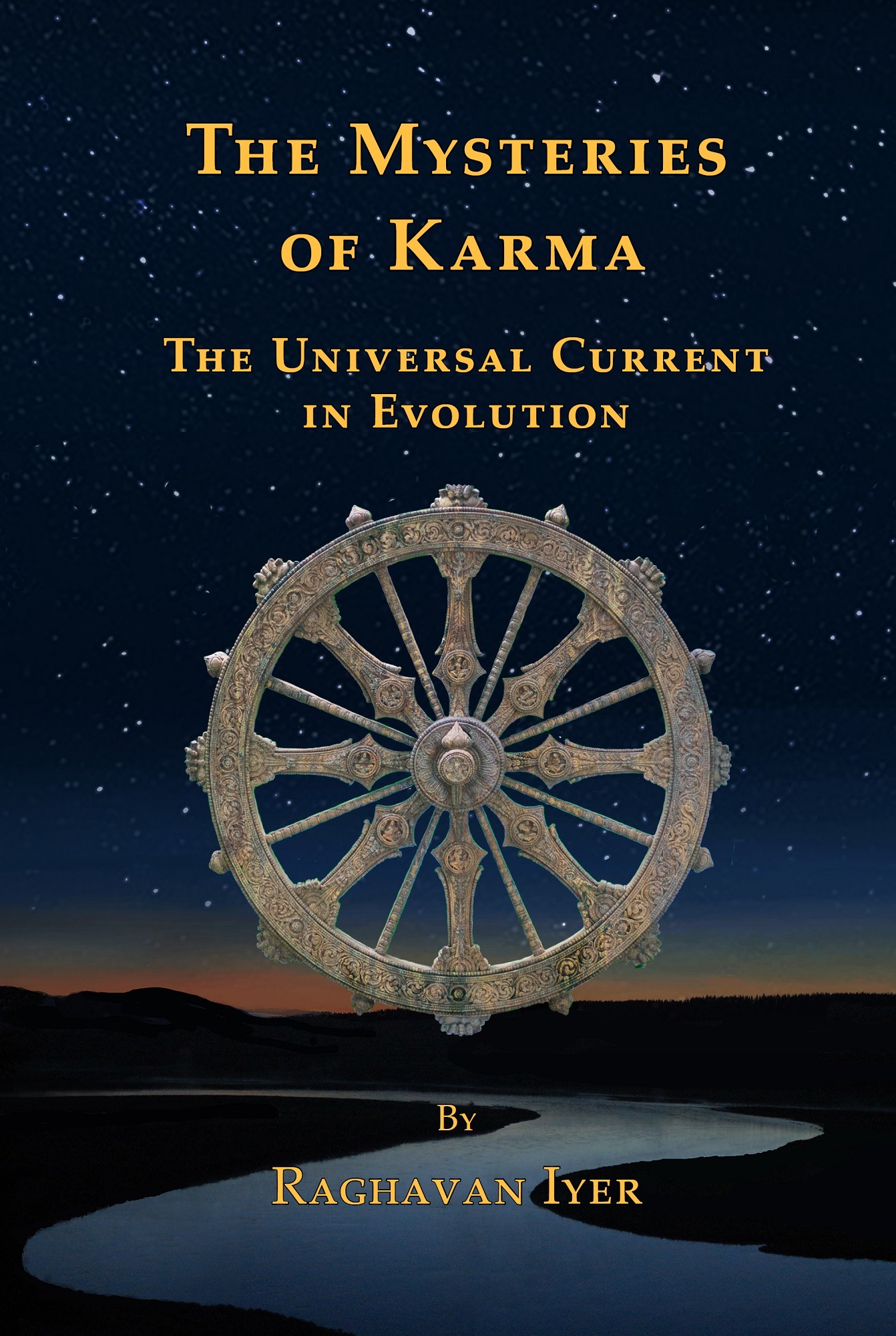
The Dharma Wheel on the cover was engraved in the 13th century-built Konark Sun Temple in Orissa, India, a UNESCO World Heritage site. The temple was designed as a chariot consisting of 24 such wheels, each wheel having a diameter of 9 feet 9 inches with 8 spokes. Each wheel acts as a sun dial and the various engravings shows the daily activity of people at different hours of the day. Image editing by Michael McNicholas.
Printed in the United States of America
"All that we are is the result of what we have thought: it is founded on our thoughts and made up of our thoughts. If a man speak or act with an evil thought, suffering follows him as the wheel follows the hoof of the beast that draws the wagon . . . . If a man speak or act with a good thought, happiness follows him like a shadow that never leaves him."
Gautama Buddha
"There is an orderliness in the universe, there is an unalterable law governing everything and every being that exists or lives. It is no blind law; for no blind law can govern the conduct of living beings."
M. K. Gandhi
CONTENTS
INTRODUCTION
EDITOR'S NOTE
THE GUPTA VIDYA ESSAYS
EVOLUTION AND KARMA
KARMA AND TRANSMUTATION
KARMA AND CHOICE
KARMA AND DESTINY
KARMA AND REPENTANCE
RESONANCE AND VIBRATION
PURITY AND POLLUTION
WISDOM IN ACTION
APPENDIX I: KARMA AND METAPHYSICS
Karma: The Universal Current
Karma Is Deity In Action
The Causes Of Existence
Metaphysics, Ethics And Karma
The Five-Pointed Star
Rounds, Races And Karma
Karma And Evolution
Kumaras, Evolution, And Karma
Restoration Of The Soul
Opportunities In Kali Yuga
The Central Thread
APPENDIX II: KARMA AND PSYCHOLOGY
Wisdom-Sacrifice
Karma And Meditation
The Great Choice
Accepting Karma
Beyond Form And Delusion
Understanding And Karma
Sacrifice And Karmalessness
Rekindling A Golden Moment
The Lessons Of Karma
Cooperating With Karma
The Mixing Of Karmas
The Gayatri
APPENDIX III: KARMA AND ETHICS
Karma And Universal Brotherhood
The Collective Current
Karma And Consciousness
Experiments With Truth
Karma And Occultism
The Great Sifter
The Art Of Service
Karma And Patience
Ethical Responsibility
Putting Oneself In Line
The Karma Of Human Encounters
The Tidal Wave
The Recognition of Law ~ Robert Crosbie
Thoughts On Karma ~ W.Q. Judge
Karma ~ The Absolute And Eternal Law ~ H.P. Blavatsky
The Law of Karma ~ B. P. Wadia
Aphorisms On Karma ~ W.Q. Judge
Karma Is The Man That Is ~ W.Q. Judge
Is Karma Only Punishment? ~ W.Q. Judge
Is Poverty Bad Karma? ~ W.Q. Judge
Elementals And Karma ~ W. Q. Judge
Cycles And Cyclic Law ~ W.Q. Judge
The Theory Of Cycles ~ H.P. Blavatsky
The Signs Of This Cycle ~ W.Q. Judge
The Closing Cycle ~ W.Q. Judge
INDEX
INTRODUCTION
As you sow, so shall you reap.
Jesus
These words of Jesus have long been known and quoted; the modern version – "What goes around comes around" – became ubiquitous in the latter half of the last century, and both these phrases can be heard in conversations today. Superficially, they take the place of a full understanding of actions and events, but reflection reveals that they point to two fundamental features of human life and all existence. "As you sow, so shall you reap" is a profound mantra, and it points to universal causation: at every level of Nature – physical, moral, psychological, and spiritual – thoughts and actions have precise effects that can neither be denied nor avoided. We readily see that our words and actions affect others, sometimes as we anticipated and sometimes in ways that surprise us. As psychologists know and we may too often ignore, our thoughts and actions affect us as thinkers and doers, expanding or contracting our range of perception and understanding. We directly participate in the creation of the world we experience through our reactions to, assessments of, and conclusions we draw from what we encounter. This fact is true at every level, from our most mundane interactions with our surroundings and in our most abstract thinking. Although there is much in life that the world gives to us that we do not seem to control, the way we think and live actually form the environment in which we find ourselves.
That other common phase – "What goes around comes around" – can be understood to be making the same crucial point, but it also suggests another fundamental aspect of the human being and all Nature: the flow of life, including thoughts and events, is cyclic, from the repeating habits of our daily round to the movements of the heavens. This does not mean literal repetition, of course, like the repeated notes of a scratched vinyl record, but with even a little attention, we can see patterns repeated everywhere and at many levels. From the course of the sun to events in human history, we find a cyclic regularity that can aid us in understanding ourselves, others, and the world.
Both these statements, often so casually uttered, point to karma and its correlate, reincarnation. What is old, from hemlines to historical events, become new again in different but recognizable forms. The individual becoming caught in addiction through medical treatment or unwise choices struggles to "come clean." When circumstances like physical pain or the previous environment return, it is very difficult to resist readdiction. On the broadest human scale, one can look at the rise and fall of civilizations, one after another. All Nature reflects this process of birth and death and rebirth, day and night followed by another day, inbreathing and outbreathing, creation, dissolution and recreation. The cyclic nature of existence and universal causality together powerfully indicate a cosmos that is utterly interdependent, everywhere interconnected, and a single unified existence – as implied in the very name 'universe', which literally means 'one turning' or 'turning as one.’
Karma is the simple and fundamental law that governs this evolving unity, ever-changing, ever-turning upon itself, and always causally connected. Even a child can understand the simple idea of karma as action and reaction on every level, but the details of its operation in an overwhelmingly diverse cosmos are immensely difficult to discern. In this sense, karma is a mystery which may be plumbed and penetrated, but this requires great insight into our very being – everything expressed in our thoughts, feelings, and actions.
Theosophy teaches that metaphysics provides us with the required framework for understanding the dynamics of everyday life. It points to the one Source of all existence – the Absolute, which is beyond any conception. Often called Parabrahm, it is beyond and behind Brahma, the One, and Brahmā, the creative power that manifests all existence. This source cannot be defined or described, because it is beyond any conception; it is sine qua non, That without which nothing could be. In The Secret Doctrine, H.P. Blavatsky said of the Absolute, "In the sense of finite 'Beings,' THAT is Non-'Being,' in the sense that it is the one BE-NESS; for in this ALL lies concealed its coeternal and coeval emanation or inherent radiation, which upon becoming periodically Brahmā … becomes or expands itself into the manifested Universe."1 Beyond all categories of thought and speech, It cannot be said to be this or that, or even to exist or not exist. Even the fundamental category of existence cannot be applied to the Absolute, for 'to exist' means 'to stand out from,' and the Absolute cannot stand out from anything, since there is nothing to stand out from at the level of THAT, the ultimate ground of all Being.
The gradual unfoldment of everything that exists, Theosophy teaches, can be conceived in terms of Absolute Abstract Space, Absolute Abstract Motion, and Eternal Duration, themselves inconceivable to a finite mind. This unfolding trinity together is the One Life, sometimes metaphorically called the Great Breath, which manifests as all that is on every level of existence. This unity includes matter, energy and consciousness, and while we distinguish them in our physical experience, tracing them back to their source shows that they are one "breath," the One Life. Herein lies the root of all cyclic phenomena.
The unfoldment of the universe does not happen by chance; it is law-governed, and the most fundamental law from which all the laws of nature derive is called rta (pronounced rih-ta), which means 'cosmic order' or 'cosmic harmony.' It underlies the dynamics of existence at every level. A simple analogy might be homeostasis, the ceaseless adjustment in changing circumstances of an organism's metabolism so that it can survive and live in a world of continuous change. Cosmic harmony seeks balance in the endless motion that creates diversity and ever-changing conditions. In the universe, this fundamental law manifests as what we call karma – hence the idea that karma invariably rebalances any change that unbalances the whole, and all change requires adjustment. If not pushed too far, the analogy of homeostasis is useful, for it reminds us that all existence changes and homeostasis is the constant rebalancing for stability in change. The fundamental characteristic of karma can be seen as Deity rebalancing every aspect of manifestation, which is the Great Breath of existence. This means that it is the One Law, the law that pervades and unifies the whole and suffuses every level of existence.
This grand perspective gives deep meaning to the idea of action and reaction throughout Nature and in the lives of human beings. However, if this were the whole story, we would be caught in endless cycles of mechanically repeated existence. Since all thought and action will be rebalanced through reaction, karma as the fundamental law of Nature requires reincarnation. Though what is disassociated at death is recycled, each human being continues to exist, albeit on another plane of consciousness between incarnations. In theosophical teachings, we are said to be monads or souls that are inseverably part of the underlying unity of Nature. One might think of light passing through a prism. The white light enters the prism and exits as a rainbow of seven colors, a phenomenon we experience in a rainbow. The colors represent the diversity we experience in our diverse universe. These colors passed back through a prism in the right way, emerge as white light again. The manifestation of the universe and the incarnation of each human being result in this diversity. In both, we can distinguish seven principles or elements which constitute unity in diversity through time, though as pure unity before and beyond time.
These principles are typically distinguished as atma, pure spirit; buddhi, its reflection experienced as universal perception and intuition; and manas, which, as mind, exists on a plane of universal thoughts. It is this triad that constitutes the spiritual monad that is the real, immortal human being, which reincarnates in innumerable lives on Earth. We humans are also comprised of a personal mind that – for most of us - is tied to desire, which explains so much of what we call thinking. The triadic unity of Atma, Buddhi and Manas is obscured by the necessary elements of diversity – kama, which is the desire principle intimately entwined with manas, and which attracts us to various ends and objects, all of which are transient and not eternal; praṇa, the principle of life which animates all living forms; linga şarira, the astral form, which can be thought of as the underlying electromagnetic organizing structure of the physical body. What is a Unity at the initial and highest level is thus reflected throughout the diversity of the world. Though separated for purposes of understanding, these principles of human nature can be grasped in different combinations and elucidations, as H.P. Blavatsky repeatedly shows in The Key to Theosophy.
"As you so, so shall you reap" is an aphoristic way of saying that our thoughts and actions have effects that, in principle, can be known before we send them forth into the world. The seed of the oak tree will produce an oak tree and nothing else. Deep knowledge of the seed reveals what the tree will be. The same is true of our thoughts and actions – a negative thought will have negative results, just as a positive one will have positive effects. And so with actions: harsh words and deeds produce harsh responses. And just as with the oak seed, we can know the results even if we are not around to witness them directly. Thus the karma we initiate, as well as the "returning" karma we respond to, has effects that are possible to discern, at least at some level. Hence it is important to grasp the nature of our thoughts, actions and our responses to what comes to us.
If this were not true, life would be random, a chaos that could not be known or surmounted, and life would be meaningless. Ceaseless change breeds ceaseless change, and nothing else. Sir Edwin Arnold, author of The Light of Asia (1879), in which he recounts the life and teachings of Gautama Buddha, straightforwardly set out the human condition.
If ye lay bound upon the wheel of change,
And no way were of breaking from the chain,
The Heart of boundless Being is a curse,
The Soul of Things fell Pain.
Ye are not bound! the Soul of Things is sweet,
The Heart of Being is celestial rest;
Stronger than woe is will: that which was Good
Doth pass to Better -- Best.
I, Buddh, who wept with all my brothers" tears,
Whose heart was broken by a whole world's woe,
Laugh and am glad, for there is Liberty!
These promises proclaim that life is not meaningless, but that we must take steps to discover its meaning, which is coming to understand our immortal nature, now beclouded to our personal minds by those non-eternal and illusive elements that allow us to be incarnated and to learn the truths of existence: this key is karma.
Karma appears to us as a mystery because we too often fail to see the events in our lives as anything other than immediate distractions, taking their surface appearances as reality itself, as the whole story. Thinking largely in terms of our personal selves and largely ignoring the profound interdependence of all life, our thoughts and actions are in opposition to the balance that karma operates to restore and maintain. In The Secret Doctrine, Vol. I, H.P. Blavatsky says:
Nor would the ways of Karma be inscrutable were men to work in union and harmony, instead of disunion and strife. For our ignorance of those ways – which one portion of mankind calls the ways of Providence, dark and intricate; while another sees in them the action of blind fatalism; and a third simple chance, with neither gods nor devils to guide them – would surely disappear if we would but attribute all these to their correct cause….We stand bewildered before the mystery of our own making and the riddles of life that we will not solve, and then accuse the great Sphinx of devouring us. But verily there is not an accident of our lives, not a misshapen day, or a misfortune, that could not be traced back to our own doings in this or in another life . . . The law of Karma is inextricably interwoven with that of reincarnation. 2
In his remarkable poem, Sir Edwin Arnold puts the matter frankly and in graphic terms:
Pray not! the Darkness will not brighten! Ask
Nought from the Silence, for it cannot speak!
Vex not your mournful minds with pious pains!
Ah! Brothers, Sisters! Seek
Nought from the helpless gods by gift and hymn,
Nor bribe with blood, nor feed with fruit and cakes;
Within yourselves deliverance must be sought;
Each man his prison makes.
Each hath such lordship as the loftiest ones;
Nay, for with Powers above, around, below,
As with all flesh and whatsoever lives,
Act maketh joy and woe.
What hath been bringeth what shall be, and is,
Worse – better – last for first and first for last;
The Angels in the Heavens of Gladness reap
Fruits of a holy past.
The devils in the underworlds wear out
Deeds that were wicked in an age gone by.
Nothing endures: fair virtues waste with time,
Foul sins grow purged thereby.
Who toiled a slave may come anew a Prince
For gentle worthiness and merit won;
Who ruled a King may wander earth in rags
For things done and undone.
Higher than Indra's ye may lift your lot,
And sink it lower than the worm or gnat;
The end of many myriad lives is this,
The end of myriads that.
Only, while turns this wheel invisible,
No pause, no peace, no staying-place can be;
Who mounts will fall, who falls may mount; the spokes
Go round unceasingly!
Given this timeless and universal perspective, the solution to the mystery of karma must lie within the individual, and insight into its workings will be found only there. While careful observation of Nature and the appreciation of cycles can help, such knowledge as we gain from observation will not free us from the chains of ceaseless change and karma. Theosophy teaches that this endless cycle of action and reaction, endless reincarnations that uplift and throw us down, can be broken only by transcending the karmic cycles entirely. Though that lofty goal is far away, steps can be taken toward it through introducing increasing levels of harmony within our own being and our relationships to the world. Ancient religious traditions have all taught that self-purification is the key to treading the path to this true spiritual freedom. This process is no mere adherence to conventional morality; it involves radical self-transformation. That begins with the attempt to insert the personal self into the unified whole, which means that every thought, motivation, gesture and action must be scrutinized for any taint of selfishness, which is, after all, thinking and acting for oneself without serious regard for others and the whole. The demagogue and tin-pot dictator illustrate selfishness in brilliant colors, but we must acknowledge their traits in ourselves, even if they are masked by conventional behavior and so appear in milder forms.
How do we think and act without continuing to chain ourselves to the rounds of karma? In the Bhagavad Gita, a luminous scripture in the Hindu tradition and vital to theosophical thinking, Krishna, as the personification of the One Self of All, speaks to Arjuna, the warrior who is becoming his disciple. There, Krishna says that we should think and act free from desire, with regard only to what is right and needed in any situation and not with attachment to the results of our actions. We can learn to renounce all results by giving them to Krishna. In thought, we should think of the whole of humanity and life; in action, we should act for the good of the whole, thereby sacrificing our limited self by inserting it into that whole. To the degree we can do this, and with practice that degree increases steadily, we free ourselves from karmic results that bind us so tightly to the endless rebalancing, which often seems to our limited personas to be simply retribution, rather than an opportunity to learn. The Buddhists speak of the paramitas, the virtues that lead us beyond our limited and transient personas toward spiritual knowledge that liberates us from our ignorant condition – the very condition that binds us to the wheel, as so eloquently characterized by Sir Edwin Arnold. The Bhagavad Gita presents a portrait of the self-governed Sage, an enlightened being who knows firsthand the reality to which our ignorance blinds us. Arjuna asks Krishna for a description of this Sage who has transcended even karma, and Krishna answers:
A man is said to be confirmed in spiritual knowledge when he forsaketh every desire which entereth into his heart, and of himself is happy and content in the Self through the Self. His mind is undisturbed in adversity; he is happy and contented in prosperity, and he is a stranger to anxiety, fear, and anger. Such a man is called a Muni. When in every condition he receives each event, whether favorable or unfavorable, with an equal mind which neither likes nor dislikes, his wisdom is established, and, having met good or evil, neither rejoiceth at the one nor is cast down by the other. He is confirmed in spiritual knowledge, when, like the tortoise, he can draw in all his senses and restrain them from their wonted purposes. The hungry man loseth sight of every other object but the gratification of his appetite, and when he is become acquainted with the Supreme, he loseth all taste for objects of whatever kind. The tumultuous senses and organs hurry away by force the heart even of the wise man who striveth after perfection. Let a man, restraining all these, remain in devotion at rest in me, his true self; for he who hath his senses and organs in control possesses spiritual knowledge.
In the same discourse, Krishna contrasts our condition with that of the Sage:
He who attendeth to the inclinations of the senses, in them hath a concern; from this concern is created passion, from passion anger, from anger is produced delusion, from delusion a loss of the memory, from the loss of memory loss of discrimination, and from loss of discrimination loss of all! But he who, free from attachment or repulsion for objects, experienceth them through the senses and organs, with his heart obedient to his will, attains to tranquillity of thought. And this tranquil state attained, therefrom shall soon result a separation from all troubles; and his mind being thus at ease, fixed upon one object, it embraceth wisdom from all sides. The man whose heart and mind are not at rest is without wisdom or the power of contemplation; who doth not practice reflection, hath no calm; and how can a man without calm obtain happiness? The uncontrolled heart, following the dictates of the moving passions, snatcheth away his spiritual knowledge, as the storm the bark upon the raging ocean. Therefore, O great armed one, he is possessed of spiritual knowledge whose senses are withheld from objects of sense. What is night to those who are unenlightened is as day to his gaze; what seems as day is known to him as night, the night of ignorance. Such is the self-governed Sage.3
The goal represented by the self-governed Sage is distant, but it casts a warm and inviting light on our possibilities as human beings. In our inmost natures, we are already That which we seek and yearn for, even if we do not know it. It is only because Unity is an established fact in Nature and all of existence that we can grow into a greater realization of that Unity, most importantly by basing all of our thoughts, feelings, actions and lives upon selfless service of the Self of All.
The Voice of the Silence speaks of two paths presented to us as we awaken spiritually and make continuous effort to realize the vision presented in the Bhagavad Gita. One path leads to complete absorption in the One Life, stripping the Monad of all characteristics and thus disappearing from the manifest universe and unable to do anything in it. The other is a rejection of this final step, gaining all that is necessary for it, yet remaining in the universe and using the transient principles only as needed to help and serve all humanity in its spiritual evolution. The first path was called "an exalted and glorious selfishness" by the great mahatma known as the Maha Chohan or Great Master. The second path foregoes this ultimate nirvana in recognition of the suffering of humanity and the need for guidance toward the harmony and peace of realized unity. This is the Bodhisattva ideal, the intentional sacrifice of one’s own bliss for the sake of the whole.
When the reality of the One Life is sensed and heartfelt, we can readily see that any thought or action supportive of separateness – that we are somehow separate from others and the world, an illusion that often deludes individuals – will produce consequences that run counter to universal Harmony. If we do some good, good will return, but in the universal scope of life, we need to look beyond both bad and good to that serene balance that gives unbiased perception at every level of our being. We are, in fact, that One Life in reality, though we find it difficult to think of ourselves as such, much less experience it. The ethics of Theosophy are not merely for becoming a better person, but rather they lead us towards purification of the mind and heart so that we increasingly and naturally insert ourselves into the whole of humanity and, indeed, all of life. Put simply, Theosophy teaches the path of the Bodhisattva.
Raghavan Iyer summarizes the nature of the Bodhisattva-Adept, thereby indicating what each of us must strive to become if we would realize our true nature and be of lasting benefit to humanity and all of life.
To become karmaless is to become an Adept, fulfilling every single responsibility completely whilst having no debt to discharge. At any given time, becoming aware of something undone, of something not returned, one is able to amend and redress the balance. Desiring nothing for oneself, the plenitude and bounty of boundless being may be given away to others. Unconcerned about the accrual of merit, one is free from the insidious separateness of moral self-satisfaction and complacency connected with the idea of being virtuous. All of this is burnt out, and one needs no thanks from others, oneself or the universe itself. Instead, one creates spontaneous rhythms of breathing which keep one moving with full attention from one duty to the next without residues and with no inherence in the linga shariram. This is what it means to reduce the lunar form to a zero at will, to attenuate the coil in the spleen, reducing it to ashes and leaving only the seed for the makers of your vesture.4
In striving to embody this remarkable state, we increasingly resonate with the Great Breath itself, and though such a possibility may be beyond our present capacity to fully understand it, we can nonetheless move in that direction, which is also the direction of the emerging humanity of the Aquarian Age and far beyond. Since karma, the principle of rebalancing, implies that the process never ends while there is change, and so points to reincarnation, what we do toward this great goal will carry over into the future beyond the dissolution of the present incarnation, to be picked up again in future lives.
This volume is an exploration of the law of karma, its mysteries, and what it means for human beings at whatever level each one can understand. Though rich in metaphysical foundations, it is filled with practical advice to make the pilgrimage to true knowledge and selfless service step by step. In a time when there is a great call for individual rights, it is timely that the correlative responsibilities are also illuminated, for each of us treads the path of life for herself or himself. No one can do it for us, though great teachers, such as the author of this volume, can point the way and assist us if we are willing. It is up to us to make it a reality in our lives and amongst our fellow human beings. To the extent we attempt to do so, we resonate with the reality of the One Life at some level. The essays and extracts presented here will aid anyone who aspires to such a greater spiritual life, demonstrating that we can grow in understanding, self-knowledge, and authentic service of the whole.
Elton Hall, Ithaca, NY
John Powers, Norfolk, VA
Footnotes
1 H.P. Blavatsky, The Secret Doctrine, Vol. l, p. 7 (Facsimile of the original 1888 edition, Los Angeles: The Theosophy Company.)
2 Ibid., pp. 643-644.
3 The Bhagavad-Gita, Chapter II.
4 Raghavan Iyer, "Resonance and Vibration," The Gupta Vidya Vol. I, p. 219, Theosophy Trust Books.
EDITOR'S NOTE
Given the profound statement of Prof. Iyer – "the science of karma is the discovery of . . . hidden correspondences in oneself and throughout the visible and invisible cosmos" – there is clearly a need for such a work as this to provide a comprehensive treatment of Prof. Iyer's teachings on the subject. This work does just that, and is modeled after one of our previous books entitled Consciousness and Civilization in the Aquarian Age. Both of these books replicate the same structure as Prof. R.N. Iyer's 3-volume book, The Gupta Vidya, with the primary essays coming first, followed by several appendices containing important supplementary materials.
Like our previous book, all of the essays in the first chapter, The Gupta Vidya Essays, and the quotations in the first three appendices, were first published in Prof. Iyer's magnificent three-volume set entitled The Gupta Vidya, also published by Theosophy Trust Books. The first five essays in the first chapter form the groundwork for Prof. Iyer's teachings on Karma; they are followed by three supplementary essays – also from The Gupta Vidya – that explain the manifold dimensions of the Universal Law. The first three appendices contain extensive quotations found elsewhere in the three volumes of The Gupta Vidya - "supporting documents" - that amplify and extend the ideas in the essays in the first chapter. The quotations in Appendices I-II-III are quite comprehensive; i.e., they comprise all of the most significant mentions of 'Karma' in other places of the three volumes.
Theosophy Trust is deeply grateful to Prof. Elton A. Hall not only for his illuminating Introduction, but also for his extensive and diligent work in collecting together and ordering all of the quotations found in the first three appendices. This was truly a monumental task, for which Prof. Hall has our deep appreciation.
All of the articles and readings in this work can be found in digital format on the Theosophy Trust website at: https://www.theosophytrust.org/RNI-article.
Editor, Theosophy Trust Books
THE GUPTA VIDYA ESSAYS
EVOLUTION AND KARMA
It now becomes plain that there exists in Nature a triple evolutionary scheme, for the formation of the three periodical Upadhis; or rather three separate schemes of evolution, which in our system are inextricably interwoven and interblended at every point. These are the Monadic (or spiritual), the intellectual, and the physical evolutions. These three are the finite aspects or the reflections on the field of Cosmic Illusion of ATMA, the seventh, the ONE REALITY. ... Each of these three systems has its own laws, and is ruled and guided by the different sets of the highest Dhyanis or 'Logoi'. Each is represented in the constitution of man, the Microcosm of the great Macrocosm; and it is the union of these three streams in him which makes him the complex being he now is.
The Secret Doctrine, i 181
Man and Nature, Atman and Brahman, are One in their transcendental origin, but threefold in their manvantaric manifestations through interlocking planes of consciousness and form. The mystery of the Three-in-One is mirrored in the archetypal mode of instruction exemplified by Gautama Buddha, who shed the pristine light of Bodhisattvic Wisdom upon the span of all three worlds, teaching devas, men and gods. The complex riddle of human nature inscribed in the sevenfold vestures of man and Nature can only be deciphered through a progressive comprehension of all its interconnected links ranging from the homogeneous planes of arupa ideation to the most material planes of differentiated form. The complete union of karuna and prajna, of compassion and self-knowledge, depends upon the all-inclusive integration of every element and atom participating in the cyclic sweep of cosmic evolution. Under the supreme decree of eternal harmony, all that lives forms a single community and brotherhood, bound together and governed by the law of Karma.
Within that vast programme, each evolving unit is joined to every other by laws of collective and distributive action, and it is upon the correct understanding of these coordinate links, inherent in the interrelationships of the embodied vestures, that the further spiritual growth of humanity depends. In practice, and in time, this requires the seeker self-consciously to differentiate and comprehend the origin, functions and virtues of each of the principles in man. To acquire skill in action, the logic of the programme of evolution must first be seen in terms of its triadic nature, and then applied, with moral discrimination, according to the laws of analogy and correspondence, within each of the seven kingdoms of Nature. Through tapas and ascetic striving, guided by devotion to the Mahatmas and rooted in a vision of the Bodhisattvic ideal, each pilgrim-soul can discover and unlock the mysteries hidden within the microcosmic world of the visible and largely invisible vestures.
Examined from the standpoint of individual effort, this task may be seen as a progressive and painful, though extremely rewarding, process of inserting personal existence into universal human history and ultimately into cosmic evolution. For the student of The Secret Doctrine, this may be put in terms of the fusion of cosmogenesis with anthropogenesis through entry into the path of The Voice of the Silence. Acquisition of a dialectical understanding of the operation of Karma, in its triple operation in the spiritual, intellectual and physical fields, arises from an awareness of eternity in time which yields that timeliness in conduct spoken of by Krishna as renunciation in action and by Buddha as skilful means.
As a starting-point, one must come to see that the diverse rules and laws applying to the different kingdoms of Nature and their coordinate schemes of evolution are inseparable expressions of one universal law of growth. Whether put in terms of the relationship between the Unmanifest Logos and the diverse Logoi operating on different planes, or in terms of the differentiations of Spirit and Matter out of one homogeneous Substance-Principle, the complex structures and varied modes of growth participated in by human beings represent a single triadic process. In the language of the Commentaries upon the Book of Dzyan, this central principle is put in terms of the magnetic attraction exercised by the model of the Heavenly Man over every spark of sentient life evolving throughout the infinitudes of space.
1. 'Every form on earth, and every speck (atom) in Space strives in its efforts towards self-formation to follow the model placed for it in the 'HEAVENLY MAN'.... Its (the atom's) involution and evolution, its external and internal growth and development, have all one and the same object – man; man, as the highest physical and ultimate form on this earth; the MONAD, in its absolute totality and awakened condition – as the culmination of the divine incarnations on Earth.'
The Secret Doctrine, i 183
This is a general law applicable to the whole of life, from the tiniest atom to the most massive form, all of which evolve from Akashic prototypes that are like seeds within the Cosmic Egg of Brahmā, the container of the Heavenly Man. As in the awesome metaphor of the Ashwatha tree, with its roots in heaven and its branches and leaves below on the planes of manifestation, life proceeds from formlessness into form and ever seeks to return through the circulation of its essences and elixirs to its transcendental source.
For all human beings in the present period of evolution, spiritual growth consists in awakening noetic awareness of formless spiritual essences, a process of Manasic maturation which requires precise apprehension of the different sets of Dhyanis and ancestors involved in the complex karmic heredity of humanity. The ascent to Monadic awakening culminating in self-conscious divinity proceeds pari passu with an increasing participation in the sacrificial descent of the Light of the Logos into the human temple. Humanity is the beneficiary of vast processes of evolution that were completed on preceding globes both in the present earth chain and in the previous chain of globes known to us as the moon chain. Like dwarfs seated upon the shoulders of giants, men and women of the present enjoy the privilege of self-conscious existence and survey the grand prospects of future evolution only because of the sacrifice of Mahatmas and Dhyanis throughout ages without number. Metaphysically, there is neither a beginning nor an end to the series of vast epochs of manifestation, and the significance of reaching the man-stage of evolution lies in the prerogative and potential of becoming a co-worker with Nature, with Amitabha, the Boundless Age.
Terrestrial evolution may be conceptually divided into three streams, corresponding to the Monadic, the intellectual and the physical components set forth in Gupta Vidya. The phrase 'Monadic evolution' points to the emergence of successively higher phases of spiritual activity of the metaphysically indivisible unit called the Monad, or the Atma-Buddhi. In reality, that Monad is not subject to change or alteration, but is the constantly presiding divine presence at the heart of the sphere of mayavic and samsaric existence. In its highest sense, the MONAD is single and impartite, and the conception of a plurality of Monads is merely a terminological convenience within the veil of illusion. Pythagoras taught that the MONAD, having radiated Divine Light, retires into the Divine Darkness.
Although Monadic evolution is spoken of as equivalent to spiritual evolution, both Spirit and Matter, with all their differentiations, are ultimately One, inseparable from meta-Spirit or Atman. Nonetheless, within the planes of differentiated existence and consciousness, it is helpful to distinguish the realized degrees of universality and individuation of consciousness attributable to the evolving sparks of the One Life. Hence, in the metaphysics of The Secret Doctrine there is a fundamental distinction between the hosts of solar and lunar Monads, the Agnishwatha and Barhishad Pitris. Within the stream of intellectual evolution, and associated with the Solar or Manasa Dhyanis, are to be found the exalted bestowers of self-conscious intelligence upon incipient humanity. Within the stream of physical evolution and associated with the building of the mortal vestures of man are to be found the hosts of the lunar Pitris. Whilst it is possible to distinguish the ancestry and attributes of the various principles of sevenfold man, ultimately there is only One Principle – the Atman.
The development of humanity in the present series of globes began at a point like the intersection of cosmogenesis and anthropogenesis. As the sevenfold theatre of evolution known as the earth emerged from pralaya, and the Fohatic life-wave began to quicken the sleeping centres, those Monads from the moon chain which had attained the highest degree of physical evolution on the old chain commenced their activity in the first of the new worlds. Restricted in their degree of Monadic activity to the fourth plane, these builders of form were capable of recapitulating evolutionary development only up to the incipient human-germ stage. Progressively, over the first three and one-half Rounds of the development of the earth chain, these lunar Dhyanis unfolded, through the power of instinctual intelligence, the rupas that constitute the lower kingdoms of Nature.
Viewed from the Monadic standpoint, this process is equivalent to a descent or involution of Spirit into Matter, of consciousness into form. Viewed from the standpoint of Prakriti, it is a process of elevation of the undifferentiated life-essence characterizing the elemental kingdoms through stages and degrees of refinement, corresponding to a progressive permeability to the Atmic light. By the mid-point of the present or Fourth Round, this process of the working up of substance into incipient human form reached its culmination. It was at this juncture that the preferred forms became the vehicles of already self-conscious Monads associated with the intellectual stream of evolution. This point is depicted thus in the Commentaries upon the Stanzas of Dzyan:
2. 'The Dhyanis (Pitris) are those who have evolved their BHUTA (doubles) from themselves, which RUPA (form) has become the vehicle of monads (seventh and sixth principles) that had completed their cycle of transmigration in the three preceding Kalpas (Rounds). Then, they (the astral doubles) became the men of the first Human Race of the Round. But they were not complete, and were senseless.'
Ibid., i 183
After this long period of gestation, the prepared rupas became the vehicles of Solar Monads through the lighting up of Manas, which occurred over eighteen million years ago. To understand this awakening of consciousness, one must clearly distinguish between the evolution of intelligence and the development of form. Although, for the sake of our comprehension, it is helpful to speak of lunar Monads reaching the human germ stage in earlier Rounds, and to speak of incipient human Monads throughout the early phases of the Fourth Round, it must be understood that these references are to beings which are human in form though not in consciousness. Further, the emanation of the fires of Manasic awareness into these incipient forms should not be understood as the entry of Monads into forms which are already occupied by other Monads. It is like the successive passage of two rays of light through the same aperture; the ray has become intensified, rather than multiplied. Referring to this mystery, Jesus said: "I and my Father in heaven are One."
True human existence presupposes the inherent possession of the higher arupa fires of Manasic awareness. Amongst the Agnishwatha custodians of the sacred fire, distinctions may be drawn between those who had attained full enlightenment in prior periods of manifestation and those who had not yet completed the task of intellectual human self-evolution during the Rounds of the moon chain. There is a further distinction between those differentiations of the Monadic essence which only reached the incipient human stage in the middle of the Fourth Round of the present globe and which only entered upon the stage of human existence on that globe, and the former two classes of human beings. It is upon the correct understanding of the karmic attainment of each of these three classes of human beings that a proper understanding of justice and injustice in human life depends.
Much contemporary confusion between the spiritual and the intellectual, between the intellectual and the physical, is due to the unwarranted degree to which human consciousness is presently limited by attachment to the outward plane of sensory existence. As a result, wandering into the astral regions is often mistaken for awakening to spiritual consciousness, whilst intellectual life is reduced to an inductive enumeration of empirical particulars. The Secret Doctrine devotes considerable attention to the development by the lunar Dhyanis of the ethereal vestures underlying physical evolution. The student must understand that the region of outward sensation is a reflection of the lowest, or seventh, component of the astral; the realm of the lunar Pitris comprises the entirety of the lower four planes of existence. Hence, the ethereal lunar Dhyanis evolved out of themselves astral doubles. This process of subtle development proceeded from within without throughout the entirety of the first three Rounds, beginning with the most developed lunar Monads and eventually including all those less developed Monads which would enter the human kingdom on the present globe.
By the beginning of the Fourth Round, incipient humanity was essentially complete as an astral type, though as yet lacking in self-consciousness. During the Fourth Round, with each successive Race and Sub-Race, up until the beginning of the Fifth Race, there has been a progressive consolidation of the external form surrounding the astral double, the linga sarira. Corresponding to this process, and running parallel with it simultaneously, was a progressive adaptation of the physical form and structure of the fauna of the earth as the latter passed through its stages of geologic formation. Altogether, there was a tremendous consolidation of matter which produced a connection between the astral and the physical that has an important bearing on the porosity of the evolving brain to the Light of the Atman.
Given this broad understanding of the development of human form through the activity of the lunar Pitris, most of the inheritance of humanity from the early Rounds, and indeed the early Races of the present Round, lies hidden within the casement of the physical form. Existing on subtler planes of matter and consciousness, the evolving humanity of the early Rounds was largely ethereal. Subsequent to the incarnation of the Manasa Dhyanis into the waiting forms in the Third Root Race, at what is called the balance point in a series of Races and Rounds, the development of the inner astral man has proceeded along different lines. Yet, owing to the tremendous debasement of human consciousness during the Fourth Root Race, both the nature of the transformations affecting the ethereal vestures, and even the very existence of those vestures, have become obscured to human awareness. Hence, the deeper meaning of these interior processes and their vital relevance to the intellectual evolution of humanity are virtually terra incognita to present humanity. Recognizing the blindness of contemporary awareness, the Commentaries state:
3. 'The inner, now concealed, man, was then (in the beginnings) the external man. The progeny of the Dhyanis (Pitris), he was "the son like unto his father." Like the lotus, whose external shape assumes gradually the form of the model within itself, so did the form of man in the beginning evolve from within without. After the cycle in which man began to procreate his species after the fashion of the present animal kingdom, it became the reverse. The human fœtus follows now in its transformations all the forms that the physical frame of man had assumed throughout the three Kalpas (Rounds) during the tentative efforts at plastic formation around the Monad by senseless, because imperfect, matter, in her blind wanderings. In the present age, the physical embryo is a plant, a reptile, an animal, before it finally becomes man, evolving within himself his own ethereal counterpart, in his turn. In the beginning it was that counterpart (astral man) which, being senseless, got entangled in the meshes of matter.'
Ibid., i 184
This passage points to the underlying karmic continuity within the entire scheme of evolution and also to the crucial significance of the difference between its physical and intellectual components. Whilst the development of the inner astral man was the result of the sacrifice of the lunar Dhyanis through the early Rounds, the development of self-conscious individuality was the result of the Great Sacrifice of the Manasa Dhyanis, who lit up in every incipient human Monad the power of choice, the potency of intelligent conscious reflection in the human mind of the Universal Mind. Humanity, in the great height of its Golden Age over eighteen million years ago, was in a state of mystic meditation attuned to the universal host of Creative Fires which had come down as a single, beneficent initiatory Presence. This glorious truth and lost light has come down in every myth and tradition of all the tribes of humanity, including those who, alas, concretized and misused the sacred Teachings at terrible karmic cost to themselves. The principle that humanity is the progeny of the Dhyanis, "the son like unto his father," grown lotus-like from a seed within, has a dual and a triple meaning. In relation to the early Rounds, it refers to the process of formation and consolidation of the astral around the sishta or seeds of future human form borne by the lunar Dhyanis. Commencing with the descent of the Manasa Dhyanis in the Third Root Race, it refers to the flowering of the self-conscious powers of intellection around the bright ray of the descending Manasa.
Fundamentally, unfoldment from within without is the archetypal mode of growth on the spiritual plane. Both the ascent of the astral form and the descent of the higher principles are interrelated aspects of a single process of equilibration between the poles of Spirit and Matter. The lotus plant, each seed of which contains a complete blueprint of the full flower, provides through its phanerogamic growth a perfect model of the spiritual mode. In every spiritual system, therefore, the lotus is venerated, and various spiritual centres in man, as well as the cosmic centres of life-giving and death-dealing forces, have been compared to lotuses.
During the eighteen and three-quarter million years since the awakening of Manas, the modes of creativity and birth have shifted from the androgyne state of the earlier human races to the present separation of the sexes. The earlier Races of humanity, likened symbolically to dragons and to eggs, reproduced themselves by those agencies and means which are now somewhat familiar to students of biology through the study of various nonhuman species. With this shift, there was a reversal in the mode of development of form. Under the current scheme, embryogenesis recapitulates the entire series of forms assumed by the evolving astral form of man during the early Rounds. Here, however, it is important to recall the mantram – 'Nature unaided fails'. Despite the marvellous complexity and variety of forms evolved by the lunar Pitris in the stream of physical evolution, it is simply impossible for these material agencies to produce a human being. It is for this reason, incidentally, that no amount of genetic manipulation can produce anything other than a Frankenstein's monster. To produce a human being, something more is needed than is contained in the karmic and genetic programme of material evolution.
The attainment of human consciousness can only come about through the descent of self-conscious beings perfected in prior periods of evolution. Hence, there is universal awe and reverence for the entire host of these beings, all of whom gathered around their Chief, Dakshinamurti, the Initiator of Initiates, and came down into the forming worlds of the earth chain. Fully perfected in previous manvantaras, their presence in these worlds is solely for the sake of presiding over the programme of intelligent human evolution. Reverence for the Manasas is the hallmark of the degree of human evolution of the soul; the more highly evolved an individual human being, the more readily does it display a spontaneous devotion towards Mahatmas and Gurus. Such is the natural tropism of human consciousness.
During this early Golden Age of humanity, when all alike felt the luminous presence of the Agnishwathas within, human beings at the same time enjoyed the use of the ethereal vestures, with their marvellous powers, evolved from the lower kingdoms. That these powers and faculties are now atrophied, and virtually unknown to present humanity, is the karmic consequence of the misuse of knowledge in the Lemuro-Atlantean and especially in the later Atlantean Fourth Root Race. Whilst the involvement of Spirit into Matter in the first three Rounds and in the early Races of the Fourth Round was a necessary aspect of the karmic programme of evolution, the self-conscious degradation of Manasic intelligence, through identification with the lunar forms, was not. The enormous liability of human beings to recurrent types of psychic and physical disease, as compared to the inhabitants of the animal kingdoms, is a direct consequence of this needless fall into matter. Grave though these susceptibilities may seem, however, they are of little import when compared to the spiritual consequences of the Fall – the closing of the Third Eye and the loss of awareness of the Agnishwatha Pitris.
Given the self-imposed burden of spiritual as well as psychic blindness, it is not surprising, though still tragic, that humanity is scarcely aware of, much less able to respond to, the challenge of the transformations being wrought by cyclic law within its mental and material vestures. In order to regain initiative as a Manasic being, one must grasp the deeper significance of the fact that, prior to the descent of the Manasas and prior to the separation of the sexes, the entire programme of human development was from within without, and that after this point, human development began with the recapitulation of the entire physical scheme of evolution within the mother's womb. Thus, on the physical plane, ontogeny recapitulates phylogeny, but only up to the point attained by mindless lunar evolution over eighteen million years ago. Therefore, for the past eighteen million years, through the power of self-evolution, human beings have had to gestate out of their astral bodies, by a process of separation and self-training, the embryo of that which will become, over many lives in the future, an Adept.
H.P. Blavatsky took trouble to explain in a veiled way the secret and complex Teachings of threefold evolution to those who did not have access to Sanskrit, Chaldean or other ancient languages and texts, and those who could not use the arcane symbol systems to benefit from the wisdom of the enlightened. This Teaching is essentially different from any seventeenth century idea of human rationality or eighteenth century doctrine of human progress or Victorian doctrine of complacent optimism. This ancient Teaching is directed towards millions of years in the future and millions of years in the past, and its principal lesson, which should be more comprehensible in an age of computers, is that in this cosmic programme the minutest difference that is made every moment has tremendous bearing upon what happens through exponential curves over millions of years.
Once one truly understands human evolution, as distinct from the instinctual and involuntary evolution of the lower kingdoms, one can also grasp the warning implicit in the esoteric Teaching that the cycle of metempsychosis for human Monads is closed at this point of the Fourth Round and the Fifth Root Race. It is technically impossible for human beings who totally fail to be human to take bodies in the animal kingdom. Hence, the tragic prospect awaiting those who cannot make full and proper use of the Manasic principle is eventual annihilation. Thus, one can also come to appreciate the enormous compassion of the Teachers in the nineteenth century when, since 1848, the muddy torrents of kamaloka broke loose. Owing to nefarious practices of mediumship in séances and elsewhere, and through an obsessive and excessive concern with lunar ancestors, there was at that time a vast outpouring of bhuts and elementaries from the dregs of the astral plane. This same year, termed by some historians as "that wonderful year", witnessed a great variety of outbreaks and upheavals throughout all the countries of Europe. Owing to the appalling karma of 1848, great compassion was shown in the partial transmission of Teachings which had always been locked in the secret sanctuaries, and this in itself heightened the karma of human beings.
If one now looks back to the Victorian Age, it is evident that events did not work out as many people had hoped. Indeed, even in the last ten years of the nineteenth century, a death-blow was given to the Victorian Age. By the First World War the Victorian order, which had been so much taken for granted, had collapsed. In the Second World War the entire old European order collapsed. Now we are witnessing the culmination of the ancient Karma of Israel. All of this is part of the programme of Karma which is no respecter of personal emotions, likes or dislikes, or the sectarian predilections of human beings through excessive attachment to external forms.
There is a tremendous logic to the precipitation of karma in the programme of cyclic evolution. That logic is on the side of every immortal soul. It is not on the side of the ratiocinative mind. It is not on the side of kamamanas. It is unequivocally on the side of Buddhi Manas. Therefore, every human being's urge to transcend the boundaries of the personal self, and every human being's deep desire (which is expressed every night in sushupti, and which may be strengthened through daily meditation) to come closer to the One Flame, to the Light of the Logos in the heart, is truly blessed. But if one wanders in the opposite direction, one risks much and it would be the height of unwisdom. The Avatar quickens life amongst those who are responsive, but the Avatar also quickens the doom of those who are unwilling to avail themselves of the Light. This is evident to the intuition of growing numbers of souls throughout the world who wish to remain in the forward current of human evolution which gives birth, and not be caught up in that reverse current which propels into the vortex whatever is inconsistent with the humanity of the future.
This implies a decisive moment of choice for humanity; the power of choice is the hallmark of Manasic existence, and its intelligent exercise gives true self-respect. To meet the trials of the future, it is helpful to have some conception of the excellences inherent in humanity. The lakshanas displayed by the early Races can and will become the norms of the future Races. Each human being has participated in the spiritual civilization of the Third Root Race when
. . . in the beginning, mankind were morally and physically the types and prototypes of our present Race, and of our human dignity, by their beauty of form, regularity of feature, cranial development, nobility of sentiments, heroic impulses, and grandeur of ideal conception.
Ibid., i 185
These are the marks of human potential and perfectibility of which every human being has been capable for over eighteen million years. Over that span, alas, a small minority of mankind has become involved in psycho-physical inversion and
. . . the gradual debasement and degradation of man, morally and physically, can be readily traced throughout the ethnological transformation down to our time.
Ibid.
Even where this process of degradation leads to the permanent withdrawal of the soul from the human tenement, the withdrawal of the ray back into its parent source and the consequent need for the One Flame to emanate a new ray totally disconnected from the prior series of incarnations, there is no wastage. Even so unspiritual and materialistic a lunar form would be made use of in the programme of Karma, serving as a vesture for those Monads delayed in their entry into the human kingdom until the Fifth Round through the ancient sin of the mindless. Such is the karmic economy in nature that the astral vestures vacated by failed human beings will form the karmic compensation of those Monads held back from human life and imprisoned in anthropoid forms, owing to the omissions and delays of selfish egos in the Third Root Race. As the anthropoids die out during the latter part of the Fifth Root Race, their Monads will pass into the astral forms of the Sixth and Seventh Races of this Round. Then, in the Fifth Round, these Monads will enter directly the stream of Manasic intellectual evolution and be welcomed into the human family.
Distant though this age millions of years away may seem to ordinary mortals, to the eye of the Initiate it is like tomorrow. Strange and arcane as these Teachings may seem to an intelligence caught in the dark folds of matter, they are inevitable consequences of the universal decree of harmony and justice governing the sweep of cyclic evolution. Yet, for those courageous pilgrim-souls who want to take seriously the Pledge of Kwan Yin – the Bodhisattvic vow to aid every sentient being caught in the bonds of samsaric existence – the intricate and elegant complexities of Monadic, intellectual and physical evolution must be understood and mastered in their applications throughout the three worlds. For the aspirant to godlike Wisdom and Divine Compassion, everything turns upon the conception of space, time and consciousness. If one would rise above the ocean of samsara, above the fourth plane, and choose the path of renunciation, one must enter the boundless void and eternal motion of the Atman, and become the willing servant of the One Law of Compassion and Sacrifice, mahakaruna and mahayajna.
The Gupta Vidya I
KARMA AND TRANSMUTATION
According to esoteric teachings there are seven primary, and seven secondary 'creations'; the former being the Forces self-evolving from the one causeless FORCE; the latter, showing the manifested Universe emanating from the already differentiated divine elements.
Esoterically, as well as exoterically, all the . . . enumerated Creations stand for the (7) periods of Evolution, whether after an 'Age' or a 'Day' of Brahmā. This is the teaching par excellence of Occult Philosophy, which, however, never uses the term 'creation', nor even that of evolution, 'with regard to primary "Creation":' but calls all such forces 'the aspects of the Causeless Force.'
The Secret Doctrine, i 446
Each individual is an essential if unequal participant in the fourteen phases of evolution indicated in the Puranic Teachings concerning the seven creations. All human beings share in the most subtle and sublime spiritual resources of the universe as well as in its more manifest and mundane features. From the standpoint of mental growth and moral learning, the foremost element of human self-existence is its partial participation in the Mahatic self-transcendence of the Kumaras. Through the fiery spark of universal self-consciousness, every human being is sacrificially endowed with the priceless gift of learning truth, the right perception of existing things, and the capacity for Bodhisattvic action. Existing as the latent seed of divine self-consciousness, it is an inseparable portion of the impartite field of primordial Wisdom – Dzyan – which supports and pervades the differentiated universe.
Divine Wisdom is at once the luminous awareness of its origins lost in the ineffable Darkness and Silence as well as the directing intelligence of the noumenal cosmos. As Brahmā-Mahat it is the architectonic wisdom of Karma mirrored in the Buddhic faculty in man. As Brahmā-Rudra it is one with the hosts of Manasa-Dhyanis, endowing human beings with the immense potential of its transcendental wisdom. In the devotional heart of every human being it is Ishwara, the Ishtaguru, the prototype and preceptor, the living light of the lost Word guiding the pilgrim-soul along the Path.
The awakening of wisdom is not the exclusive concern of human beings as distinguished from the other kingdoms of Nature. Rather, it is the common current carrying every centre of life forward through evolutionary cycles of transformation. Governed from within by the universal law of harmony and compassion, each phase of evolution and each kingdom of Nature elaborates and defines one of a series of indispensable stages of growth. Each affords its own array of opportunities and each is circumscribed by its own limiting laws. Poised between transcendental unity and mayavic differentiation, consciousness experiences a series of states distinguished by permutations of space, motion and duration. Through birth and death, through involvement and withdrawal, through affirmation and negation, the appropriate soil is prepared and the seeds of self-consciousness quickened so that they might germinate and flower into the fullness of time.
Viewed in this light, the present phase of human evolution may be seen as a period of mature awakening to universal responsibility. To the extent that human beings realize their inmost identity with the Kumaras and Bodhisattvas, they may perceive the solidarity of their being with all other souls and hence the universality of their obligation of compassion. To the extent that they are illuminated and energized by the transcendental wisdom of the Kumaras, they will find within themselves the skill and strength needed to meet the just demands of a life of joyous service to other beings. As the active awareness of the bond of Being hidden in Non-Being, Karma is the basis of a philosophic fusion of the concepts of human nature, obligation, potentiality and destiny. Encompassing all from Brahmā-Mahat to the tiniest atom, Karma is inseparable from the world-wielding spirit of Wisdom which creates, sustains and regenerates manifestation out of nonmanifestation.
Karma is thus one of the most mysterious and at the same time one of the most practical themes. In the present cycle it is the sacred responsibility of those who have been fortunate to receive the teaching of karma to use the doctrine intelligently and patiently, so as to be able to communicate by example – which is the school of mankind – as well as by precept – which is the mode of service to one's fellow beings – those insights into karma which they have been privileged to garner. Buddhic intuition with regard to the operation of karma is indispensable to human beings who wish to gain noetic control over their lives and instruments so that they may remain attuned to the potent vibration of the 1975 Cycle. As the karmic station of humanity demands the integration of Buddhic awareness and Manasic deliberation, the cultivation of mindfulness through daily exercises in meditation is an essential starting-point in gaining insight into karma. The practical art of mindfulness can begin with attentiveness to extremely simple and elementary points of existence. For example, in a variety of Buddhist schools aspirants are encouraged to observe their mode of breathing. By counting breaths over a period of time and by observing the rhythms of outbreathing and inbreathing, one can become aware of the pauses involved in breathing – before an outbreath, after an outbreath, before an inbreath, and after an inbreath. Such attention to breathing is not, however, equivalent to mindfulness, but must be linked through contemplation to an understanding of inward processes in consciousness. Inbreathing is important in relation to the powers of assimilation, preservation and absorption. Outbreathing is important in discharging one's debts to the seven kingdoms of Nature and to all human beings, seen and unseen, with whom one interacts. Each opportunity to breathe outwards is an opportunity to either bless or curse life-atoms.
Every human being is a receptacle of life-atoms from billions of other beings, immersed in a constant circulation that passes in and out of every astral form. In and through these shariras or vestures there is a ceaseless movement in the ocean of life of classes of life-atoms, which themselves belong to the hebdomadic kingdoms and sub-kingdoms of Nature. Each entering and exiting life-atom experiences and retains the impress of the thought and feeling of the human being presiding over the ephemeral vesture. All of these kingdoms and classes of elementals have had an archetypal function in the history of cosmic and human evolution. By combining a firm if rudimentary grasp of the metaphysics of Gupta Vidya concerning the seven creations with a persistent attention to the elementary processes of life, one can acquire through mindfulness a minimal insight into the magical process of breathing, thinking, feeling and willing. Minimally, one can begin to see that crude empirical notions like good luck and bad luck, being accident-prone or fortunate, are inadequate to an understanding of the exactitude and precision of karma. Similarly, one may come to see that neither wishful or dreamy thinking nor mechanistic or reductionist assumptions can be adequate to comprehend or cope with the challenges of life.
The awakening of the divine creative potential within human nature through an apprehension of karma requires a blending of a macro-perspective with a micro-application. Human beings in the Aquarian Age are the cultural inheritors of a vast vision of the physical universe constituted out of billions upon billions of galaxies. Whilst they may have few opportunities to observe the galaxies, they have many opportunities to hear and read about them. The reality of galactic space is much more alive for modern man than it was for the masses of people living before the present century. Through planetariums, through books and through the mass media, millions of people have been able to gain a glimpse of the awesome reality of myriad stars. Through the excitement of mental and physical voyages of discovery, many children of the present century have gained some inkling of the place of the earth amidst the starry heavens. Through this macro-perspective which is the heritage of contemporary humanity, individuals everywhere have gained access to the vast purifying powers of space. At the same time, the capacity to make use of such knowledge in daily life requires a micro-approach, something of that sort of attention stressed with great integrity in the Buddhist tradition. Beginning with Gautama's enigmatic Flower Sermon, there is a subtle emphasis placed upon the mystery of the individual flower, the beauty of the particular petal, the intimations of the individual moment.
Something of the same spirit was exemplified in the long life of Albert Schweitzer, who, out of his enormous compassion and sacrifice, laboured from small beginnings until his dying day, serving the needs of the ailing and the distressed. Schweitzer thought that the central problem of modern civilization came down to its lack of a sense of the sacred, its lack of "reverence for life". Through this great mantram, his therapeutic legacy to humanity, Schweitzer drew attention to the need for compassion, intelligence and humility in every interaction with Nature or other human beings. Through reverence for the smallest things and empty spaces in life, reverence in human relationships and for the potentials in all human beings, the sense of the sacred can be restored. As Schweitzer said, "Truth has no special time of its own. Its hour is now – always." This is the micro-approach, through which in every single hour one can make a significant difference. If only one would see clearly, every moment can make a decisive contribution to the current of ideation that is the surest sovereign protection of each and every human soul.
There is an essential relationship between the degree of one's reverence for life and the degree of one's apprehension of the mystery of life itself. Understood causally, it is the rate of vibration of one's ideational current which determines the degree of integration of one's macro-perspective and micro-approach to life. Some understanding of this principle may be seen in contemporary science, which seeks to connect the laws governing the life and death of galaxies and stars with the laws of micro-physics governing the vibratory properties of particles and energy. The same tendency in modern thought is seen in attempts to connect even the somewhat mechanistic theories regarding brainwaves and neurological phenomena with the still rather crude notion of mental vibrations affecting feelings and behaviour. The awakening of Divine Wisdom and the establishment of true continuity of consciousness depend upon a clear insight into the relationship between ideation and the involvement of life in form. Gupta Vidya teaches that life precedes the first atom of form, and that its manifestation on the seven planes must be traced to the active Dhyani-energies on the plane of Mahat.
Beginning with the primordial self-evolution of Mahat, Divine Mind or the Spirit of the Universal Soul, from the One Causeless Force, the series of seven primary 'creations' traces out the differentiation of the divine elements of invisible Nature. From the aggregate of spiritual intelligences, the Dhyanis and Manus constituting the primordial Logos, the first manifested and creative power, issue the influences stirring the first breath of differentiation of the pre-cosmic elements in primordial Akasha. This is the passage from the chaotic pre-nebular period of cosmogony to the first stages of cosmic life, the fire-mist period, wherein atoms emerge from laya. Here the second hierarchy of Manus and Dhyanis arises, those who in turn will originate the realm of form or rupa. Thus, in the sevenfold primary creation, as well as in the sevenfold secondary or material and terrestrial creation, the differentiation of the primordial germ of life precedes the evolution of life and form. The laws governing the manifestation of life on the terrestrial globe mirror the laws governing the agitation of undifferentiated cosmic matter by Mahat or Divine Intelligence. Through a purely transcendental process, witnessed solely by the supra-divine intelligence of the Rudra-Kumaras,
The Supreme Soul, the all permeant (Sarvaga) Substance of the World, having entered (been drawn) into matter (prakriti) and Spirit (purusha), agitated the mutable and the immutable principles, the season of Creation (manvantara) having arrived.
The Secret Doctrine, i 451
Pointing to the pervasive and profound mystery of the relationship between ideation, life and form, H.P. Blavatsky intimates something of the connection between breath and vibration, and speaks hopefully of the approach of modern thought to the ancient mystery.
. . . the absolutely eternal universal motion, or vibration, that which is called in Esoteric language 'the GREAT BREATH', differentiates in the primordial, first manifested ATOM. More and more, as chemical and physical sciences progress, does this occult axiom find its corroboration in the world of knowledge: the scientific hypothesis, that even the simplest elements of matter are identical in nature and differ from each other only owing to the variety of the distributions of atoms in the molecule or speck of substance, or by the modes of its atomic vibration, gains every day more ground.
The Secret Doctrine, i 455
The ability to sustain a current of ideation, or vibration, through mindfulness in the blending of a macro-perspective and micro-application is the mature fruit of meditation and self-correction nurtured over lifetimes. Continuity of consciousness is the result of continuity of striving rooted in knowledge of the laws of Karma. For the ordinary human being who does not remember much of the past ten years of the present life, speculative pseudo-knowledge and supposed information regarding past lives is neither reliable nor helpful. All genuine knowledge is self-knowledge and derives from the soul-powers of deliberation, discrimination and detachment. It requires the ability to look at the world of objects in relation to the subjectivity of the ray of light that comes from a single universal and transcendent source. Gradually, through self-devised efforts checked by Karma, one must deepen devotional reverence for life, progressively purifying the inner vestures and the mind through the negation of all identification with form. Entering the void, one must seek the archetypal perspective of the Rishis who witness the eternal dawn of manifestation with the words,
'There was neither day nor night, nor sky nor earth, nor darkness nor light, nor any other thing save only ONE, unapprehensible by intellect, or THAT which is Brahma and Pumis (Spirit) and Pradhana (crude matter)' (Veda: 'Vishnu Purana Commentary'); or literally: 'One Pradhanika Brahma Spirit: THAT was.' The 'Pradhanika Brahma Spirit' is Mulaprakriti and Parabrahmam.
The Secret Doctrine, i 445
Mulaprakriti is the veil of primordial matter, or pre-cosmic chaos upon TAT, the unthinkable and the unspeakable. This ever exists, whether there are manifestations of myriads upon myriads of galaxies and stars, or whether there is nothing in the Divine Darkness in boundless space and eternal duration in which the ceaseless motion of the potential breathing of the One breathes breathless. When the mind is raised to the apex of contemplation of non-manifestation, one voids the entire cosmos. When this is done again and again, then, like those who get used to the rarefied air of higher altitudes by climbing mountains, one's mental breathing changes. It becomes possible to return to the daily sphere of obligations with a freshness, sweetness and an afflatus of supernal light. The more one experiences this, the more the mystery deepens and the more one is grateful for breathing, and grateful for learning and living. To learn truth and to see life rightly are the prerogatives earned by those who under karma become srotapattis, entering the stream of search for Divine Wisdom.
Every aspirant at the portal of the Path should know that it is possible by meditation to go beyond the galaxies, to reawaken the lost Eye and to restore the lost Word. No human being should ever hesitate to dare – spiritual life demands daring and courage, the virya of authentic striving. In that sense, every human being should reach for the sky, and indeed go beyond the sky, and having done so should come down to the tip of the nose. Of the five ordinary senses, the sense of sight is the most extraordinary in that the horizon of vision is much greater than the parameters of the other four senses. For example, it is possible for any person of average eyesight to see the tip of the nose, but at the same time to see the sun ninety-three million miles away. Even the most rudimentary reflection upon the power of vision reveals the immense privilege that human beings enjoy in their power of sight. In many meditative exercises it is useful to start by bringing together both eyes in a focus at the tip of the nose. There will be some initial eye strain for those unaccustomed to the practice, and it should not be forced. Nor should one engage in this practice of focussing the organs of vision upon the organ of breath merely upon the physical plane without thinking of that which is beyond oneself and also within the heart.
Ultimately, the quest for the awakening of wisdom through meditation is the quest for the realization of TAT –That which is the boundless space beyond the cosmos and also present in every atom. It is in the eyes and at the ends of one's fingers, and also at the tip of the nose. It is everywhere and nowhere, transcending mind and the categories of thought. It is the ONE that is neither first nor last, but ALL. As H.P. Blavatsky suggested,
It is on the right comprehension of this tenet in the Brahmanas and Puranas that hangs, we believe, the apple of discord between the three Vedantin Sects: the Advaita, Dwaita, and the Visishtadvaitas. The first arguing rightly that Parabrahmam, having no relation, as the absolute all, to the manifested world – the Infinite having no connection with the finite – can neither will nor create; that, therefore, Brahmā, Mahat, lswara, or whatever name the creative power may be known by, creative gods and all, are simply an illusive aspect of Parabrahmam in the conception of the conceivers; while the other sects identify the impersonal Cause with the Creator, or Iswara.
Mahat (or Maha-Buddhi) is, with the Vaishnavas, however, divine mind in active operation, or, as Anaxagoras has it, 'an ordering and disposing mind, which was the cause of all things'.
The Secret Doctrine, i 451
Sometimes the Absolute has been characterized as the supremely passive unconscious, but this is merely an expression because, strictly speaking it is neither conscious nor unconscious. It ever is. Brahmā, Mahat and Ishwara are all references to the creative principle in the cosmos. They afford different ways in which to understand the non-relationality of the absolute abstract Parabrahm. At the same time, however, if they are not anthropomorphized or concretized, they can provide a ladder of ideas for use in meditation for those who wish to bridge the gap between the knower and the known, and between the unknown and the Unknowable.
For the human being who adopts the spiritual discipline of meditation in earnest, it becomes enjoyable to undertake repeated exercises in spiritual training, in mind-control and in mindfulness. Through unwavering resolve and unremitting attention to details, the srotapatti enters upon the arduous path of self-evolution which leads ultimately to the unfoldment of the Third Eye. Under the ever-watchful eye of Karma, which must be mirrored in the disciple's own vigilance, the mysteries of the seven primary and seven secondary creations must be unlocked from within. These 'creations' correspond with periods of cosmic and human evolution, as well as with various modes of differentiation in the rupa and arupa worlds, and the respective hierarchies of solar and lunar Dhyanis which constitute the inner nature of man. This process of awakening to the fourteen colours of the rainbow is referred to in the Puranas as the Eighth Creation, concerning which H.P. Blavatsky stated:
The 'eighth creation' mentioned is no Creation at all; it is a blind again, for it refers to a purely mental process: the cognition of the 'ninth' creation, which, in its turn, is an effect, manifesting in the secondary of that which was a 'Creation' in the Primary (Prakrita) Creation. The Eighth, then, called Anugraha (the Pratyaya-sarga or the intellectual creation of the Sankhyas, explained in Karika, v. 46, p. 146), is 'that creation of which we have a perception' – in its esoteric aspect –and 'to which we give intellectual assent (Anugraha) in contradistinction to organic creation'.
The Secret Doctrine, i 456
A relevant and accessible example of this process of voluntary Manasic self-evolution can be found in the practice of taking daily mantrams or seed-thoughts for meditation and application. In this practice depth will follow upon continuity and continuity will follow upon resolve. The aim is to employ potent ideas in order to blow away mental misconceptions which are bound up with the limitations of the lunar astral form. Human beings are liable to limit themselves through sense-perception, acquiring a foreshortened and angular view of who they are. Through the progressive negation of false limitations, it is possible to regenerate awareness of the sphere of light that surrounds every human being, and to sense the intimate and close connection between that sphere and the sphere of light that surrounds every animal, every object, even every globe and planet, ultimately even the sun and the entire starry universe.
To remove the scales from one's eyes, to dissolve the encrustations and petrification that block the inner currents of vision, is a matter of careful concentration, wherein one focusses upon the core, the mathematical central point, in metaphysical space. Metaphysical space is a homogeneous medium in which there are none of the relations between parts that are found in the differentiated world of ordinary sense-perception. There are regions wherein the familiar divisions of time have no meaning, and light-energy flows instantaneously. To learn to inhabit these regions self-consciously, one must develop conceptions of energy-fields very different from those encountered when, for example, one pushes a cart through the aisles of a supermarket. But if one cannot do the latter calmly and patiently, one cannot learn to do the former.
One must learn to go at a speed which is governed by the needs of many other beings, but also amidst the clutter of objects and the narrow corridors through which one must move with patience and humility, stopping at each counter until one finds what it is that can be used to feed one's child and family. Again, it is the micro-approach to daily obligations which is the basis for deepening the powers of concentration and meditation. Owing to the enormous elasticity of the mind, it is capable of tremendous expansion as well as intense focus, but its wings will be clipped if it is weak in the embodiment of dharma. To understand in any degree the ubiquity of TAT is simultaneously to realize one's obligation to every point of life and to find within oneself the resources required to fulfil one's dharma. Broadly considered, the Eighth Creation spoken of in the Puranas is the transmutation through meditation, devotion and action of the responsibilities of human existence.
It is the correct perception of our relations to the whole range of 'gods' and especially of those we bear to the Kumaras – the so-called 'Ninth Creation' – which is in reality an aspect of or reflection of the sixth in our manvantara (the Vaivasvata). 'There is a ninth, the Kumara Creation, which is both primary and secondary', says Vishnu Purana, the oldest of such texts. 'The Kumaras', explains an esoteric text, 'are the Dhyanis, derived immediately from the supreme Principle, who reappear in the Vaivasvata Manu period, for the progress of mankind.'
The Secret Doctrine, i 456
Behind the screen of what seems to be material objects there are myriads of devas and elementals, gods and demi-gods, but to see them requires the eye of Buddhic intuition. One has to break down the false screen which is imposed upon objects and creates the illusion of the furniture of the world, with all its tables and chairs, cabbages and kings. Behind all of these are whirling centres of energy revolving in ceaseless motion at tremendous and different rates, and some of them are fundamental particles connected with what is called anti-matter. They are capable of instantaneously affecting fields extending over millions of miles. To penetrate the false screen of the visual world of objects, which is false because entirely relative to sense-perception, it is necessary to seal up the eyes and the mouth, as was the tradition in the Mysteries. By closing the mouth, one shuts out the desire to manifest, and with that the perceptual screen. One is liable initially to experience a dizzy buzzing in the brain, the bees of scattered thoughts, but they can be wiped off as one would wipe a slate clean with an eraser. The mental screen can be cleaned by thinking of the Divine Dark. One must banish all thoughts, voiding the sense of self, voiding the illusion of objects, voiding the sense of time, of yesterday, today and tomorrow. One must void all the six points of perception – north, south, east, west, above and below – but this is difficult because one has to start from below and to reach above, and it then takes time to destroy the distinction between the above and the below. To do this one must travel so far within that what is within is without, and what is without is within.
As the discipline of mental renunciation matures, a vast range of possibilities will unfold before the eye of the soul. One will become extremely aware of 'gods', which are millions upon millions of devas and devatas called elementals and belonging to the different kingdoms of Nature – sylphs and salamanders, gnomes and undines – all of which are invisible to the physical eye but cluster and move together in extremely disciplined arrays. Many people have some vague sense of this, through their relationship to machines and to animals, but when one becomes directly aware of this invisible world, then it becomes possible to raise one's sights cosmically to the magnificent perspective wherefrom one can broadly view human karma over eighteen million years. This is a vast period of time, far beyond the conception of many of the greatest minds of the age, but it is the privileged perspective of the human being who sees himself or herself as an immortal soul and wants to enact this truth in daily life. It is a perspective based upon meditation and the conviction that every being is an immortal soul. It is tested through one's ability to perceive others as rays of one source of light, enacting the reality of the immortal soul in all the vicissitudes of life.
As this conviction deepens and ripens, one will begin to sense the privilege of breathing on earth and will recognize the gift of the Kumaras, the Dhyanis who lit up the spark of self-consciousness in every human being. In Puranic tradition the Kumaras are sages who live as long as Brahma, being created by him in the first kalpa. Esoterically, they are the progenitors of the true spiritual SELF, the hierarchy of the higher Prajapati under the guardianship of and headed by Rudra-Nilalohita, and derived immediately from the supreme Principle. Meditation upon the Kumaras is both potent and benedictory, and once truly touched, it will leave one silently absorbed in deep rapture for a significant period of time. But then one will recall the teaching about mindfulness, and go forth into the world combining refined karmic precision with authentic creativity in the performance of duty out of love and compassion. Practising balance, one will both reach with extreme humility to the highest conceivable meditation, and at the same time act in the world with the inner confidence that one can genuinely help other human beings.
Maintaining mindfulness, one can transmute work and home into sacred arenas for the elevation of life-atoms, and can discover in every circumstance of life the golden opportunity to render true service. Long before one can honour the true presence of the Kumaras within, and regain the lost Word and the lost Light, one must come to see that there is no karmic meaning in meditation apart from the desire to render service to all that lives. Long before one can gain any direct sense of the ways in which Nature is the ally, pupil and servant of the perfected human will, one must quicken through meditation gratitude and deep inner humility for the privilege of being able, as a human being, to do something constructive each and every day. However intermittent the effort, one can create a noetic current which extends through the seasons until the point is reached where one wins true self-respect for the first time by staying with something that one starts. Authentic self-respect comes from binding oneself to do something noble and worthwhile for the sake of the human race. It is the karmic consequence of mindfulness. Once established, it will gradually bring about a change in the tropism of the life-atoms of the vestures. Meanwhile, under karma, one will encounter the hosts of angry elementals impressed by one's own past errors, delusions and incompletions, which are now neglected and want to be indulged but should be ignored. If one holds fast to the heart-vibration and the central current of ideation, then these will go away, and one will become like a child living in a magical world.
Whispering to the Ishtaguru within, who is felt but not yet seen, and listening to the whispers of Buddhi to Manas, but without speaking about these matters to anyone else, one may begin to recover the child-state. There is a holy simplicity in being like a little child, and a tremendous protection from interference with one's inner life by ignoramuses in the world. In time, under karma, as one becomes wedded to a life of meditation, service and consecration, one will become prepared for the linking of the Eighth to the Ninth Creation, the union of Manas and Buddhi in the presence of the Paramatman.
Learn now that there is no cure for desire, no cure for the love of reward, no cure for the misery of longing, save in the fixing of the sight and hearing upon that which is invisible and soundless. Begin even now to practise it, and so a thousand serpents will be kept from your path. Live in the eternal.
The operations of the actual laws of Karma are not to be studied until the disciple has reached the point at which they no longer affect himself. The initiate has a right to demand the secrets of nature and to know the rules which govern human life. He obtains this right by having escaped from the limits of nature and by having freed himself from the rules which govern human life. He has become a recognized portion of the divine element, and is no longer affected by that which is temporary. He then obtains a knowledge of the laws which govern temporary conditions. Therefore you who desire to understand the laws of Karma, attempt first to free yourself from these laws; and this can only be done by fixing your attention on that which is unaffected by those laws.
Light on the Path
The Gupta Vidya III
KARMA AND CHOICE
My friend, if the whole path and movement of heaven and all its contents are of like nature with the motion, revolution, and calculations of wisdom, and proceed after that kind, plainly we must say it is the supremely good soul that takes forethought for the universe and guides it along that path.
Athenian Stranger
Plato
Anyone who wishes to make practical use of the universal principles of justice and compassion inherent in the doctrine of karma must first grasp the idea that what we call the karmic effect is actually inherent in the karmic cause. This could be seen in two ways: first of all, philosophically or metaphysically, and secondly, morally. If karma refers to the totality of interaction of all beings in a single, unified cosmos, then it must be the case that every single act, rooted in a thought or an idea, already contains within itself the whole series of manifestations which appear to exist as its distinct effects. That appearance is illusory. What we call the effect of an act is already contained in the origination of the first impulse of the first thought and feeling constituting the act. This is very difficult to comprehend metaphysically. But anyone could come closer to understanding it from the moral standpoint.
Each one could look at any single act that he has done and link it up to the state of mind in which he acted and to the quality or colour of feeling that was present in that act. He could look behind 'thought' and 'feeling,' in the separative and specific sense in which the words are used here, and attempt to see the act in terms of the totality of his character, in relation to the whole of his life, at least since he became a responsible adult, whenever that was for the individual person. The whole of his life has led to this particular act. On this act we have the indelible stamp of the kind of person he is and has become in all the time since the moment of birth, but, more perceptibly, at least since he became a responsible adult. If the whole of his being is imprinted upon that act, in a universe of law he has already, in the very act, determined the consequences of that act to himself as a mind-being, as a unit-being. Therefore, any sound morality would be one that provides a self-validating, compelling and continually applicable basis for ethics, both on the plane of thought and on the plane of feeling, which together are represented in what we call external acts.
A person who is wise and fortunate enough to include a method of relative and increasing self-scrutiny into his day is engaged in what might be called 'doing one's moral arithmetic.' If he could do this, he would soon be able to work out a few simple sums. Then he would not have to wait, in an Epimethean way, for the sum totals of external effects, from which it is extremely difficult to trace back. Anyone who has studied a bit of elementary mathematics knows, if he is given the answer to a problem, that from the answer one cannot speedily work out the process that leads to the answer. In a very good teaching system, a person would be given more appreciation for grasping the process, even if the actual answer reached is only an approximation. Certainly, this would be preferable to rewarding a person who happened to hit the answer but did not have the proper sequence of steps that follow from the initial statement of the problem, using the relevant basic rules or equations or tables that are provided to him to work out this answer.
In the moral realm this is extremely difficult, and points to the difference between ignorant human beings and Adepts. An Adept is one who has mastered the mathematics of the soul. Indeed, he embodies it every moment, twenty-four hours a day, and therefore he continually acts with a seeming casualness but out of a profound deliberation based on total detachment. With this perspective, we can understand the reason why the heavenly wisdom in relation to karma should be imparted, in this day and age, with the extraordinary care that has been taken by the Mahatmas. Those who have the good karma – even if not entirely deserved in this life – of coming into contact with Bodhi Dharma are given the opportunity to move from a position of muddle and irresponsibility to a gradual awakening to their responsibility as moral agents: as Manasaputras, as descendants from the divine ancestry of the great collective host that gave the fire of self-consciousness to human beings over eighteen million years ago. Those who do reasonably well render incalculable service. No one can do more than try, and even to try is to make a real choice. They are, in a sense, fortunate, because they are protected from attachment to results since they are not in a position to calculate what Adepts alone can work out precisely. They can render some benefit to the whole of the human race, to the karma of a nation, to the family in which they were born, and to their associates.
The time has come when no student of Theosophy can afford to ignore the practical moral implications of this aspect of karma, even if he is not immediately ready to grasp the profound philosophical and metaphysical basis of the idea. We have found already in this century, in the last twenty-five years, that the idea has partially come into contemporary thought. Inward responsibility is the focus of several exploratory efforts by contemporary philosophers who want to see its application to punishment. Wittgenstein raised the question whether there is any internal, rather than extrinsic, relation between an act and its reward or punishment. Philosophically, this is difficult to grasp, but deep down we must feel a profound pity and compassion for any person who is a murderer and who is now delighted, in one sense, that he does not have to be executed, but who, on the other hand, is nonetheless excruciatingly tortured by his own thoughts. In some cases, such persons may spend a whole lifetime adding to their karma by broodings that are even worse than the thoughts which led to the murder committed. In other cases, they may be able to look back upon what was done with a sense of relative bewilderment, which Simone Weil would have called a kind of "innocence through penitence."
No one could truly make a moral use of the teaching and become a real penitent without becoming ready, before the moment of death, to have deserved the priceless privilege of coming into contact with divine wisdom. To do this seriously requires spending time reflecting upon the idea of the interpenetration of cause and effect and how it applies to each and every one. As long as there is no understanding and proper study of karma, no one will be able to introduce any order into his life relative to the disorders of our time. Nor will he be able to generate a current of true repentance or appreciate the relationship of mercy to justice that is essential to a comprehension of concepts like reward and punishment. There is the statement in The Ocean of Theosophy that "Karma is a beneficent law, wholly merciful, relentlessly just, for true mercy is not favor but impartial justice." Normally, we think of mercy as gratuitous or arbitrary and justice as relentless or ruthless. In terms of the universal law of karma, human appellations like 'justice' and 'mercy' are misleading. They are merely approximations arising through an inadequate understanding of connections between causes and effects applicable only over very short time spans and also modified by the gap, not merely between any legal system and the moral justice of the universe, but between the theory of that legal system and its working in practice.
Suppose a very sincere man truly wanted to find out what is due from him to every other human being on earth – let us say because he has consulted ancient wisdom or merely because he has read Godwin, or even because he thought about it. If this person then asked what could it mean for him to do justice to every human being he ever met in this life, it would be very difficult for him to make a practical response. The mathematics are too complicated. The person hardly knows anyone else. It is forbidding enough to do justice to any human being on earth. But that is what is required on the path of understanding, of Jnana Yoga.
Supposing, then, this person said, "To the extent to which I cannot know what is due from me to every single being, and yet that is where I want to go – though it take a very long time, even many lives – I have a firm faith that the very desire and determination to go in this direction is not only a holy one, because it is the noblest feeling I feel, but it is wholly compatible with the truth and totality of things." This makes immensely joyous the prospect of having myriads of opportunities in future lives to be able to perfect the enterprise. Such a person might also say, "Meanwhile, to the extent to which I do not know what doing justice to every single human being means, I might as well err in one direction rather than in the other." As long as one is caught up in attavada, the delusion of being separate from everyone else – the only conception of sin in the teachings of Buddha – then, if one is going to sin it is better to sin in the direction of exaggerated praise of others than in the opposite direction.
If this generation is to make the enormously arduous move from being the most abnormal in soul-sickness to becoming human, it would be extraordinarily important to emphasize mercy and compassion. Beyond all else, to be human is to radiate benevolence. As long as one strives to be compassionate and merciful, it will be imperatively and inevitably the case that one will come to understand justice better. Through mercy one may come closer to an appreciation of divine justice, cosmic justice, and above all learn what it means to be just to every living being, every elemental, every constituent of the seven kingdoms of nature. Every single human being has also the prerogative of doing justice to his or her true self.
Metaphysically, in relation to the three planes of the Unmanifested, there is no distinction in the Three-in-One between absolute, attributeless Compassion, absolute, dimensionless Truth, and absolute, unconditional Love. There is no difference because all three together constitute the invisible point in an ever-revolving mainspring that is the vital centre of the great wheel of universal harmony. Through the notion of harmony, a person might come to reflect upon the metaphysical relation between justice and mercy as centripetal and centrifugal forces. The starting point to gain this perspective is self-examination. Take a period in one's life. A day might be too short for this for the average person – you might take a week, a month, a year – and actually list out on a sheet the number of occasions on which one either omitted or was fortunate to be able to exemplify justice to every other human being. Then on a separate sheet list the number of occasions on which one tried to be merciful to other human beings, or where through thoughtlessness and inconsideration rooted in self-worship – which is nothing but the insecurity of the shadow – one omitted to be merciful. Soon one will make an amazing discovery because one will find that these are two different aspects of a single truth. That truth is the degree to which ignorance was the pole star of one's life centred in the personal mind, and the extent to which one's highest ideation became manifest in one's consciousness and conduct.
No act is performed without a thought at its root, and this is the basis of karma for thinking beings. This is always the case. What it implies in strict elementary logic is that even the most apparently automatic act has a thought at its core, either at the time of performance or as leading to it. A being who is fully self-conscious, who has attained to universal self-consciousness, and therefore is totally aware of the Self, is incapable of ever engaging in any act at any time without an instantaneous and simultaneous awareness of the intention accompanying it. Because this idea is so sacred, a lot of harm is done by people who talk idly of 'thought-forms' and 'vibrations.' This is the sad result of dissemination, among the unready mass, of the delusions of the failed students of Philosophia Perennis.
In ordinary language we all are aware of what it means to say, "Oh, that's a good idea." "Oh, that's a good thought." Everyone, at some time in his life, maybe at some season of the year, has had a good thought for someone else. "Oh, let me do this for someone else. Let me send this Christmas card. Let me express this goodwill." Every human being has experienced the most natural form of occultism – having a good thought and seeking for it an appropriate form of expression. In this age where it is so rare, they are very privileged who, through the magic of the madness of love, spend a lot of time not just on the benevolent thought but on the manner and the appropriateness of the expression of the thought. Some people, by a kind of soul-intuition from previous lives, and especially when they are very young, realize that a good idea must have the total purity of privacy if it is to be preserved. There must be an insulation from uncongenial elementals in making that thought inviolate, wrapping it up within an invisible circle of secrecy and privacy, so that it becomes a point in metaphysical space and may find an appropriate form.
When we begin to see this, we are better able to know what it means to earn the privilege of hearing the teaching that men are manifested gods, creative mind-beings; Manasaputras bearing the burden of the responsibility for raising all manifested matter; carriers of the divine mandate of helping the great architect, the collective demiurge behind the manifested universe. These thrice-blessed "fortune's favoured soldiers" may suddenly begin to feel the immensity, the grandeur, the glory of the responsibility of being human, a thinking being, capable of choosing at will a thought and, by dwelling upon it and pouring over it the waters of selfless love, being able to find, out of the more subtle matrix of life-atoms which constitute the thought-vehicle, a form for its benevolent expression. In other words, a person who lives by an inner light begins to see that the real form of a true thought is wholly invisible. It has nothing to do with differentiated matter or the externalities of dependent origination in dependent relationships. He really comes to understand something about subtle matter.
Two alternatives face such a person, and both alternatives apply to different classes of cases, so that he has a constant choice problem, like the choice problem of the Demiurge mentioned in the Timaeus. Out of many worlds is patterned only one world. This is the dilemma which the Demiurge must overcome. The human being, too, must be ready to grasp the fundamental problem of choice facing him. On the one hand, there are certain thoughts which are of such quality – impersonal, universal, unifying, beneficent – that where they are self-consciously generated or drawn from the Akasha, they do not need any form. They are like sparks or like shooting stars that descend with a speed much greater than that of light and they find an appropriate way of sparking off myriads of atoms. On the other hand, there are those thoughts which need to be encased in a purified, distilled essence, but fashioned out of a purified astral form, out of something more than differentiated matter but something less than the pure, undifferentiated, universal, homogeneous essence. Such thoughts, when they are given that kind of force, are deliberately chosen mental assets. They become available for all other human beings encountered in our lives and yet may also become embodied for a very long time to come so that others could draw upon them for almost an indefinite future.
What a great privilege, then, is open to the human being who has had the good fortune to learn from Brahma Vach. No one should ignore the ideal as a fit object of meditation. Every person is equally entitled to make the attempt, and no one need fear that he is so unworthy that he cannot make it. On the other hand, he should be spared the terrible karma of the delusion that Everest may be climbed quickly. 'Climbing Everest here means choosing every single thought. That is very hard. It requires lives. But one can begin right now choosing a few thoughts, having a little less passivity in relation to most thoughts every week, a little less of that disordered, unthinking, thoughtless, machine-like activity which is lower than that of the animal kingdom, and a little more of deliberate thought. One could, within three months, make amazing discoveries about the mystery of karma – more discoveries from three months of this practice than from a lifetime of mere use of the word 'karma.'
William Q. Judge pointed out that "the weak and mediocre furnish a weak focus for karma, and in them the general result of a lifetime is limited, although they may feel it all to be very heavy. But that person who has a wide and deep-reaching character and much force will feel the operation of a greater quantity of karma than the weaker person." A character broad in vision, generous in sympathy, deep in motivation, firm in the degree of deliberation – this is the self-created product of thought ranging from calm consideration to continuous meditation. Whether a man will have "much force" will depend upon becoming one-pointed in the use of force. Kierkegaard spoke about the purity of heart that goes with a concentration of will when it is focused upon one thing at a time. This is the same idea as that expressed by Cardinal Newman in the line, "Lead kindly light, one step enough for me," which was so much a favourite of Gandhi. These steps form a very beautiful kind of dance. The great pioneers of the future choose to learn this on the physical plane and in the moral realm, but with the intention of making themselves a bridge to other human beings who want to learn to do this dance, step by step by step.
This means the will is very much involved. The will is weakened by obscurity of mind, by conflict of feelings, by lack of priorities in relation to purposes. The conservation of energy is the baseline upon which every man takes a stand. On this basis alone he determines the degree of intensity to the force that he can release. There have been many men of much force, but their vision was limited. Their motivation was not rooted in the depths of their being, and so they became like Ozymandias. They created huge thought-structures and towards the end of their lives a few wrote manuals for the benefit of others, telling them to do this, that, and the other thing. But the will was disproportionate in relation to the idea. What is most critical, then, in the formation of character is the food that a human being receives in the way of spiritual and mental diet.
Spiritual and mental diet forms the character. If a person wanted to use this teaching, he would make vast discoveries by doing a little meditation upon the Three Fundamentals of The Secret Doctrine in the light of the idea that their ethical bearing is universal. They enable the person, whoever, whenever, over the years, who decides to become a student of Gupta Vidya, to widen his vision and deepen his understanding. And he can do this at home, at work, in solitude, and in all spheres of life. Wherever he walks, he walks in a sphere of light and he walks as a man with an ever-widening vision. He becomes a man whose character is rock-like in its integrity. His integrity is as firm and unyielding as the spinal cord when it is a true vehicle of the divine fire, and his being is magnanimous with the fullness of his heart. He reaches outside of himself in every direction – his mind and soul compassionately encompassing every possible point of view, especially when embodied in the haunting, stumbling efforts of another human being who is trying to begin by asking, "Who am I?" To truly answer this question could be centrally important to anyone who wants to become, over the next thirty years, in the humanistic phrase of a nineteenth century writer, "A man not of property but of character."
The whole practical use of the teaching requires recognition of the distinction between the various classes of karma. If we would understand not merely when karma is expended in spite of ourselves, but when we could make a difference in relation to the expending and altering of effects of karmic influences that work in our lives, we must see the operation of the three classes within the three fields mentioned in the ancient and sacred axioms upon the subject of karma. A crucial aphorism states:
Changes may occur in the instrument during one life so as to make it appropriate for a new class of Karma and this may take place in two ways: through intensity of thought and the power of a vow, and through natural alterations due to complete exhaustion of old causes.
The choice here relates to positive, deliberate, Promethean penances that any man could engage in – intensity of thought and the power of a vow. Intensity of a thought means that the thought is worthy of meditation, of being used for reflection. The stronger the nature, the more impersonal and intense will be the force of the meditation. The more recurrent that meditation, the more that intense thought is generated to a point where it goes into orbit.
Every time one's mind turns to meditation, there is, unfortunately, some obscuration. There are forms that arise in connection with it as in the denser part of the earth's atmosphere. Any person who thinks that with the steam engine of existing thought he is going to propel himself into outer space – and 'outer space' equals 'inner space' metaphysically – is making a mistake. But there is no reason for a person to aim to start off with reaching the moon or any planet further off from the earth. He might start, however, by hoping that he attains to sufficient intensity in his meditation to begin to become a revolving wheel, such that when it revolves, it lifts him somewhat above the grosser atmosphere of the earth, but which yet, as it revolves, smoothly comes back into earth life. This revolution is, after a point, calm and steady.
If intensity of thought is understood in this way, the power of a vow is enshrined in the ancient idea of a pilgrimage. Step by step, true pilgrims move by the power of a vow. A vow is taken by a person who, in taking it, stands looking in a certain direction, with a clear purpose in mind. Whatever minor vows we take follow from a great vow – a vow to be a good student of Bodhi Dharma. To bring that down into today means making many decisions, making minor vows. We should not tell anyone these vows unless there is need to do so for the sake of helping others. They should simply be carried out. To combine two analogies, even if a pilgrim comes by borrowed car and mechanical transportation, he has eventually to walk toward the doors of the mystery temple, to be received and come in on his own.
A vow has to do with an attitude of mind. Unless there is an adjustment and a purification in the attitude of mind, intensity of thought cannot be handled. Intensity of thought will boomerang and it will merely make one's karma worse. This happens to many people. One does not want it to boomerang except to the extent to which it, Shiva-like, attenuates and destroys the shadowy self-idea. On the other hand, one wants one's thought to reach out as a beneficent force to all other elementals, mixed with psychic embryos that constitute the universe in its preponderant astral light, as well as the planes above and planes below. A person who can direct such a beneficent motive will find that intensity of thought will be potent and constructive if it is accompanied by the positive and penitent attitude implicit in the taking of a vow.
To take a vow means, "I am soft, I am shaken that I live like this. If these things are representative of my mental attitudes, I will expiate them, not merely by my suffering and recognition that that is the way I was, but also in a conscious sacrifice of similar intentions upon the altar of that holy and untrodden invisible, unmentioned, intangible ground of the heart." There alone one may truly worship the causeless cause. There, the only object of worship is the universal spirit. The only priests are good thoughts and good intentions. The only sacrificial victim is the personal self, with its inimical and hostile intentions and thoughts that are incompatible with and unpurifying to the sanctity of the inner sanctuary.
Because of the great holiness of the subject of karma, and because all vows remind us of the Buddha's vow, it is appropriate to recall that any human being could learn from the example of Gautama Buddha. From his example we may appreciate the full strength that is possible from a life-binding resolve: self-generated, self-binding, self-administered, constant and consistent, focused upon one main, universal impersonal idea. Anyone who seeks the ancient Path to enlightenment can thereby earn for himself the invisible sacred bond with the Lodge of Mahatmas. He who wishes to be worthy of that association until the moment of death could, by the power of a vow to help and serve other human beings, wipe out many karmic residues. He could gain the immense privilege of accelerating, with a toughness in response and anticipation, the self-conscious purgation of personal and constrictive karma.
Even though all of this sounds so forbidding, it is like a grain of dust in relation to the voluntary sacrifice of those who descend on earth to take upon themselves the karma of all. They take upon themselves the limitations and weaknesses of all, and do what they can with that additional burden to increase the opportunities of those struggling souls who, despite their failures of yesteryear and of previous lives, warm at the moment of choice and have earned the joy of a new beginning. Such a soul could say, "I am not worried anymore about the past because I know that I am a manasa." Such an one will bring his questions about the mysteries of Self and karma to Brahma Vach. He can stand erect and proud as a man and walk like one, silently determined to increase his efforts on behalf of every human being caught in the overwhelming agony of ignorance. It is ignorance of the Bodhi Dharma, ignorance of themselves, and ignorance of the self-made windings of karma that make men suffer. It is only by the karmic force of a vow made on behalf of all our fellow men that the dawn of universal enlightenment may be hastened. Such a vow will be a living power in a man's life, making him a living embodiment of the unity of all beings.
Begin thy work, first having prayed the Gods
To accomplish it. Thou, having mastered this,
That essence of Gods and mortal men shalt know
Which all things permeates, which all obey.
And thou shalt know that Law hath established
The inner nature of all things alike;
So shalt thou hope not for what may not be,
Nor aught, that may, escape thee.
Pythagoras
The Gupta Vidya II
KARMA AND DESTINY
It is the Spiritual evolution of the inner, immortal man that forms the fundamental tenet in the Occult Sciences. To realize even distantly such a process, the student has to believe (a) in the ONE Universal Life, independent of matter (or what Science regards as matter); and (b) in the individual intelligences that animate the various manifestations of this Principle. . . .
The ONE LIFE is closely related to the one law which governs the World of Being – KARMA. Exoterically, this is simply and literally 'action', or rather an 'effect-producing cause.' Esoterically it is quite a different thing in its far-fetching moral effects. It is the unerring LAW OF RETRIBUTION.
The Secret Doctrine, i 634
Karma is the universal law of the One Life in all its myriad manifestations from the cosmic to the atomic, spanning eternity and the present in each moment. Every evolving intelligence encapsulated in matter is unerringly subject to the ceaseless effects of Karma and must conform itself, at first unconsciously and then freely, to its inexorable decree of universal harmony. The doctrine of Karma unveils the metaphysical key to the mysteries of authentic human choice, free will and divine destiny, but it can be comprehended only when applied with Buddhic insight to the large experiences and small events of life on earth. To discern the karmic meanings of the complex details of daily life, whilst experiencing the elusive mystery of incarnation, one must begin with the vibratory rates of the simplest thoughts and feelings, words and deeds, linking them to levels of motivation, states of consciousness, fixity of mind and fidelity of heart. Each thoughtful or thoughtless impulse of the inner nature magnetizes one's environment through the activity of the organs of the outer vestures, invoking exact compensation and ethical retribution. There is nothing mechanical in the karmic adjustment of magnetic differentials; it is an inward and moral process, an integral aspect of a continual choice between spiritualization and materialization. The distinction between distributive and collective Karma, like the difference between the raindrop and the storm, exists within a larger process of essential unity. Humanity and its units, its races, nations, tribes and individuals, embody a vital energy and share a common destiny which none may resist or repel. The eternally patient and compassionate teacher of mankind, Karma sternly instructs each and all in the supreme lesson that there is no individual enlightenment or welfare apart from sacrificial service to every sentient being, collectively constituting the One Life.
This pivotal principle, the substratum of free will and destiny, may be understood in terms of the choice between the manvantaric star of one's individuality and the personal star of a single lifetime. Throughout all possible variations in personal destiny over myriad lifetimes, this choice must be made again and again. The clarity and direction of one's choices in previous lives shape the fabric of circumstances in which one chooses in this life and future lives. That fabric might be a refined tapestry in which may be etched the mystic emblems of the pilgrimage of the soul, or a coarsely knotted cloth of confused dreams and missed opportunities. Psychologically, there is the wayward choice between two voices: one is the voice of illusion and delusion, of the senses and of the separative personal consciousness which cannot embrace a holistic perspective encompassing many lives; the other is the voice of Krishna-Christos, the voice of God in man which speaks in the universal language of the soul. There is a direct relation between one's recurrent choices in regard to these voices, and one's readiness, in the realm of action, to ally oneself with Krishna, standing luminously alone, or his innumerable adversaries. In the Mahabharatan war fought on Kurukshetra, the field of external encounters, individuals are constantly making, mostly unconsciously or with partial self-consciousness, fateful choices between Krishna and his armies. This archetypal choice was offered by Krishna to the depraved Duryodhana, who rejected Krishna in favour of the armies trained by him, reflecting shortsighted empiricism. When Arjuna was offered the privilege of having Krishna as his charioteer, he happily and willingly chose Krishna, even though he did not fully fathom the invisible stature of Krishna, let alone his cosmic splendour.
Philosophically, the Mahabharatan war is emblematic of the inevitable ethical and spiritual struggle to which every human soul is irreversibly committed by the fact of Manasic awareness, traceable to the sacrificial descent and benediction of the solar ancestors over eighteen million years ago. Each chooses, Krishna teaches, according to his lights, whatever seems best. Thereby the subtle threads of one's self-devised destiny are fused, and one must pass below the throne of Necessity without looking back, like the pilgrims in the Myth of Er, to live out and learn from the karmic results of one's choice. Recorded by the Lipikas, engraved in one's vestures and reflected in surrounding circumstances, this destiny rises up to meet the soul at every turn in life. Yet, though it is 'written in the stars', destiny does not preclude the risks and possibilities of further choice.
Only, the closer the union between the mortal reflection MAN and his celestial PROTOTYPE, the less dangerous the external conditions and subsequent reincarnations – which neither Buddhas nor Christs can escape. This is not superstition, least of all is it Fatalism. The latter implies a blind course of some still blinder power, and man is a free agent during his stay on earth. He cannot escape his ruling Destiny, but he has the choice of two paths that lead him in that direction, and he can reach the goal of misery – if such is decreed to him, either in the snowy white robes of the Martyr, or in the soiled garments of a volunteer in the iniquitous course; for, there are external and internal conditions which affect the determination of our will upon our actions, and it is in our power to follow either of the two.
The Secret Doctrine, i 639
Even if through past actions one is destined to suffer miseries at the hands of various agencies, the power of choice remains. It is a constant factor throughout all the vagaries of karmic precipitation. As Plato taught, the gods are blameless for the inward condition of the soul in every situation, and each sufferer must choose between either preserving purity of consciousness or becoming stained by the iniquities of unthinking reaction, mental violence and a refusal to take responsibility.
Choices are not random. Collectively, they show a tonality and texture which traces the line of life's meditation, the dominant choice over a lifetime. This choice depends upon the degree of discernment of the different types of external and internal conditions surrounding the soul. Externally, there are myriads upon myriads of elemental centres of intelligence already imprinted by the thoughts, feelings and acts of individuals, past and present, embodied and disembodied. They are drawn to each person and respond to the rationalized desires of the lower self, thus giving seeming substantiality to the entrenched delusion of personal existence based upon likes and dislikes. Those who are extremely weak-willed from the standpoint of the soul and excessively self-willed in the eyes of others have fostered the deceptive notion that they are forging their own path in the world, whereas in truth they are only acquiescing through compulsive reaction in their lunar destiny. Alternatively, there are internal conditions which include the solar potency of pure ideation of the Monad, the immortal Buddhi-Manas which is capable of sustaining a strong current of selfless meditation. The range and richness, continuity and depth, of such meditation depend upon mental calm, unconditional compassion and spiritual fearlessness. On the noumenal plane, thought, motivation and volition are indeed inseparable. Authentic mystical states arise from the fusion of the deepest aspirations, the finest feelings and the strongest affirmations of meditation within the solemn stillness of the sanctuary of the soul. Daily renewed in deep sleep, consecrated at dawn and dusk, and invoked with humility before sleep, the inward vision of universal good may be made into a continuous current through the potency of a Vow. In time one can silence the lower mind at will, altering the polarity of the nervous system, and ponder the karmic meanings and lessons inherent in the events and opportunities of each day. Thus reaching beyond any limited sense of identity and in the oceanic calm of one's true selfhood, one may listen to the voice of God within the heart, the daimon honoured by Socrates and Gandhi. For a trained mystic who has learnt to give Nature time to speak, the inner voice can become the ever-present Chitkala, the benediction of Kwan Yin as a constant guardian.
For the average person, whose highest vestures are veiled by the samskaric residues of past actions and present vacillation, the inner voice cannot be heard and the pre-birth vision of the soul is forgotten. Yet, they may be mirrored dimly in the muddled personal mind as vague and chaotic recollections, as feeble and faltering notions of some essential reform to be made in life, or some sacrificial act of goodness to be offered in the service of others. Through inconstant flickerings along the invisible spinal cord, there may be sporadic resolves to renew the most precious moment one can recall from early childhood or from fleeting contact with the benevolent current of past teachers. In a variety of ways, even if only fitfully and imperfectly, every person can receive help from internal conditions which can release the spiritual will. The greater the fidelity, the selflessness and self-assurance with which one cleaves to these inner promptings of the immortal soul, the more instantaneously they light up the immediate task at hand. Above all, the more they are heeded, the less the effort needed to sustain continuity. With the same certitude, the opposite consequences follow for those who foolishly ignore or flaunt this inner guidance for the sake of enhancing the delusive sense of personal self-importance. But even the most spiritually impoverished human beings are sheltered by the invisible protection of the Divine Prototype, and therefore even amidst the muddle and froth of psychic fantasy there is a concealed thread of truth. Wise and loving friends might be able to recognize and strengthen it. A true spiritual teacher could help to sift the wheat from the chaff, quicken the inward process of alchemical transmutation, and show the pathway to Divine Wisdom.
As the One Law of spiritual evolution, Karma is more generous to each and every human soul in need of help than the niggardly thinking of the nihilistic can envisage. It is neither a doctrine that is so abstruse and remote that it cannot be related to the present moment, nor is it nearly as inflexible and hostile as claimed by those who have gratuitously declared a vote of no-confidence in themselves and in the human race. Far from precluding the idea that each human being has a unique and inherently significant mission on this earth, the Law of Karma actually ordains that every single person has a divine destiny which he or she alone can and must fulfill. There is an authentic dignity and beauty, a profound meaning, to the uniqueness of the divine presence in and around every human soul. The sacredness of individual choice was affirmed as the basis of human solidarity by the inspired forerunners of the Aquarian Age, those luminaries who initiated the Renaissance and the Enlightenment in Europe. If the prospect has not yet smiled upon all, this is because too many have laboured under the dead weight of traditional theology or secular fatalism.
Those who believe in Karma have to believe in destiny which, from birth to death, every man is weaving thread by thread around himself, as a spider does his cobweb; and this destiny is guided either by the heavenly voice of the invisible prototype outside of us, or by our more intimate astral, or inner man, who is but too often the evil genius of the embodied entity called man.
Ibid.
The heavenly voice of the invisible Prototype is heard and felt, without any external tokens of empirical certitude. In the life of a good and simple person, who makes a mental image of Christ or Buddha, Shiva or Krishna, that voice may seem to come in a form engendered by the ecstatic devotion of the individual who has purity of heart. Many thousands of people all over the world belong to the invisible fraternity of fortunate souls who, having made a fearless and compassionate invocation on behalf of a friend or relative in distress, suddenly heard a vibrant voice of authoritative assurance and sensed an aureole of light soon after. This voice may appear to come from outside oneself, and, paradoxically, that other voice, the voice of the intimate astral, all too often the evil genius of man, seems to originate within. When it speaks, it aggravates the confusions of the compulsive persona, inducing the hapless listener to rush into mindless activity. When the heavenly voice speaks to the depths of one's soul, it has a calming influence and allays the anxieties of kama manas. There is a natural soul-reticence to tell others about the heavenly voice, and a grateful concern to treasure its words in silence. However well-intentioned, anything that is allowed to pass through the matrix of the psychic nature risks distortion and generates a smoky obscuration that acts as a barrier to further guidance and profounder help from the Divine Prototype. What begins as unthinking indiscretion soon becomes delusive, and unless promptly checked, culminates in abject servitude to the astral shadow. Then, deceived by this simulacrum, the shadow of oneself outside the path of dharma, one is drawn in a direction that may be contrary to one's true destiny. This abdication from the soul's self-chosen task in the course of evolution may initially be imperceptible but the choice of destinies remains as long as the two voices can be heard.
Both these lead on the outward man, but one of them must prevail; and from the very beginning of the invisible affray the stern and implacable law of compensation steps in and takes its course, faithfully following the fluctuations. When the last strand is woven, and man is seemingly enwrapped in the net-work of his own doing, then he finds himself completely under the empire of this self-made destiny. It then either fixes him like the inert shell against the immovable rock, or carries him away like a feather in a whirlwind raised by his own actions, and this is – KARMA.
Ibid.
One cannot continue to listen to the voice of delusion until one finds oneself trapped in the self-woven meshes of despair, and then hope to be suddenly and vicariously saved. Recognition of the futility of seeking vicarious salvation is no reason for inertia or fatalism. One should never underestimate the potency of tapas and true repentance. Sages alone are in a position to judge the karmic ratios and curves of any person and they never dismiss the hope of self-redemption for a single human being. They understand the practical import of the Bodhisattva vow, which is rooted not in wishful thinking but in the essential nature of the soul. Even if only at the moment of death, when the Divine Prototype assists in the separation of the principles, inner guidance is available in recognizing the true meaning of one's life. Long before the transition called death, there are precious opportunities in times of cool reflection, and during the nightly passage into sushupti, to strengthen the bond with the Higher Self. But these opportunities must be used wisely if one is to take hold of the plank of salvation – the immortal Monad – and not be carried off by the whirlwind of worldly distractions.
By bringing Buddhic intuition to bear upon the necessary relations of past causes and present effects in particular situations, it is possible to extract karmic lessons from a ceaseless process of becoming which would otherwise appear random, chaotic or even trivial. Whilst it may seem easier to apply a general principle to a specific situation than to derive higher meanings from lower phenomena, it is important though difficult to show relevance, integrity and proper timing in bringing the abstract to bear upon concrete contexts. These interrelated aspects of Buddhic understanding, intimately connected with the Platonic teaching about the upward and downward dialectic, are mirrorings of Karma operating on the mental plane through cyclic time. Both the seemingly subjective processes of thought and the apparently objective features of its activity are instantiations of the One Law. Metaphysically, it is the inseparability of spirit from matter that accounts for the immutability of law in nature and the correspondence of modes of action between different planes of substance or matter. Nevertheless, there is a fundamental distinction between noumena and phenomena, between spiritual factors and physical forces, and this is connected with the crucial difference between the Akashic Divine Prototype and the astral form, the manvantaric star and personal constellation of each incarnated individual.
The entire teaching of Karma is an elaboration of the truth of "absolute Harmony in the world of matter as in the world of Spirit". We need to see the similitude of all things and the signature of the Divine in all the works of Nature. Anyone can appreciate the beauty of the sunrise and sunset or look at the night sky and sense the harmony of the heavens. But in the West, since the days of Pythagoras and Plato, it was already known, and commented upon by Cicero and Philo, that few could connect what they saw in the firmament with what was taking place around them on earth. For too many people spend too much time in idle gazing, without looking from above below and from below above, bridging the gap between heaven and earth. The benevolent and protective feeling towards the whole of humanity experienced by astronauts privileged to view the good earth from outer space is a poignant pointer to the future. But it is not necessary to journey into outer space to gain a feeling for global welfare. Strong and mature men and women of universal culture can serve as witnesses to the human significance of the harmony of the heavens, and become attuned to the music of the spheres. Sensing in their own hearts the majestic harmony of the metaphysical world of spirit, they may recognize its mirrorings in the world of matter.
Karma either comes as an avenging "fury or a rewarding angel". The distinction has nothing to do with externals, but rather with the inward spiritual impulse of one's actions, which by their benevolent or selfish motivation, draw back upon the doer the blessings or curses of unerring destiny.
Yea –
'Wise are they who worship Nemesis'
– as the chorus tells Prometheus. And as unwise they, who believe that the goddess may be propitiated by whatever sacrifices and prayers, or have her wheel diverted from the path it has once taken. 'The triform Fates and ever mindful Furies' are her attributes only on earth, and begotten by ourselves. There is no return from the paths she cycles over; yet those paths are of our own making, for it is we, collectively or individually, who prepare them.
Ibid., i 642-43
The only prayer that is consistent with the religion of responsibility is the sacrificial invocation of the Higher Self on behalf of all humanity. Through growing gratitude for the gifts already received from parents and teachers, one may gain the courage and honesty to correct one's freely chosen course. In time one can learn to insert oneself into the universal giving and receiving of that which is the heartbeat of sacrificial Karma. With greater intelligence and maturity, with more wisdom and discrimination, but above all, with a profounder benevolence for all living beings, one will enter into a richer sense of the citizenship of the world. Nourished in the silence and solitude of meditation upon the One Light, one can exemplify a detached precision and effortless transcendence as a compassionate participant in the visible cosmos of beings who are sharers in collective Karma. In time one may sense the awesome stature of the manvantaric star of each individual abiding behind and beyond the panoramic changes induced by the personal constellations which provide opportunities to participate in the samsaric stream of individual and collective self-consciousness.
The Gupta Vidya II
KARMA AND REPENTANCE
There are two influential doctrines which could colour the attitude of the seeker of wisdom towards the concept of true repentance. Both doctrines contain a germ of truth, but in their extreme formulations they are false and pernicious, dangerous distortions. One is the fatalistic doctrine of mechanical repentance, tied to a severely formal view of punishment. We have the notion that the only way in which we can expiate our sins of omission and commission is by receiving in the future the precise penalties attached to our acts, that there can be no repentance which mitigates our penalties. We may say to a sinner, "You have done wrong; you may regret your action and you may try to learn the lesson of your failure, but you cannot avoid the consequences of your act in the future; your karma is bound to catch up with you sometime and you must be ready to receive your penalties." The other doctrine is that of sudden repentance, sometimes linked to the idea of vicarious atonement. We have here the notion that it is possible by profound regret and a dramatic act of confession and self-abasement to set aside the inexorable working of the law of Karma. We may say to a sinner, "You have sinned, yet you need not be oppressed by the thought of your future penalties; you can here and now cancel the consequences of your past sins; you can invoke the compassion of the Illustrious Beings who are the Great Guardians of the Law; you can implore the forgiveness and the blessing of the God within you." Which is worse – a too mechanical or a too lax interpretation of the Law of Karma? What is true repentance?
In order to answer these questions we could usefully turn to the story of Ajamila in Book VI of The Bhagavatam. By means of stories from the lives of prophets and kings, sages and devotees, this great scripture popularizes the truths contained in the Vedas. It would be easy to draw the wrong lessons from these stories or to read into them our own preconceptions. Every story must be seen as a corrective to a prevailing error or a half-truth concerning morality, salvation and the spiritual life. There are the well-known stories about Narada, Kapila, Dhruva and Prahlada and many stories about Sri Krishna. This fascinating work was composed by Vyasa, who handed it down to Suka, who in turn passed it on to King Parikshit, from whose court it was subsequently transmitted by saintly minstrels.
The story of Ajamila is briefly as follows. He was a man who married a woman of evil ways and became very dishonest, an easy prey to wicked and sinful habits. Of his ten sons, his favorite was the youngest named Narayana. One day, when Ajamila thought he was dying, he was terror-stricken by the sight of three ugly, demon-like attendants of the King of Death. He called his son Narayana, but as he uttered the name his mind became wholly concentrated on Narayana or Vishnu, the Lord of Love. While he was thus intently meditating upon God, there appeared before him the attendants of Lord Vishnu who confronted the attendants of Death. The latter asked the former why they were preventing the Law from taking its course. As a man sows, so must he reap, they said. Man is subject to the three gunas and his present life shows plainly his past as well as his future. His deeds leave their impressions on his subtle body and these impressions control his actions, and his future life is determined by all his present deeds. Ajamila was in his early youth, the attendants of Death reminded the attendants of Vishnu, a devout and truthful man, self-controlled, well versed in the scriptures, a friend to all beings and creatures. But one day, while in the woods gathering flowers for worship, he was aroused by the sight of a lustful couple, lost all control of himself, became greatly attached to the woman who was a wanton, forsook his lawful wife for her and gave up the pure life that he had been living. He wasted his entire fortune trying to please this woman and began to employ dishonest means to earn his living. He was now about to die in all his sins, to be taken to the King of Death who would punish him justly, and the suffering he would undergo could purify him.
The attendants of Vishnu replied that Ajamila had expiated all his sins by uttering the name of God and surrendering himself to the Lord. Wrongdoing is not eradicated or expiated, they said, if the mind continues to follow wicked desires, but when the name of God and the love of God have purified the heart all sins are completely destroyed. The mere name of God has power to save even the most depraved. On hearing all this, the attendants of Death went away and Ajamila regained his consciousness and gradually got back his health. He felt that he had received a great blessing perhaps owing to a few good deeds stored up from his past, and his whole life seemed to be transformed. He gave up his evil ways, renounced his home, practised Yoga for many years, attained self-control, and his mind became firmly fixed in the contemplation of the Divine Self. When death finally came to him, he gave up his body while chanting the sacred name of God and absorbed in meditation, thus freeing himself from the bondage of karma.
In the preamble to this story we are told that if a man commits sinful acts which he does not expiate in this life, he must pay the penalty in the next life and his suffering will be great. Expiation and repentance are of no avail to a man who continues to commit sinful acts knowing them to be harmful. All sinful thoughts and evil deeds are caused by ignorance and true expiation comes from illumination. The fire of spiritual knowledge consumes all evil and ignorance, and complete transformation of the inner life is accomplished by following and living the Truth and through the development of the love of God. Even the most sinful man is purified if he surrenders himself to the God of Love and with whole-souled devotion serves his devotees. The path of love is the simplest way by which to free ourselves from sin. Death is conquered and the fear of death is overcome by meditation upon Krishna, the God of Love. This message and the illustrative story of Ajamila seem to imply that a man can, by intense and sudden repentance, earn for himself the right to expiate his sins through prolonged meditation and devotion in this life, even freeing himself from the bonds of karma. It would also seem that such a view is contradictory to the doctrine of exact and inexorable Karmic retribution.
W.Q. Judge stated that "Karma is a doctrine too vast and complicated to be disposed of by set rules applied like balance-sheets to commercial enterprises; but one thing is certain – Karma is action viewed from every side and on each occasion." In his article entitled "Is Karma Only Punishment?" he points out that one branch of the Law of Karma deals with the vicissitudes of life, with the differing states of men, with rewards and punishments. Each state is the exact result bound to come from acts that disturb or preserve the harmony of Nature. Karmic rewards work both on the material plane and on the inner character, on the circumstances and on the tendencies of the person placed in a particular environment. We are continually fitting our arrows to the bow and shooting them forth, but it is not the arrow or the bow that counts. The important thing is the motive and the thought with which the missile is shot. Again, in his article on "Environment," Judge held that the real environment to be understood and cared about is that in which karma itself inheres in us. It is only because we see but an infinitesimal part of the long series of karmic precipitations that any apparent confusion or difficulty arises.
The third aphorism on karma points out that "Karma is an undeviating and unerring tendency in the Universe to restore equilibrium, and it operates incessantly." Aphorism No. 6 states that "Karma is not subject to time, and therefore only those who know the ultimate division of time in this Universe know Karma." Aphorism No. 13 holds that the effects of Karmic causes already set in motion "may be counteracted or mitigated by the thoughts and acts of oneself or of another." Further, we know from Aphorism No. 19 that "changes may occur in the instrument [of the Ego] during one life so as to make it appropriate for a new class of Karma," and this may take place through intensity of thought and the power of a vow and through natural alterations due to complete exhaustion of old causes. Aphorism No. 20 tells us that the soul and mind and body "have each a power of independent action," so that "any one of these may exhaust, independently of others, some Karmic causes." Aphorism No. 25 makes it clear that "birth into any sort of body and to obtain the fruits of any sort of Karma is due to the preponderance of the line of Karmic tendency." Aphorism No. 27 asserts that "measures taken by the Ego to repress tendency, eliminate defects, and to counteract by setting up different causes, will alter the sway of Karmic tendency and shorten its influence in accordance with the strength or weakness of the efforts expended in carrying out the measures adopted." Finally, Aphorism No. 28 affirms that "no man but a sage or true seer can judge another's Karma."
The section on Karma in Light on the Path similarly presents an occult rather than a mechanistic conception of Karma. We learn that the future is not arbitrarily formed by any separate acts of the present but that the whole of the future is in unbroken continuity with the present as the present is with the past. Even a little attention to occultism produces great results. When a man gives up the indecision of ignorance, even one definite and knowing step on the good or evil path produces great karmic results.
He who would escape from the bondage of Karma must raise his individuality out of the shadow into the shine; must so elevate his existence that these threads do not come in contact with soiling substances, do not become so attached as to be pulled awry. He simply lifts himself out of the region in which Karma operates.
This is precisely what Ajamila did. He learned that there was no cure for desire, for the fear of death or the thought of reward and punishment save in the fixing of the sight and hearing upon that which is invisible and soundless. He freed himself from the bonds of karma only by fixing his whole attention on that which is unaffected by karma. If Ajamila was able to invoke the name and the love of God on the approach of death, this must have been because he did not allow his misdeeds to corrupt his inner consciousness or to destroy the line of his ideation in his early life and in previous lives. Ajamila's repentance may seem to us to be sudden or even easy, but this is precisely where we are mistaken. It is only a highly evolved soul who can refrain from rationalization even when he falls into a nightmare of wrongdoing, who can bring total intensity to his thought of his Higher Self and the God of Love. It is because we are not in a position to know the entire karmic sequence in the lives of Ajamila, it is because we do not see that part of his karma was working through his finer tendencies developed over a long period, that we look upon his dramatic conversion as an easy way of expiation and a setting aside of the Law of Karma.
Many people take a crudely materialistic view of karma and cannot come closer to its profoundly mysterious workings on the subjective planes of consciousness. Every human being has within himself the karma-less fount of being, the Guardian and the Divine Parent who is a spectator of karma but is untouched by it. Mere personal repentance is of no avail and cannot expiate our sins or free us from the effects of our actions. True repentance must belong to our deepest natures, must clearly reveal the root cause of our betrayal of the divine within us, the crucifixion of the God within. Spiritual conversion or resurrection is only possible if we cease to identify ourselves with our personal sheaths while assuming full responsibility for their scars, and if we wholeheartedly activate our vesture of immortality by sacrificial tapas and regenerative meditation. It is a mistake to isolate sinful acts or acts of repentance if we wish to grasp the working of the Law of Karma on the invisible as well as the objective planes of being.
And he said unto them:
Take heed what ye hear: with what measure ye mete, it shall be measured to you; and unto you that hear shall more be given. For he that hath, to him shall be given; and he that hath not, from him shall be taken even that which he hath.
And he said:
So is the kingdom of God, as if a man should cast seed into the ground; and should sleep, and rise night and day, and the seed should spring and grow up, he knoweth not how. For the earth bringeth forth fruit of herself; first the blade, then the ear, after that the full corn in the ear. But when the fruit is brought forth, immediately he putteth in the sickle, because the harvest is come.
And he said:
Whereunto shall we liken the kingdom of God? or with what comparison shall we compare it? It is like a grain of mustard seed, which, when it is sown in the earth, is less than all the seeds that be in the earth; but when it is sown, it groweth up, and becometh greater than all herbs, and shooteth out great branches; so that the fowls of the air may lodge under the shadow of it.
And with many such parables spake he the word unto them, as they were able to hear it.
The Gospel According to Mark, 4:24-33
The Gupta Vidya II
RESONANCE AND VIBRATION
As the aggregate sound of nature is shown to be a single definite tone, a keynote vibrating from and through eternity; having an undeniable existence per se yet possessing an appreciable pitch but for 'the acutely fine ear' – so the definite harmony or disharmony of man's external nature is seen by the observant to depend wholly on the character of the keynote struck for the outer by inner man. It is the spiritual EGO or SELF that serves as the fundamental base, determining the tone of the whole life of man – that most capricious, uncertain and variable of all instruments, and which more than any other needs constant tuning; it is its voice alone, which like the sub-base of an organ underlies the melody of his whole life.
H.P. Blavatsky
The Theosophist, January 1882
The entire cosmos is a complex matrix of sound and light vibrations. Every element in our world and every kingdom of beings derives its essential nature from the keynote resonating as the basis of its consciousness. All primary questions concerning origins and destiny turn upon the rate of vibration, the plane of matter and state of consciousness, and corresponding conceptions of space, time and motion. Beyond the planes of manifestation and prior to the primal differentiation of spirit and matter lies the one invariant and all-potential vibration of the Paramatman, which through its radiation gives periodic form and substance to the septenary cosmos. It is necessary to discard the false notion that each human being is somewhat like a machine or a self-contained box. As the universal vibration of the One Life is at the core of every living form, no being in the universe is entirely dependent upon any external source of motion. Owing to the transcendental commonality of consciousness, all beings are inevitably involved in a universal system of mutual interdependence.
Whilst mechanistic models of Man and Nature, popular in the seventeenth century, served to stress the order of Nature, they nonetheless contributed to the false notion that each person is separate and identifiable with a body construed as a self-contained mechanical unit. Today, however, no one who is well-informed even at a simple level about electronics can think in this way. To take a contemporary analogy, it is more plausible to think of oneself as a collection of receiving and transmitting centres, capable of self-attunement to a wide variety of vibrations in the universe. Even the elusive concept of a unified field theory corresponds on the physical plane to the metaphysical idea of the eternal motion of the Atman.
The idea of universal vibratory consciousness must be linked to the concept of ethical responsibility if it is to be of help to human beings in daily life. The idea of instantaneous interdependence of all beings must be joined to the ideal of continuity of consciousness through variegated experiences. Memory must be linked to motion. Since the eighteenth century and the development of the mechanical theory of heat, all physical conceptions and models of memory have been circumscribed by the doctrine of entropy. In this view, all motions exist on the same plane and are therefore subject to mutual interference and obscuration, gradually tending to the increase of chaos and confusion. In such a scheme, it is inconceivable that any vibratory motion could be preserved intact over any long period of time. This itself is a consequence of the assumption that all things are moved from outside, and that, being subject to conflicting external influences, no single body can remain in a constant vibratory state of motion. For theories of memory, this implies that any matrix wherein memory resides must be constantly subject to corruption and forgetfulness. Thus ethical responsibility is ephemeral and all learning is inevitably undone by entropy.
In various popularized versions, especially in the social sciences and in psychology, the mechanical theory of heat has come to resemble an a priori road-block barring all conceptions of universal responsibility and continuity of consciousness. Conceptually, it is important to recognize that the law of entropy applies only to closed systems having no access to additional sources of energy. Philosophically and psychologically, it is crucial to see that these sources of energy might just as well be internal as external.
The ethical significance of the problem of memory and forgetfulness was stressed by both Plato and Shankara. Plato held that all learning is recollection, whilst Shankara said that the negligence of recollection is death. But unlike contemporary mechanists, they held that learning and life are capable of enormous conscious extension. These abundant possibilities are connected with the Vedic conception of fire, the pristine symbol of wisdom and the immortality of spirit, as well as with the primal heat of Kamadeva associated with the manvantaric awakening of the manifested universe. According to Gupta Vidya, the universe is not a closed system but is instead pervaded by the immanence of its purely transcendental radiation. This immanence, which is realized in the fullest enlightenment, is reflected within the universe in an ordered series of planes and sub-planes of consciousness and matter. On each of these planes, objective existence and subjective relationship correlate with characteristics of space, time and motion defining that plane. Each plane, however, stands as the effect of a more noumenal plane whilst at the same time serving as the causal basis of a yet more differentiated plane, all within the overall limits of a vast gamut of manvantaric manifestation. Life on the highest noumenal plane is consciousness of the illimitable ground of all possible differentiated existence.
As the highest noumenal vibrations in the cosmos are themselves constantly sustained by the unmanifest eternal motion of the Atman, human beings can strengthen and maintain fidelity to those vibrations through self-transcendence and self-purification. Each vibratory state of consciousness on every plane is a reflected resonance of the highest noumenal states of consciousness and hence of Atma Vidya. This is the meaning of the occult axiom: The highest sees through the eyes of the lowest. Yet to realize this self-consciously, it is necessary to work with secondary and tertiary vibrations. The term 'self-reference' actually refers to a process in consciousness whereby a vibratory matrix of long or short duration is established on a plane or sub-plane that is subjective when compared to the apparent content or basis of the reference. In this way, all self-conscious activity on an objective plane has a tendency to establish or reinforce subjective matrices on relatively subjective planes. These matrices, which do not decay through the mere passage of time on more objective planes, form the basis of memory – and hence of continuity of consciousness and ethical responsibility. As H.P. Blavatsky explains:
Nothing that takes place, no manifestation however rapid or weak, can ever be lost from the Skandhic record of a man's life. Not the smallest sensation, the most trifling action, impulse, thought, impression, or deed, can fade or go out from, or in the Universe. We may think it unregistered by our memory, unperceived by our consciousness, yet it will still be recorded on the tablets of the astral light.
Lucifer, October 1891
This implies that every feeling and every thought, however unequivocal or guilt-ridden, everything that one has known within the privacy of one's own solitude, has been recorded in a universal computer. Every visible and invisible manifestation is somewhere recorded. Manifestation itself is a process of unfoldment from within without; but insofar as human beings operate from without within, they do not grasp the nature of the inward matrices of their own manifestation. Nothing that is recorded may be lost or erased. No angel or saviour can alter or edit the karmic record. No sensation or act is too trifling to be registered. This is a staggering fact. Normally, in their egocentricity most people see every occurrence in relation to their own likes and dislikes.
Gupta Vidya, however, affirms that the most trivial element of experience of any single being, and particularly human beings, is permanently retained in a kind of universal brain. But whereas mechanistic information resides on media that are external to the being generating and deploying that information, karmic information resides within the subtle vestures of the being itself. It consists of conscious vibrations, feeling-tones, colorations of attitudes, flavours of actions, aromas of characters, all of which are elements of one's conscious existence. Every vibration in manifestation, from the last vibration of the Seventh Eternity at the end of pralaya and the first flutter of manvantaric dawn, to the supple creative light witnessed in the final sandhya before pralaya, is alive and suffused with the consciousness of the One Life. Every field of objective sensation springs from the differentiated Dhyani-energies of that One Life in manifestation intimated by those mystics who speak of the aroma of lifetimes being preserved in the sutratman. For human beings, the cycle of incarnation involves a continual disintegration of everything below the fourth plane, and a continual recording of everything in the living Akasha and astral light. Light itself, as vibration, is life.
Once this is understood, it is clear that there can be no flight from the cosmos or escape from the past. No agency of vicarious atonement can rewrite the record for any being. One's response to this realization is itself a decisive step in consciousness with immense karmic consequences. To some the very idea may seem sinister. This is the result of an absurd adolescent escapism that has been reinforced by self-appointed external authorities using false dogmas to trade in human weakness. This is not only unscientific and arbitrary, but also dangerous. It is characteristic of all systems which are unphilosophical but employ religious and occasionally pseudo-scientific language, including behaviourism. Anything and everything which tends to erode the sense of ethical responsibility is false. Anything which addresses human beings in terms of their enormous responsibility for all that they have emanated and initiated is true. Yet this still provides only one, though basic, criterion – responsibility and irresponsibility. We need a more complex conception offering an account of the degrees and interactions of responsibilities. Without it, one's conception of individuality will remain truncated, while one's concern with karma will be perverted into an interest in salvation and damnation.
To understand the operation of karma and memory across lifetimes, it will help to consider situations where there is a loss of memory within a single lifetime, and the nature of the opportunities afforded by the recovery of memory. For example:
There are cases on record of long months and years of insanity, of long days of fever when almost everything done or said, was done and said unconsciously. Yet when the patients recovered they remembered occasionally their words and deeds and very fully. Unconscious cerebration is a phenomenon on this plane and may hold good so far as the personal mind is concerned.
Ibid.
Such an abrupt break in personal memory can be prompted by fever, the influence of drugs, psychic spells, madness, infatuation, terror and fear. Similar though less serious lesions in memory occur through impulsive talk, automatic action or daydreaming, through intensity of emotion or confusion of thought. All of these processes involve the spiritual nerve-currents of the subtlest vesture, which affect in turn the intellectual nerve-currents of the mind-vesture, and, ultimately, the astral nerves and the physiological form. All of the vestures resonate and respond to each other ceaselessly, whether one notices it or not. Thus, in comparison with the self-consciousness of an Adept, human beings are behaving thoughtlessly, unself-consciously or semiconsciously most of the time. When they suddenly recall what they have been doing after a spell of oblivion, they are often terrified of confronting themselves or any honest human being.
Perhaps, however, one will not be afraid and wish to run away when confronted with the implications of one's past actions. In proportion to one's commitment to the pursuit of integrity before the traumatic episode, one will be relieved to remember what one actually did. Though shamed and shocked to discover one's actions, one can refine moral sensitivity through a chastening experience. Instead of fleeing from memory, one will gladly receive the help needed to prevent recurrences in the future. Like Immanuel Kant, who said that he was grateful to be awakened from the nonage of his dogmatic slumbers, individuals seeking participation in the humanity of the future will make every effort to overcome the unconscious cerebration of the personal mind. This unconscious cerebration – so boring, so inconvenient and so pervasive – is entirely at odds with the quickening of the Race-mind that is taking place in the present cycle. Beings will either become automata or more wide awake, morally and spiritually. The only effective contribution individuals can make to the future is through bringing ethical awareness to the centre of one's consciousness, making it the basis of every act and every attitude. If one fails to do this, one's awareness will become frenetic and manic, and certainly not honourable. Self-respect is only possible through the acquisition of moral self-consciousness, for that is the only basis of the fearlessness required to face alternatives. Only when this is possible can one look at one's accounts and have the courage to change the line of action and thus to rectify them.
Yet if all of this is only applied to the personal mind and to personal memory and consciousness, it will only yield an ego-centered sense of ethics and moral awareness. In becoming concerned with one's motives and moral life, one should not just become more preoccupied with oneself. Meta-psychologically, holding oneself up as a victim of the world is little different from holding oneself up as entirely responsible for the whole world. If one forgets that other people are moral agents, and sees them only as puppets upon the stage of one's moral life, one becomes outwardly permissive, yet inwardly self-righteous. In a position of responsibility, yesterday's libertine becomes today's tyrant. Whilst powerless, the crypto-power maniac is content to play the role of the victim, acting out martyrdom whilst wallowing in judgementalism. But it is rapidly becoming impossible to live unless one truly loves other human beings and lives for them. Unless one can learn to live for children, one cannot live for the future. Nor is this merely a matter of words or exhilarated emotions. It is a function of one's capacity to hold a transcendental vibration in one's consciousness, thereby giving life to what is real and turning away from what is dying with no fear, but with calm compassion. Only thus can the subjective matrix of personal self-reference be dissolved from above below.
Collective humanity is presently undergoing a crisis that is both painful and fortunate. During this psychological Vietnamization of the world, there is no escape. There are corpses, shells, wounded and deformed beings everywhere in the astral light. They may seem to be other people, but they all affect elements in oneself which are distorted and deformed. This is not actually new; a noble seer like H.P. Blavatsky spoke in the nineteenth century of modern civilization being a necropolis. The Rishi sees astral forms and auras not in some psychic way but calmly and consistently, everywhere and all the time. Without the slightest disturbance to his or her state of consciousness, everything is known and nothing is hidden. Naturally, the eyes of a seer are eyes of deep wisdom and immense compassion for humanity. And when the seer speaks, it is from a universal standpoint.
Behold the Hosts of Souls. Watch how they hover o'er the stormy sea of human life, and how, exhausted, bleeding, broken-winged, they drop one after other on the swelling waves. Tossed by the fierce winds, chased by the gale, they drift into the eddies and disappear within the first great vortex.
The Voice of the Silence
This vision of the spiritual travail of humanity, caught in the darkness of loneliness and despair, of spiritual failure and desperation, is overwhelming. It cannot be either understood or assimilated by personal consciousness, but requires a universal vision of karma and human experience. Authentic impersonality in consciousness must be restored, whether through contemplation of the vastitude of starry Nature, through adoration of heroic figures and scenes in distant epochs or through meditation upon universal ideas. To connect oneself to the fathomless resources of the akashic light, one will need a conception of the karmic recording process which goes beyond any analogy to the individual brain or a computer. Instead, one must conceive of every atom in every blade of grass as intimately and eternally involved with every other sentient atom throughout the whole cosmos. This is difficult to conceive of because of the immense thoughtlessness, callousness and insensitivity of much human interaction. Caught up in their self-conceptions, individuals imagine that they are isolated in consciousness from each other, or if they take interaction seriously, they tend to blame each other for the disturbances they experience. To counter this narrow view, one might re-read some of the great plays of Shakespeare: in the great duet between the frightened apprentice Macbeth and the more accomplished black magician, Lady Macbeth, who nonetheless goes mad in terror at the end, we see the agitation of nature consonant with human beings. Not only is there a resonant response to every human emotion on the sounding-board of Nature, but one may even, if perceptive, discern in these responses of Nature the archetypal processes that envelop the human individual in birth and in death.
Kama loka and devachan are objective resonances of human consciousness; as permanent possibilities in nature they are present everywhere and always. If, with all their implications regarding soul-memory and the cycle of reincarnation, they are not perceived continuously, it is because human beings are so isolated in their personal awareness and bodily identification that they are blind to the causal matrices they are continually elaborating. Without overcoming this obscuration of consciousness it is not possible to consult the book of memory and the book of judgement at the dawn and twilight of incarnation in a constructive manner. During life, individual karma and memory must be inserted into the vast living fabric of visible and invisible Nature, which is conscious and responsive at every point, having nothing to do with any mechanistic conceptions of the recording of information.
Personal memory is a fiction of the physiologist. There are cells in our brain that receive and convey sensations and impressions but this once done, their mission is accomplished. These cells of the supposed "organ of memory" are the receivers and conveyors of all the pictures and impressions of the past, not their retainers. Under various conditions and stimuli, they can receive instantaneously the reflection of these astral images back again, and this is called memory, recollection, remembrance; but they do not preserve them.... But the Universal Memory preserves every motion, the slightest wave and feeling that ripples the waves of differentiated nature, of man or of the Universe.
Lucifer, October 1891
Once one understands that in universal memory everything is not only recorded but felt, one can no longer hold to a separative concept of ethics. Instead, one will turn to the perspective of the poets, the seers, the Great Compassionaters who have always taught that every thought affects every plant and every star. Whilst caught up in a separative conception of ethics, one may hold oneself responsible for hurting another person, but not necessarily every leaf and plant on earth. Yet, when human beings generate maleficent vibrations, every element in Nature is wounded. Innumerable ripples reach out throughout all differentiated Nature, and they are all preserved in the universal memory, not merely as information about individual lives, but as part of the constitutive basis for living beings in general. When this observation is coupled with a consideration of the problem of unconscious cerebration, at the level of the personal mind, the entire nature of the quest for continuity of consciousness is transformed. Instead of simply insisting to oneself that one should be more responsible or more effective, that one should learn from past failures so as to acquire virtue in an egocentric sense, such personal conceptions are supplanted by a sensitivity to universal responsibility, universal causation and the operation of karmic law within the framework of universal unity.
The Wheel of the Good Law revolves for all at all times. If individuals are not aware of everything that is emanating out of them and creating effects throughout the whole of nature, this is because they are indulging in their own vibrations in a self-protective or egotistic manner. Whether positive or negative, one's feelings nonetheless affect the overall vibratory field of life in which all living beings live, move and have their being. Unlike mechanical means of recording, which make a frozen image of the motion that produced them, the karmic preservation of vibrations preserves the actual motion itself. Because karma works regardless of whether one knows about it or not, everything produces irreversible consequences that return upon oneself quite independently of whether one remembers producing the causes or not. Since one is ceaselessly interacting with everything else and constantly sending out and receiving back karmic vibrations, human life on the objective plane is perilous. Depending upon one's past thoughts, feelings and actions, the universe can be a hazardous place. To conceive of all this in terms of a limited and egotistical notion of security, particularly on the outer physical plane, is simply to reflect an ignorant fear of karma grounded in lack of self-consciousness. Measures of self-protection, locking oneself behind doors, are only hopeless and delusive stunts. Owing to the integrity of karma and the universal memory, there is no place to hide from the consequences of one's actions.
These fearful and self-righteous responses to the lessons of karma are bound up with the standpoint of a finite differentiated self-limiting personal consciousness. If one could become capable of burning out the sense of separateness of personal identity, and become attuned to universal life and feeling, universal thought and consciousness, with universal memory which receives all action, one could become karmaless. Such is the paradox of karma and memory. The more limited one's self-reference, the more one feels karma and the more one fears it. The more universal one's sense of self the more one becomes all karma and even karmaless. To resonate to the universal naturally implies that whenever there is a quiver of pain anywhere in the world, which is constantly witnessing birth and death, that pain is going to be felt. The pain of every being is relevant to the universal memory and in meditation the greater height and breadth of one's perspective is going to draw one into contact with all this pain. It is not possible to draw the tremendous range of manifestation self-consciously into awareness without at the same time experiencing all karma, without learning to respond compassionately to every sigh of everything that lives and breathes. At the same time one becomes karmaless because the conception of a personal karma associated with the limited self no longer has any meaning. One is no longer subject to personal reaction in terms of likes and dislikes, but instead lets go of everything personal and lives only in the universal. Therefore, there are no residues to sustain the matrix of personal self-identity.
To become karmaless is to become an Adept, fulfilling every single responsibility completely whilst having no debt to discharge. At any given time, becoming aware of something undone, of something not returned, one is able to amend and redress the balance. Desiring nothing for oneself, the plenitude and bounty of boundless being may be given away to others. Unconcerned about the accrual of merit, one is free from the insidious separateness of moral self-satisfaction and complacency connected with the idea of being virtuous. All of this is burnt out, and one needs no thanks from others, oneself or the universe itself. Instead, one creates spontaneous rhythms of breathing which keep one moving with full attention from one duty to the next without residues and with no inherence in the linga shariram. This is what it means to reduce the lunar form to a zero at will, to attenuate the coil in the spleen, reducing it to ashes and leaving only the seed for the makers of your vesture.
All of this is far removed from the sort of egotistical self-absorption that many people believe is equivalent to spiritual life. Many people recognize at some level that they are going in the opposite direction, but they do not know what to do about it. Instead of moving in the direction of serene joyous self-transcendence combined with courageous acceptance of karma and human pain, they are becoming more and more preoccupied with success and failure. They re-enact everything to do with personal likes and dislikes but do so on a more subtle plane bound up with individuality. They walk backwards. No one, at this point in evolution, is doing this for the first time. If people are in this position, it is because they have been there before in other lives. Possessing knowledge, they made mistakes, but they do not now remember what they did because their consciousness is obscured by the consolidated ego. This creates a hardening of the apertures of the soul, as if a stone were blocking the free flow of energies from above the head down through the spine to the toes. As a consequence their consciousness and their memory are bound in a sphere of small radius. The only way to cut these bonds is to determine to learn from all karma, and then to treat everyone as a teacher.
Every experience of pain should be taken as an opportunity for learning. A preoccupation with salvation should be converted into a dedication to the endless process of learning. This cannot be done with a frenetic violence that only reinstantiates egotism. Instead it is better to sit back sometimes and reflect upon what has happened. When it does not interfere with evident duties, it is good to take time to ask oneself: "Which way am I going? What kind of person am I becoming? Why did this happen? Why did I do these things? Why didn't I have more control over my speech? Why do I have such egotistic reactions and such hostility towards innocent people? What do I ultimately value and what do I ultimately want to become? Who am I?" This self-questioning should not be undertaken in a self-accusatory mood, but rather with a meta-psychological calmness rooted in the contemplation of metaphysical ideas. It aims to get to root causes through dianoia and to prepare the questioner for authentic learning.
As all consciousness on every sub-plane of the seven planes of the universe derives from the Atman, even if one's efforts to learn originate on the plane of personal existence, they invoke a sacred and universal vibration. The earnest desire to learn inevitably strengthens the antaskarana bridge. It is not possible to become altruistic overnight and very few can master karma, but all can become true learners and experience the joy of continuous learning. The more one learns, the humbler one will be in coming to judgements about other human beings or in issuing indictments of nations, races and institutions. Whilst sensing a great deal that is wrong, one will be moved to find out where one can do those little things that add up to something that is clean and right. One will become more of an observer and learner, suddenly finding the world to be a vast and generous school. Then one will become more attentive to the invisible layers of this cosmic university, noticing its invisible classrooms with invisible textbooks and invisible beings involved in teaching and learning. One will notice that people cannot say what is keeping them alive, because they do not remember when awake what they experienced in deep sleep. One will realize that it is impossible to understand, and therefore to judge any human being from the outside. Only when one learns to look upon others with love and compassion rooted in a sense of the mystery of the Ego is it possible to learn from all.
What applies to others applies to oneself. While becoming humble towards other beings, one can become fearless in one's own quest for the truth, rejecting all evasions and excuses. As one becomes rooted in a life dedicated to learning, one's whole conception of memory and of what it is important to remember will change. When the primary concern is to do justice, there can be no fear to remember anything, but at the same time there will be no tendency to indulge in a great deal of memory which is useless. Above all, it will be important to keep green and fresh the memory of the moment of spiritual birth, the moment of spiritual awakening and initiation at the most minor level. Pride in one's soul-memory is not a matter of detail and information, but rather of a vibratory current of consciousness. Whether this is put in terms of the posture of the shravaka, the lanoo disciple, the devotee and searcher after truth, or the pilgrim-soul, self-conscious fidelity to this vibration is crucial to soul-memory. By maintaining this vibration intact, it is possible to begin to shift the emphasis in the fields of one's karma. These fields are not related to each other like the rooms of a house, but rather as the butter, the milk and the water before the churning. They are the interwoven resonances of the one primal vibration of the invisible Word, and the science of karma is the discovery of their hidden correspondences in oneself and throughout the visible and invisible cosmos.
As soon as one constitutes oneself an apprentice to this science, even in the most probationary way, one naturally becomes a silent adorer of the mighty peaks in human evolution, beings of boundless love and compassion, who are not sitting somewhere else, and who are not merely appearing at certain times as Teachers, but who are always present and working in subtle ways. Suddenly one becomes aware that there is a great deal hidden which one did not fully understand, and that at various moments in one's life one has been spoken to by human beings overbrooded by their Dhyanis. To have received such profound help from any other human being and to realize the meaning of the event is at once to begin to revere the ceaseless relevance of karmaless beings in a world of painful learning, of extremely slow but real progress, where, by modest increments, humanity moves in ways that are authentic, unseen and unmanifest.
Through strengthening thought, memory and choice, one will become relaxed in reference to likes and dislikes, but in extreme earnest in relation to truth. That is why one enjoys the privilege of human existence. Like Ivan in Dostoevsky's The Brothers Karamazov, one will seek to know the meaning of life and the cause of the persistence of pain and sorrow. By inserting the purpose of one's life and the sweet aroma of one's spiritual striving into the universal stream of spiritual evolution, one may earn in time the privilege of coming into the presence of the Guru. Having established within oneself a firm standpoint of authentic human responsibility, one will be ready to commence the study of universal compassionate action.
The Gupta Vidya I
PURITY AND POLLUTION
Every 'Round' (on the descending scale) is but a repetition in a more concrete form of the Round which preceded it, as every globe – down to our fourth sphere (the actual earth) – is a grosser and more material copy of the more shadowy sphere which precedes it in their successive order, on the three higher planes. On its way upwards on the ascending arc, Evolution spiritualises and etherealises, so to speak, the general nature of all, bringing it on to a level with the plane on which the twin globe on the opposite side is placed; the result being, that when the seventh globe is reached (in whatever Round) the nature of everything that is evolving returns to the condition it was in at its starting point – plus, every time, a new and superior degree in the states of consciousness.
The Secret Doctrine, i 232
The archetypal image of man as the sacred seven-leaved Saptaparna plant suggests the sublime integrity of human development, encompassing the spiritual, mental, moral and astro-physical spheres of existence. The heart of the Man-Plant is the sutratman, the thread-soul spun from the distilled essence of the diverse experiences of the threefold Atma-Buddhi-Manas in its repeated incarnations in the lower quaternary. The triadic heart of hebdomadic humanity mirrors the complex differentiation of the triple Logoi which takes place at the dawn of cosmic manifestation. But to comprehend the correlation between the ONE, the twofold and the threefold in the cosmos, between Atma, Atma-Buddhi and Atma-Buddhi-Manas in man, one must understand the cyclic processes of evolution throughout the hierarchies and kingdoms of Nature. In particular, one must appreciate, morally and spiritually, the immense scope and vital significance of human self-consciousness. Unless and until human beings overcome their unnaturally protracted fascination with the lunar aspects of their evolutionary ancestry, they will be unable to discern their present predicament or discover their true status as conscious participants in the cosmic process.
The complex ills of contemporary humanity result from a long history of abdication of responsibility in consciousness. Many souls have assuredly utilized the prerogative of self-consciousness to move closer to enlightenment, whilst others have already irreversibly fallen off the human path during this epoch of manifestation. The great bulk of humanity has failed to meet its fundamental obligations to the rest of Nature. In order to understand this collective karma, it is necessary to see human existence within the broader context of cyclic evolution. The earth, as the common theatre of evolution, is comprised of a circle of seven stages or globes, around which the evolutionary life-impulse passes seven times, each immense circling of the seven globes constituting one of the seven Rounds. Each stage of activity in each of the successive Rounds provides for the development of certain states of consciousness which correspond to the plane of matter correlative with that stage. As the Atma-Buddhic Monads engaged in this process are themselves divisible into seven kingdoms falling under seven hierarchies of being, owing to their attained development in earlier periods of evolution, their internal and external relations to each other vary enormously in the different cycles of terrestrial activity.
Whilst all the elements of this vast and variegated process are ontologically reducible to one absolute substance-principle, no mere assertion of this metaphysical reduction will generate a sense of ethical responsibility. Instead, what is needed is a shrewd comprehension of the intimate relationship between the partially awakened self-conscious human Monad and the hosts of unself-conscious Monads which constitute the vestures of man and the deceptive veils of external Nature. In regard to the laws that apply to the elemental kingdoms, H.P. Blavatsky cited the work of Henry Pratt, who sketched the Kabbalistic teaching:
They held that . . . Spirit and Matter of corresponding opacity and density tended to coalesce; and that the resultant created Spirits, in the disembodied state, were constituted on a scale in which the differing opacities and transparencies of Elemental or uncreated Spirit were reproduced. And that these Spirits in the disembodied state attracted, appropriated, digested and assimilated Elemental Spirit and Elemental Matter whose condition was conformed to their own.
Ibid., 234
The greater the purity and ethereality of a human being's vestures, the greater will be the transparency of the Buddhic light of the Atman. When the vestures are composed of a very fine set of filtering elementals, light will shine through them without obscuration. The capacity to focus the light of universal awareness resides in Manas. When acting naturally, Manas chooses universal themes for focussing the noumenal light of Atma-Buddhi. This means that Manas tends to levitate, to rise upwards higher and higher, towards ever-expanding perspectives upon consciousness, matter and energy. At the same time, as is all too evident, Manas can, through its projected ray, get locked within the lower sensorium, the mundane class of promiscuous perceptions connected with name and form, comparison and contrast, status and security, novelty and curiosity, all that is evanescent and illusive. This in itself is a result of the impure quality and leaky texture of the lower vestures, especially of the astral form. Through recurrent patterns of temporizing thought, strong associations are forged between a human being and vampirizing sub-classes of the elemental kingdoms. Through these profane alliances, the embodied human consciousness is drawn into sterile fields of suffocating material existence, following the destructive lines of its carnal attractions. These conditions vary tremendously, as Pratt suggested:
. . . there is a wide difference in the condition of created Spirits; and in the intimate association between the Spirit-world and the world of Matter, the more opaque Spirits in the disembodied state were drawn towards the more dense parts of the material world, and therefore tended towards the centre of the Earth, where they found the conditions most suited to their state; while the more transparent Spirits passed into the surrounding aura of the planet, the more rarefied finding their home in its satellite.
Ibid.
This clearly connotes that not all human beings live in the same dimension of space-time. They may be grouped according to divergent states of consciousness; hence there could be within a single family, within a community, certainly within a nation, people representing differences of consciousness so vast that they constitute a virtual sub-species of humanity. In the most propitious cases these beings, having achieved a certain level of personal invulnerability, would always be universalizing and elevating themselves. But others, despite the best will in the world, have consolidated or inherited extremely tenacious tendencies that push them constantly towards the shadow-play of the physical senses. They are, therefore, blinded to the joyous possibilities of what would otherwise be the natural upward arc of the metaphysical imagination. Human beings of all sorts may be characterized in terms of these marked divergences in consciousness which invariably reflect the closeness or looseness of the relation between the immortal triad and the mutable quaternary, between spiritual will and material ossification. What might be called a human being's basic level of self-consciousness is directly proportional to that Monad's evolution as an independent centre of primordial formless intelligence. In any particular case, the degree of this noetic individuation is a direct function of how that ray of self-consciousness has, over a period of eighteen million years, used life-atoms and the vestures, either universalizing itself or failing to do so. This is the secret history of every human soul.
Looked at in the aggregate, all immortal souls presently experiencing the complexities of this earth chain in the Fourth Round are themselves the inheritors of an evolution that goes back to prior Rounds and earlier periods of evolution. In the first three Rounds, before reaching the stage of nascent self-consciousness, every Monad would have acquired a wealth of spiritual experiences in ethereal vestures, all of which is part of the universal memory of mankind. Each unfolding Round of evolution is like a day of Brahmā, composed of one revolution of the wheel of the planetary chain or one circling of the Monadic Hosts around the seven globes. In the Fourth Round, human evolution reaches the high-point of physical development, crowning its work with the development of the perfect physical vesture. This point of maximum involution of spirit into matter represents the fullest development of physical consciousness. After attaining this threshold, evolution begins its return movement towards spirit. In this vast perspective of human evolution, humanity has already passed that point of intense involvement in differentiation at the atomic and molecular level. This is evident in the subtlety and refinement of the human cellular structure, nervous system and specialized organs. There is an immeasurable gap between, for example, the human hand and an animal's paw. Each human being carries in his hands and other organs instruments that are the product of an extraordinary specialization of natural intelligence. But this privilege – having a hand with a firm thumb, five fingers and all its mounds corresponding to the different planets – is too little considered and too often taken for granted.
Even those fortunate enough to have had access to the arcane teachings regarding Rounds and globes, the correspondences and analogies between Nature and Man, have neglected this meditation. Though supposedly liberated from both theistic and materialistic conceptions of evolution, they have succumbed to superficial views of spirituality. Few, if any, have thought to connect the ten virtues with the twice-five fingers of the two hands. However many have reflected upon the phrase "constitutionally incapable of deviating from the right path", few have tried to understand irreversibility even on the physical plane, to recognize that it might apply to leading a little child by the hand across precipitous terrain. There is no point in being more or less reliable when guiding a child along the edge of an abyss; one needs nothing less than absolute irreversible stability. Gandhi understood this well and tirelessly attempted to impress it upon his followers. Even disregarding so extreme a case, one can remind oneself that such a firm stability is the indispensable basis of industrial civilization. People must be prompt and reliable in going about their work. No matter how much they may be driven by lesser or distracting motives, they either turn up at work at a certain time or accept, and expect, the inevitable consequences. This works all the way through Nature and society, so much so that it is taken to be common sense. The difficulty, then, is for people to bring to bear this stringent sense of reliability upon the inner life, with its whirling thoughts, chaotic feelings and everyday moral choices.
The fundamental problem is to generate a sufficient sense of reality for the inner pilgrimage when it is freely chosen and when it is neither baited by external rewards nor buffeted by internal fears. Not all human beings are the same in this regard. Some need the stimulus of fear more than others. This is due to the aggregate character of all the impressions they have made upon the life-atoms in their vestures during their incarnations over the past eighteen million years. At any given time, through one's predominant state of consciousness, one establishes a link with elementals, which on different planes belong by affinity to quite different classes. They themselves function in groups and are connected with the five visible and two invisible elements of Nature. They are also therefore connected, by analogy, with other globes of the earth chain, and are consubstantial with matter, either in a rarefied form corresponding to the first three Rounds or in an extremely dense state connected with the point of maximum differentiation in the Fourth Round.
Viewed in a larger time scale than is ordinarily accessible to human beings, the entire process of Nature is circular; every Round on the descending scale is but a more concrete repetition of the one preceding it. Similarly, every globe within a Round on the descending arc is a materialized copy of a more ethereal sphere which preceded it in the successive descents of consciousness through the three higher planes of the earth chain. On the fourth globe in the Fourth Round, humanity has completed the involutionary arc of this process and is now engaged in the difficult push upwards and inwards towards the source of all life-energy. The immense suffering of present humanity comes from the lapses of irresponsible beings who lost touch with the great evolutionary thrust. Regardless of the exact nature of these collective failures of prior civilizations, and regardless of the particular burdens that these failures have placed on present humanity, it is now necessary for all human beings to learn to move upwards self-consciously in the ascending arc.
In practice, this means that human beings must acquire greater control over their conscious energies, a much greater capacity to withdraw from external stimuli and deformed images. This internal refinement of consciousness is the method of evolution itself, which acts to spiritualize and etherealize the complex nature of all beings, bringing them successively on to the levels of the globes in the descending arc of evolution. Thus, on the ascending arc the fifth globe corresponds to the third globe of the descending arc, the sixth to the second and the seventh to the first. A corresponding relationship exists between the Rounds themselves. This upward process is essentially the sublimation of matter and its impressibility by intelligence, which is the constructive function of thinking beings in the creative use of matter. The general sum-total of impulse given by thought to matter includes the laser-sharp contributions of legions of Adepts as well as the more haphazard effusions of millions of laggard souls. Without being an Adept, it is impossible to assess the awesome nature of this sum-total. Most human beings are, by definition, active at a middle level of consciousness and therefore are unable to understand the enormous range of alchemy that arises in human experience. They touch only a minute segment of meaningful experience in any given lifetime. Whilst the humanity of a particular Race and Round will act under a general limiting curve of consciousness, present humanity falls far short in optimizing its opportunities under the curves that apply to it, and this is largely through compulsive identification with lower classes of elementals negatively impressed in the past.
For the Manasa, the pure self-conscious intelligence burning brightly in the divine sphere of every human Monad, there is no inherent difficulty in understanding the nature of embodied experience. Yet for the incarnated ray, the personality, merely to talk of SAT, to talk of the eternal bliss experienced by the higher Triad, does nothing to bring about the progress of the Monad as a sevenfold being. On the contrary, idle and egotistic speech about spirituality precipitates the terrible dead weight of religious orthodoxy which stultifies human aspiration. The selfish desire for liberation, the warped assumptions of self-righteous judgementalism and the delusion that human souls can somehow opt out of the cosmic programme have never been a part of the true esoteric Teaching. What is true, however, and comprehensible is that any human being can by deep meditation, by noble association and by good fellowship learn to apply the sacred Teachings at some level, gaining brief though nourishing glimpses of spiritual realities. When through moral perseverance such moments are threaded together, they may become the basis of lines of noetic ideation which will have a definite bearing upon the quality of astral vesture and the degree of refinement one will possess in the next life. Given the great sum-total of thoughts and choices made over eighteen million years, no human being can make an abrupt or marked difference to these factors in one brief incarnation. Half of life is spent in sleep, childhood and old age; there is hardly sufficient time and continuity of effort to make a radical difference to one's vestures in the next life. But there is time enough to change the direction of one's consciousness, the type of impression one is continually making upon elementals, and the pattern which one can extend and refine in future incarnations. After successive lifetimes of such endeavour, it is possible to create a refined and pellucid brain-mind, exquisitely tuned centres in the astral form, immediately responsive to the highest aspirations, to the most impersonal ideation.
As so few have grasped the logic and the mathematics of the Teachings of the Brotherhood of Mahatmas, many have, alas, grossly oversimplified the doctrine of Adeptship and cheapened the notion of chelaship. They never asked themselves how, if over eighteen million years they had made themselves what they were, they could expect in one short lifetime to become so different from all others. Perhaps they thought of elementals as nothing more than a convenient category of explanation for unusual phenomena, with no application to the most intimate details of mundane experience. Nonetheless, the fact remains that every human being has an inheritance of karma extending back over eighteen million years, and Nature is not about to exchange its integrity for the wishful thinking of would-be neophytes. Every human being needs to realize the texture of the sevenfold vestures and to refine them to a degree that is coordinate with the entire Fourth Round and to the Races within that Round. In the far distant future, in the Fifth Round, will come the decisive moment of choice after which no one can go any farther who has not already become benevolent and altruistic, not just in intention or on one plane, but at the primary level of root-consciousness, at the level of polarity of life-atoms. A human being who has not done this will not be able to go beyond the Fifth Round at a certain threshold.
This is the crucial juncture which is being anticipated by analogy in the Fifth Race of the Fourth Round right now. Owing to the enormous retardation in evolution in the past, it became absolutely necessary for the original vibration of the Planetary Spirit, the Avataric vibration of eighteen million years ago, of a million years ago in the time of Rama, of five thousand years ago in the time of Krishna, to be resoundingly struck again so that the resultant karma would force a widespread quickening of choice. In this way, those who cannot really keep pace may be eased out of the human form, and what would otherwise be resolved in the Fifth Round through a titanic struggle between benevolent and malevolent magic may be facilitated at this point in the Fifth Race.
This compelling necessity makes the compassionate programme of the Bodhisattvas crucial and indeed indispensable. Selfish dreams of salvation have no place in our philanthropic work for the humanity of the future. It is altogether inadequate to entertain some vague intellectual awareness that there is SAT. To live SAT, to impress every life-atom with SAT, is to become a Magus. As Gandhi understood from the ancient Indian texts, to be able to exemplify one great act of saccakriya, with the potent energy of pure altruistic truth, is to release so powerful a force that it can radically transform the consciousness of a myriad souls and minds over great spans of space and time. This is the perpetual theurgy enacted by the Brotherhood of Bodhisattvas. Even to apprentice oneself in this benevolent art requires lifetimes of rigorous mental and moral training. Knowing at one level that there is SAT in no way dispenses with the immensity and complexity of this programme. Whosoever hopes or tries to circumvent this necessarily arduous course has simply not begun to understand the profound Teaching concerning cosmic hierarchies.
The psychic complement of selfish salvationism and shallow spirituality is the equally destructive view that there is something inescapably evil about the physical body. There is very little to choose between orthodox religion, which condemns the physical body, and empirical pseudo-science, which refuses to really respect the human form. From the standpoint of the Wisdom Religion the physical body is a temple. Materialist and religious creedalists alike, whether prating of original sin or taking pride in mechanistic innovation, degrade the most divine form on earth. If children learnt to revere their bodies before the age of puberty, there would result a cultural revolution of fundamental proportions. As one of the Mahatmas explained in the last century:
Man (physically) is a compound of all the kingdoms, and spiritually – his individuality is no worse for being shut up within the casing of an ant than it is for being inside a king. It is not the outward or physical shape that dishonours and pollutes the five principles – but the mental perversity. Then it is but at his fourth round, when arrived at the full possession of his Kama-energy and completely matured, that man becomes fully responsible, as at the sixth he may become a Buddha and at the seventh before the Pralaya – a 'Dhyan Chohan'.
Mahatma M.
The root of all retardation is the persistent refusal to learn, to revere elders and to keep still. If children do not learn silence and respect, they have learnt nothing. Reverence must be instilled so firmly that it prevails in adolescence against that cowardly minority which is endemically perverse owing to its protracted inability to use its creative faculties. This perversity is a kind of demoniac defiance, often a desperate desire for inordinate attention; but it is also sometimes the influence emanating from the astral light of the soulless beings who are increasingly converging with the decay of the old order. Congregating in the so-called centres of urban civilizations and of global tourism, they have nothing but a total contempt for everything that lives and breathes. Individuals must learn to shield themselves against these appalling and polluting influences.
The mental perversity referred to by Mahatma M. goes back over the last five million years to Atlantis. In the Fifth Root Race it is wholly abnormal, because by the end of the Fourth Race it was largely eradicated. There was a tremendous victory and as a result of the tragedy of what transpired in those closing million years of the Atlantean race, the wise deliberately sought to lay down the great norms and patterns of human life at the foundation of the Fifth Root Race. The complex codes of Manu spring from this era over a million years ago. The archetypal injunctions regarding the duties of family life, reverence for elders, mutual responsibility between social orders, and the correct participation through gratitude and devotion in the Guru-chela relation were all exemplified and set down by the divine law-givers at the inception of the present Race. Everything in present humanity that is truly ethical and based upon divine wisdom goes back to that origin, though obscured in its inner meaning through the course of time and through the hypocritical misuse of sacred teachings by people enthralled by external forms. So great has been the recrudescence of Atlantean pride and wilfulness that the mighty victory of light over darkness at the inception of the Fifth Root Race has been eclipsed in the consciousness of many human beings. Many have wavered and wandered under the karmic pressure of atavistic tendencies, so that they are now altogether too suggestible to the forces of superstition, materialism and self-destruction.
One must clearly delineate the moral lines within the fivefold field of the middle human principles. The only authentic mental standpoint to take is that of total responsibility for oneself, never descending to transfer blame to anything outside oneself. The right discipline for the present and coming age is that of 'the mango principle' enunciated in The Voice of the Silence. One must learn to be as soft as that fruit's pulp to the woes and limitations of others, and as hard as its stone to one's own weaknesses and limitations. Only by doing this can one gain the inner firmness and moral strength needed to withdraw consciously from the astral form, and eventually to dissipate that form at will. This in itself is a high stage of development, and it cannot be attained until one has paid one's debts to other human beings. Even where one is still carrying debts to others both mentally and morally, it should still be possible to be profoundly grateful and responsible in relation to one's opportunities as a self-conscious Monad. Nothing less is being aimed at than the fullest possible recovery of the true meaning of the word 'man'. Derived from manushya, 'the thinker', it is man alone in Nature who is capable of keeping his head erect, capable of standing firm, capable of having a straight spine and above all capable of consciously directing benevolence towards all beings. But before one can gain full control over, or some comprehension of, the ultimate destination, one must set one's inward course in the right direction. Every human being is intuitively capable of knowing whether one is going in the right direction or not.
The forward march of human evolution has nothing to do with cowardliness or evasion, with pseudo-chelaship or nefarious manipulations. These belong to the murderers of souls, whether they parade themselves in the garb of science or sexology, psychology or religion. Every decent human being will have a natural distaste towards these grotesque mockeries of human life which only serve to weaken human responsibility. But those who consult their own consciences will discover a natural sympathy with that essential tendency in nature which evinces a progressive march towards self-mastery. They will learn to discern a design and compassion in the activity of the apparently blind forces in the vastitude of visible and hidden Nature. They will learn to appreciate the intimate adaptations of natural form to intelligent purpose; through their joyous meditations, they will learn how to assist evolution onwards from within. Rejecting all irrational conceptions of evolution based upon truncated categories, they will begin to cherish the beauty and integrity of the continual process of sifting that is spiritual evolution.
Though sharp in their immediate results and distressing to the inflated personal shadow, the tests of karma are entirely moral. In the long run they can only serve to instruct humanity in the dual law of universal justice and unconditional compassion. Those who willingly submit themselves to these ethical tests and who become freely capable of breathing for the sake of others will earn an entitlement to share in the resplendently noetic civilization of the future. Those who do not will be spewed forth by Nature. Under the ancient though eternally young Avataric impulse of the Aquarian Age, there is challenge, guidance and protection for every human being who aspires to work truly on behalf of the humanity of the future. The choice belongs to each and all.
The Gupta Vidya I
WISDOM IN ACTION
The atoms emanated from the Central Point emanate in their turn new centres of energy, which, under the potential breath of Fohat, begin their work from within without, and multiply other minor centres. These, in the course of evolution and involution, form in their turn the roots or developing causes of new effects, from worlds and 'man-bearing' globes, down to the genera, species, and classes of all the seven kingdoms (of which we know only four). For 'the blessed workers have received the Thyan-kam, in the eternity' (Book of 'The Aphorisms of Tson-ka-pa').
'Thyan-kam' is the power or knowledge of guiding the impulses of cosmic energy in the right direction.
The Secret Doctrine, i 635
Every human soul is an apprentice in the sacrificial art of applying cosmic energies for the sake of universal good. Thus, all human evolution is a record of lessons learnt, lost and rediscovered in the arduous practice of Karma Yoga. The ragged and uneven tale of recorded history and the glamour of current events are nothing but the distorted image of the pilgrimage of humanity reflected in the inverted lens of egotism. As a result, individuals oscillate between a sense of starvation for meaning in events and a sense of being overwhelmed by their magnitude. Nevertheless, there must be true Karma Yogins in disguise on the stage of the world's theatre, individuals with a measure of maturity, from whose sacrificial examples earnest students of human life may learn. Unfortunately, the energy of action is most easily stimulated by egotism, engendering a momentum that is sometimes linked to a grandiose conception of the world and of history, seemingly independent of self. Then through subsuming one's false sense of identity under some vague notion like national destiny, one can view one's life in terms of a false drama. Very often figures in public life are caught up in just such a melodramatic response to chaotic events; they regard their own choices as unique, unprecedented, momentous, fraught with extreme consequences for the future. There is in all of this, of course, an absurd element of unreality. Such illusion is conveyed in the story of the French writer who imagined a poignant meeting of some of the great women of history, including Cleopatra. Gathering together in their old age, and looking back upon their lives, they recognize their relative irrelevance. Plato in his dialogues made much the same point by putting into perspective the presumed importance of what happened in Troy.
In a world of imperfect beings, certain events and actions inevitably assume a much greater magnitude than they truly deserve in the longer view of history. Nature moves gradually, working silently and gestating invisibly under the soil. This is true of the work of sun and fire, sky and earth, air and water; all mirror in time the archetypal realm of Aether-Akasha. As Kropotkin pointed out, one could hardly recognize from a study of earthquakes and volcanic explosions the vast geological changes that take place over millions of years, proceeding through minute imperceptible increments. These almost invisible changes can accumulate to set off a shifting in the continents. Thus, massive volcanic eruptions, for example, are the result of a long series of tremors, though they come about as abrupt precipitations filled with fury and force. So long as human beings remain trapped in the realm of effects, seeing only with the physical eye and considering only a very narrow view of time, they will have no sense of the majesty and symphonic resonance of Nature, nor will they feel its resonance in their lives. Instead, they will be caught in what Thoreau called a life of quiet desperation. They will react only to whatever seems to be titanic, dramatic or volcanic, and so reinforce their subservience to the illusion of effects.
Although true of human beings in general, it is especially true of those figures in history who are powerful in a conventional sense. Whether one considers a figure like Alexander or a Genghis Khan, or a more contemporary figure like General Douglas MacArthur, one can see that it is easy for such dedicated and determined individuals to become suddenly caught in the maya of the magnification of importance of events. There may have been an element of truth in what General MacArthur saw, at the time of the Korean War, as the tremendous effect upon China of the actions of the United States. At the same time, his judgement isolated China and the United States from the rest of the world. Unlike the more discerning Lord Louis Mountbatten, he was insensitive to the aspirations of millions of souls in many burgeoning nations, great and small.
Whatever the details of an historical judgement, once one leaves out of account large portions of humanity, one can be right at a certain level, though at the expense of being caught in an exaggeration. Yet it was this same sense of the enormity of events that made MacArthur the man he was, a man capable of rendering a far greater service to the nation of Japan than he himself ever realized. As a nation stultified by its immense but wounded pride, Japan required extraordinarily delicate handling. Not only that, it needed to be shown a way out. In doing this, it was necessary to act with a true humanitarian instinct, free from any taint of racism and based on a genuine love for the Japanese people. Out of his soldier's ability to distinguish between the Japanese people and their defeated generals, it was possible for MacArthur to assist in the greatest transformation of Japanese history since the Meiji restoration. If this was evident at the time to some, though perhaps less so now to many observers, its long run and fundamental importance will not emerge until after the end of the present century, when Japan shall have fully worked out all the implications of the route it has taken – breaking with elements of its own tradition, gaining an unprecedented economic ascendancy, and yet feeling itself weighed down by the anxiety that accompanies frenetic success.
The karmic lesson to be drawn is that even the most remarkable figures in history, whether statesmen, military figures or politicians, often cannot gauge the significance of the events they seem to initiate. That man is wise in his time who, without exaggerating or underestimating his own role, understands something of Tolstoy's view in War and Peace – that the commanding generals are irrelevant and that in a sense even the vast masses of soldiers are acted upon. There is a mighty force at work in history, moving in mysterious ways through myriad wills. How they all clash and combine and resolve themselves is difficult indeed to know. It certainly cannot be understood if one subscribes to some simplistic Great Man theory of history or military strategy. Here one may learn from the example of General George C. Marshall. As a man, he no doubt took his profession as seriously as did General MacArthur; yet he was fortunate not to have had any other advantage save loyalty to his family, loyalty to what had been done before and loyalty to his teachers. Working hard and well, he at no point found spectacular success, yet he acquired a considerable wisdom in action. For a general or anyone involved in strategic planning, wisdom in action is crucial, less in regard to one's own sphere than in reference to understanding other human beings and in choosing and drawing out their hidden potential. The ability to groom talent innately presupposes some measure of self-confidence and selflessness.
This may be seen clearly in the extraordinary choice made silently and far-sightedly by Marshall of his supreme commander in Europe. At the time Marshall's eye fell on him, Dwight D. Eisenhower was in a position to become the commandant of a military college, in which capacity he could have developed his own deep interest in the profession of military strategy. Marshall wrote to him, suggesting that he might, if he liked, come to Washington and serve in a thoroughly unimportant role as a kind of attaché. Eisenhower wrote frankly of this, remarking that the position of commandant was extremely tempting, but that, out of pure and simple respect for General Marshall, he would take up his offer. What Marshall knew relatively early in the war, but kept to himself, was that there would one day come an extraordinary challenge to selfless coordination among the different allied nations. It would require a quality for which America does not prepare its people – letting others take the credit while standing behind the visible scene. It requires the ability in repetitious and protracted arenas of conflict to be cool and constructive. Marshall knew that any officer who could eventually play this role in the most crucial engagements at the end of the war would have to be trained in anonymity.
If it required a certain karmic insight on the part of Marshall to choose Eisenhower, it required a certain Buddhic intuition on the part of Eisenhower to respond to the call. Hence, he embarked upon a long apprenticeship which featured little of the excitement that he would have enjoyed had he been commandant of a college teaching military strategy. In fact, most of his duties were chores. In effect, Eisenhower merely polished the shoes of his commander, but he was happy to stay put, to watch and learn. Marshall knew that it would require an extraordinary wisdom, when the time came, to match up to the brilliance and force of personality of men like Harold Alexander, Alanbrooke and the other English generals. Most of them were well schooled in a philosophy of true sportsmanship, selflessness and disinterestedness; but at the same time it would also be necessary to cope with MacArthur-like figures on the British side such as General Bernard Law Montgomery. Remarkably, when Eisenhower was appointed as supreme commander, he quickly won the respect of Alexander and all the others, who saw that he could not be drawn into competitive games, let alone the nationalistic rivalries that were part of the high command.
Instead, they found in Eisenhower someone who was willing to learn, willing to stay quiet, but at the same time extremely strong; he was waiting to act and to act with a decisiveness born of deliberation. Eisenhower worked as karma works. When there were critical choices to be made at the end of the war, decisions affecting millions of lives and the concerted effort to bring the war to a close, the last-minute freedom of decision was left in Eisenhower's hands. Under karma he was able to initiate the final move so that World War II in Europe ended on the eighth of May, White Lotus Day, 1945. Here one may discern the Nirmanakaya influence at work, affecting selfless and open-minded individuals through their dreams and intuitions, their imagination and ideals. That larger force may also be discerned in the closure of World War II in Asia on the twelfth of August, 1945, the birth anniversary of H.P. Blavatsky. Thus one finds the most remarkable karma quietly at work; for those who were truly awake and alive to the meaning of events in 1945, it was a time of extraordinary tension, far greater than anything that has taken place since. In the intervening years lesser persons have been dislodged by relatively minor crises. None of them had had a preparation in living through crises, making distinctions and learning from events. Such is the mark of the Karma Yogin in the realm of public affairs.
Promethean foresight must be earned through a thorough study of the mistakes, as well as the wise moves, of all who have gone before. Every great military commander has the utmost respect and fascination both for the successful moves but also the avoidable mistakes made by his precursors in the field of battle. This true learning from the past means putting Epimethean wisdom in the service of Promethean forces with reference to the future. What it comes to in practice is that one must study the lives of others well enough to learn how easy it is to be mistake-prone oneself. At the same time, however, one must not let the fear of mistakes come in the way of doing the best that one knows. One's motivation can and should be to lay down as a sacrifice all that one has in the best way one can for the sake of the whole, without drawing attention to oneself. When one can do this, one can become an instrument of a higher law or collective force. In a karmic field, wherein high ideals may be intact but threatened by pollution, such as the peace that follows a horrendous war, it is possible for many people to be touched by such motivations. But to become one with an ideal and so free oneself from all pettiness and residues of personal egotism is to prepare oneself to be used by the wisdom operating through karma. Such detached ardour towards ideals was epitomized by Louis Claude de Saint-Martin at the time of the French Revolution:
The society of the world in general appeared to me as a theatre where one is continually passing one's time playing one's role and where there is never a moment to learn. The society of wisdom, on the contrary, is a school where one is continually passing one's time learning one's role and where one waits for the curtain to rise before playing, that is to say, for the veil which covers the universe to disappear.... We are only here in order to choose.
Mon portrait historique et philosophique
Foresight at that level requires the courage to negate time, the judgements of the present and also the judgements of posterity. Too many politicians dance with an eye to posterity. This is foolish. The greatest men, like Lincoln, were not obsessed with posterity but with rightness; they understood something of the timeless nature of the enactment of right in the name of an ideal. At the same time, one must make full allowance for all the imperfections in oneself, in the moment and in the act of embodying an ideal. Therefore, Karma Yoga requires a balance between a capacity to be strong in a timeless and universal field and a simultaneous ability to be courageous in that sphere wherein, as Krishna says, no act is without blame. Put in another way, one must combine a macro-perspective with a micro-application, see events both in the large and in the small. The more one is able, through detachment, to infinitize and so negate the finitizing tendencies of the human mind, the more one empties oneself into the boundless, unknown, uncertain and indeterminate ocean of space. At the same time, to gain efficiency and precision, skill in the performance of action, one must master concentration, the ability to bring things to a centre, to an intense, sharp focus. If one can fuse together this sense of infinitude and a sense of laser-like precision, one will gain much more than a sense of what is immediately relevant and essential. One will begin to see the equilibrizing forces of karma as centered upon an invisible point. It is like saying that to be able to master attention in reference to three things, for example, one must focus on some invisible fourth thing that one may think of as either inside or outside the triad, but which is, in reality, entirely beyond it.
Karma Yoga depends upon a sense of depth, a sense of that which is infinitesimal and hidden. This is known by the greatest dancers, archetypally represented by Shiva Nataraj, who are concerned not with position but motion, and who at the same time know that there is something mayavic about motion in relation to a field that is homogeneous and immobile. Its pure existence is in the realm of the mind. It is the etheric empyrean of the poets. It is like the sky in which the bird takes wing and floats in a refulgent majesty, remaining in motion, but when seen from a great distance, seemingly motionless. It is difficult indeed to understand or experience this fusion of motion and motionlessness, action and inaction, the micro-perception and the macro-perspective. When one looks at the night sky, one recognizes that boundless space itself is vastly greater than all the possible galaxies and systems. Even the immense voids in intergalactic space that have recently been discovered only give a relative sense of the metaphysical void of absolute space. And when astronomers speculate along the vague lines of the so-called Big Bang theory, this is nothing but a materialized shadow of the teaching of Gupta Vidya regarding the emanation from within without, a version of the Central Point – the one Cosmic Atom – of all the myriad centres of activity in the incipient cosmos.
Without becoming caught up in the unresolved disputes of contemporary cosmology concerning questions of the expanding universe, continuous creation and other mysteries, the ordinary person may learn to look at the sky using the mind's eye. Directing the vision of the hidden eye of the soul through continuous concentration, one will find that what one sees above in the heavens is mirrored within the heart. In particular, one may develop a sense of space in reference to the Akasha within the heart. Just as there are chambers in the heart and empty cavities in the brain, so too there is voidness throughout the human body. That voidness, however, cannot be understood in a two-dimensional or three-dimensional sense. Instead, one needs a sense of another level of matter which is consubstantial with the great universal matrix, Mulaprakriti, the Divine Darkness or primordial ground and substratum of all manifested matter. On that plane the distinction between matter and mind has no meaning; Mulaprakriti is mirrored as the Akasha within the heart. It may be symbolized as radiant matter or as a dark luminosity, and mystics have noted the striking analogies between the solar system within which the earth revolves and the miniature solar system within man. As Kropotkin said, every human being is a cosmos of organs, and each organ is itself a cosmos of cells. To be able to experience the cosmos within the empty space in the heart is to discover the seed point or bindhu within the lotus of the heart. But to experience it, one must experience the depth of introverted vision. Those who do so are actually much farther from the ordinary terrestrial realm than could ever be reached by traversing what is called outer space.
To reach the heart of action one must rethink one's view of space and time and motion. In the seventeenth chapter of the Bhagavad Gita, Krishna gives the mystical key to this meditation upon the heart of action. Having explained to Arjuna the application of the complex doctrine of the gunas, or qualities affecting all action, Krishna gives to Arjuna the talismanic mantram vitalizing all true faith and sacrifice:
OM TAT SAT, these are said to be the threefold designation of the Supreme Being. By these in the beginning were sanctified the knowers of Brahmā, the Vedas, and sacrifices.
This is the ancient and sacred mode of consecration of karma or action. The more disinterested one's practice of Karma Yoga, the more that action is itself a disinterested flow of benevolence, the more one begins to gain clues into the magical connections of the workings of karma in the large. Freed from a concern with one's own karma, one may begin to discern the karma of nations, continents, races and human beings whom one wishes to serve and help. As one makes inevitable discoveries regarding the cyclic working of karma, one will begin to recognize that the more complex the karmic mathematics, the more one's practice of benevolence depends upon strength of mind and clarity of perception in taking hold of a set of karmic curves and releasing potent seeds of action.
Therefore the sacrifices, the giving of alms, and the practising of austerities are always, among those who expound Holy Writ, preceded by the word OM.
OM is the Soundless Sound in boundless space – space beyond all subjects and objects, beyond all qualities, space which is no-thing and the fullness of the void. But OM is also in every atom, stirring within the minutest centres imaginable and in all the interstices of empty space. It is also a reverberation of one's own being, omnipresent in all the vestures, the great keynote of Nature. To be able to bring it before consciousness and to consecrate oneself to it as the Atman or eternal spirit is to reduce oneself to a zero, a sphere of light filled with the oceanic pulsation of the OM at the cosmic level. It encompasses all beginnings, middles and endings. It includes all creative, supportive and regenerative action. Most human action is not creative, but mechanical and routinized, half-hearted and preoccupied, based upon indirect calculations of consequences in the future or guilt over the past. Such action is neither free nor one-pointed. Therefore, it is significant for beings who do not normally experience creative action to set aside certain times of the day to engage in action in a deliberate spirit of sacrifice and charity – yajna and dana – for the good of all.
Since all beings must act out of internal necessity or dharma, it makes sense to set aside certain actions – kriya – as creative contributions to the universal good. Far from being grudging or mechanical, such performance of duty through action flows with a serene and steady rhythm, rooted in an ability to abstract from the outward particulars of acts and a freedom from illusion that is gained through meditation upon the OM. There is an element of illusion in all action, and hence there are always retrospective painful lessons to be learnt from it. OM is the destroyer of illusions. Through it one may learn from the flow of action, from past mistakes and illusions. By making oneself a zero, one can regenerate oneself through the OM. The OM is all this and much more. Through it one may get away from particulars, apprehending the whole, entering into the ocean of space and absolute darkness pregnant with the luminosity that contains universes. Reaching beyond the mind, it touches the deepest core of one's being connected with the immortal Self in eternity. Thus Krishna taught:
Among those who long for immortality and who do not consider the reward for their actions, the word TAT precedes their rites of sacrifice, their austerities, and giving of alms.
The moment one consecrates with the OM, one says TAT – That – without past, without limits, the boundless and nameless. To name anything is to limit it. It is not this, it is not that – neti, neti. It can never be made an object or a subject. It is prior, and yet also posterior, to the rise of all possible objects and subjects, all possible constellations of entities and atoms, all possible worlds and minds of beings. Thus having in the moment consecrated through the OM, one goes into TAT, totally negating oneself. Having heightened the significance of what one is going to do, one negates it, relinquishing every wish for any fruit of a sacrifice. Through the power of tapas one makes the sacrificial act disappear into the totality of TAT. This is a dialectical activity requiring the highest practice and exercise in self-consciousness, self-reference and the interplay of the individuality of the sacrificer and the universality of the cosmic sacrifice. As human beings will naturally experience a sense of satisfaction in an authentic act of creative sacrifice, Krishna pointed to this experience of inner fulfilment, inner freedom and inner recognition of truth:
The word SAT is used for qualities that are true and holy, and likewise is applied to laudable actions, O son of Pritha. The state of mental sacrifice when actions are at rest is also called SAT. Whatever is done without faith, whether it be sacrifice, alms-giving, or austerities, is called ASAT, that which is devoid of truth and goodness, O son of Pritha, and is not of any benefit either in this life or after death.
SAT is not a truth, but rather ALL-TRUTH. It may be experienced as truth, goodness, purity, love or a number of other modes familiar to those who are experienced in tapas. Thus, having begun by consecrating with the OM, and then emptied all into TAT, which is beyond all possible concepts, worlds, definitions and beings, one reaffirms Being at the level of invisible unity, the level of the One Light of the One Spirit. Through the trinitarian mantram of OM TAT SAT, one may consecrate activity, negate the personal self, and at the same time realize a state of self-consciousness which will give contentment, substance and continuity to a life of service. When this mode of yajna becomes as natural as breathing, it infuses creativity, sustenance and regeneration into every action.
Metaphysically, the entire cosmos of manifestation is sacrificial. All existence is sacrifice. All descent from homogeneous planes into planes of greater differentiation is a sacrifice, a kind of grace, an avataric descent of the Logos. The primordial compassion in the One initiates and inaugurates the many. The one white light breaks up into the spectrum and then into the myriads upon myriads of hues that are implicit in the hebdomadic worlds. The entire universe may be understood as a great act of compassion. If this is true of the whole, then by identifying oneself totally, in one's deepest identity, with the Logos, one may find that everything is sacrifice. Once one is attuned to the Logos in this way, then all the tiredness of calculation vanishes, to be replaced by fearlessness with facts and freedom from illusion. One can learn to live in the world, and yet live outside it; one can learn to live only for the sake of sacrifice and benefit to others. By accepting this and cooperating with the cosmic Logoic sacrifice, one frees oneself from virtually all the tension, anxiety and fear that arise out of pseudo-agnosticism, false pride and the inability to recognize that one does not know the karmic mathematics of the universe. One learns to admire the good in others and to adore the wisdom of those who are greater than oneself. As presumption falls away, so too do envy, craving and irritation.
At some point, one can come directly to grips with the twin demons of craving and contempt, like and dislike, attraction and repulsion. Every time one falls prey to the demon of craving, one is equally in the grip of the demon of contempt. So too in the reverse. Once one begins to understand the operation of these shadowy forces in the realm of shadowy selves, one may cut through the pall of murk and gloom that they induce and establish one's mind in the realm of pure light. The shadow world of interaction and action of shadowy fears and hopes is a lie obscuring the dynamic light of true action. That light moves through a dynamic field of endless sacrifice and perpetual motion. It is difficult to root oneself in a consciousness of that realm, but it can be done through training oneself to hold fast to a sense of the heart and a sense of that which is between the eyes. It is possible to create an alignment between the eye of time and the eye of eternity, between the microcosmic and the macrocosmic, between the field of specific sacrificial karma and the boundless fields of universal sacrifice – Adhiyajna. To do this is to discover wisdom in action, Karma Yoga. If one sets out in dead earnest, one may be confident that things will get worse before they get better. It simply means that each individual has a measure of karma to be worked out. The intense discomfort that one feels in this process is a sign that one is being tested by karma. In fact, one should be grateful that forces are rushing in. It is better to have them precipitate together than to be spread out over a protracted period. And as this happens, one should not advertise it, because it is something that everyone has to do.
Each human being must seize his or her birth, just as, in the Japanese fable, each human being must recognize the donkey of stupidity that he or she is carrying and quietly put it down. These are all elements of past egotism, thoughtlessness, envy, contempt and insensitivity. In the past, one saw people who were blind, deaf and dumb, and instead of saying, "May that be my burden and may I help," one said, "There but for the grace of God go I." Having separated oneself from those who have mysterious karma to bear, these failures will come back to one, and one will have to live out future lives in blindness, deafness and muteness. Whatever the karmic consequences of one's actions, one must accept them as that which is best for the soul, that alone from which one may learn. It requires extraordinary fearlessness, but when one measures up to the test of accepting the truth, one will discover authentic freedom and true humility. Letting go of pride, one will see that everything is a lesson and that one is glad to learn. As one learns this true patience, one will become grateful when one can pause to look through the eyes of other human beings. One will start to feel something about the total saga of the human enterprise, encompassing all the souls living and learning and somewhere in their hearts unconsciously loving.
Inserting one's life into the vast human enterprise, one can become a serene instrument of the cosmic sacrifice, consciously throwing all sense of self and separateness into the fire to be burnt. In the end, this is far wiser than being burnt out because of frenetic action, perversity and allegiance to the tired machinations of the false persona. Instead of being an incessant and repetitive victim to excess and deficiency, one may become like the quiet tender of a fire. Discerning the illusive elements in actions, one may gently cast them into the flames of sacrifice, receiving the warmth and joy and light of the fire and freeing oneself from the burden of ignorance. If one can make this a natural way of thinking and breathing, then one will burn out all the dross that would otherwise have formed, at the moment of death, a grotesque kama rupa.
Through the initial mastery of sacrificial skill in action, one may purify one's will and desire, minimally assuring oneself that one's actions in life will not be a source of pollution to the human race. When this healthy tropism of the soul has been restored, one is in a position to learn about the positive applications of the Fohatic power of desire. Instead of making an unconscious form or rupa out of kama, one may enter into the current of joy that accompanies sacrificial participation through meditation and action in the pilgrimage of humanity. One learns to engage in self-study solely for the sake of helping others. One learns to sleep and remain awake, to eat and bathe, to sit and walk, to breathe and think and feel for the sake of others. As this grows natural, one becomes like a station beaming vibrations to vast numbers of human beings in need. Serving as an instrument of the Logos far more than one will ever know, one remains free of the distraction of thinking about how much one may have done. Instead, one is concerned only with maintaining the mental stance and spiritual posture of sacrificial action. This is the central teaching of Karma Yoga, which brings about whatever joy, meaning and hope in life is supportable by the universe and is compatible with the joy and hopes of all other beings. Karma Yoga is action in accord with the great wheel of the Law, and it is the rightful inheritance of those who have the courage to make experiments with truth on behalf of humanity.
Instead of wasting time in daydreams about others, or about one's regrets and mistakes, one should quicken one's sense of what is necessary to do now. One must learn to stay still and do it. If one can become a one-pointed, whole-hearted person in two or three things done each day, one has embarked on the path of Karma Yoga, and the instances will increase with time. The higher cosmic energies guided by the true Karma Yogin are the energies of the highest Self – the Atman – and they are released only by the power of constructive vows. The mysteries of action and inaction are revealed only to those who bind themselves by sacred vows and commit themselves to the judgement and impartiality of Nature. The selflessness and integrity of Nature is the inward and invisible strength of the Karma Yogin. The secret is to work with the Silence residing in the unmanifest, courageously holding to the sacrificial current and welcoming the adjustment whereby distractions are dissolved and one's heart and mind are drawn back to the invisible centre. The more one can learn to shackle the unruly vestures, making them instruments of Atma-Buddhi-Manas, the more one can create a stronger karmic matrix for a more glorious future.
The Gupta Vidya I
APPENDIX I
Karma: The Universal Current
Pertinent to historical insight is the doctrine of the yugas, the cycle of four epochs through which every Race passes, the Golden, Silver, Bronze and Iron Ages. The yugas indicate a broad sweep of karmic activity at any point in the life of an individual or collection of individuals. The entire globe may not be undergoing the same age simultaneously nor may any one individual be necessarily in the same epoch as his social milieu. According to Hindu calculations, Kali Yuga began over 5,090 years ago and will last altogether for a total of 432,000 years. This dark age is characterized by widespread confusion of roles, inversion of ethical values and enormous suffering owing to spiritual blindness. Many have celebrated the myth of the Golden Age as extolling the plenitude of man's creative potential. The doctrine of the yugas is not deterministic. It merely suggests the relative levels of consciousness which most human beings tend to hold in common. Thus a Golden Age vibration can be inserted into an Iron Age to ameliorate the collective predicament of mankind. The Golden Age surrounded human beings as a primordial state of divine consciousness, but their own pride and ignorance precluded its recovery. In the wonder of childhood, in archaic myths, in the sporadic illuminations of great artists and in mystical visions, one may discern shimmering glimpses of the Golden Age of universal eros, the rightful original estate of humanity.
The progress of humanity in harmony with cyclic law is facilitated by a mature grasp of karma and rebirth. These twin doctrines of responsibility and hope unravel many of the riddles of life and Nature. They show that every person's life and character are the outcome of previous lives and thought patterns, that each one is his or her own judge and executioner, and that all rise or fall strictly by their own merits and misdeeds. Nothing is left to chance or accident in life but everything is under the governance of a universal law of ethical causation. Man is essentially a thinker, and all thoughts initiate causes that generate suffering or bliss. The immortal Triad endures the mistakes and follies of the turbulent quaternary until such time as it can assume its rightful stature and act freely in consonance with cosmic order and natural law. As man is constantly projecting a series of thoughts and images, individual responsibility is irrevocable. Each person is the centre of any disturbance of universal harmony and the ripples of effects must return to him. Thus the law of karma or justice signifies moral interdependence and human solidarity.
Karma must not be seen as a providential means of divine retribution but rather as a universal current touching those who bear the burden of its effects. This has been called the law of spiritual gravitation. The entire scope of man's affairs – his environment, friends, family, employment and the like – are all dictated by the needs of the soul. Karma works on the soul's behalf to provide those opportunities for knowledge and experience which would aid its progress. This concept could be expanded so as to encompass all connections with other human beings of even the most casual kind, seeing them as karmically ordained not for one's own progress but for the sake of those who struggle with the dire limitations of ignorance, poverty or despair. A deeply moving account of this trial is given in The Hero in Man, wherein, while walking among the wretched outcasts of Dublin, the author, George William Russell ('A.E.'), rejoices in the conviction that the benevolence he feels for each benighted soul will forge a spiritual bond through which he may help them in the future. Karma means a summons to the path of action and duty. As one cannot separate one's own karma from that of one's fellow-men, one may determine to devote one's life to the remission of the karmic burden of others.
The Gupta Vidya I-II-III
Karma Is Deity In Action
Given all this, human consciousness must move to higher levels through a steady increase in its reflective awareness of its own relations and relativities, as well as through the progressive awakening of its own fundamentally unmodified nature. In practice, these two processes are inseparable. The Immortal Spectator goes through a series of progressive awakenings from lesser to greater horizons of awareness, from derivative causes through primary causes to the Ceaseless, Causeless Cause, and from primary relations to the Three-in-One, which radiates from the ever-concealed One. The self-moving soul graduates through identification and attachment to the transient to greater identification with the "One without a second", beyond form, beyond colour and beyond all limitation. The sovereign means of this self-mastery is through threefold meditation upon indivisible mulaprakriti – the indestructible Root Substance – upon the unmanifested Logos, the source and synthesis of the primary seven Logoi, and upon the one Fohatic force of universal ideation behind and beyond cosmic electricity and cosmic eros, cosmic magnetism and cosmic radiation. Such meditation is a constant abidance in the never manifested but ever-existent Three-in-one, beyond the divine dance of the One Logos and the seven planes or forty-nine states of conscious existence.
Karma is Deity in action – the eternal, divine pulsation and breathing of the Absolute. It is the Unknowable at its Rootless Root, but it is partly cognizable as the Law of eternal causation and ethical retribution, mirroring and maintaining the universal unity and total interdependence of all gods, monads and atoms. On the three formless arupa planes, and on the four planes of conditioned consciousness and modified ever-changing matter, it reflects absolute harmony, justice and compassion. These are ceaselessly mirrored in the operations and manifestations of karmic subtotals, embodied in the vestures, the ideational causation of all beings, the networks of interrelations between the seven kingdoms and all the beings therein. Karma is the progressive driving force behind all cosmic and human evolution and involution, and as such, it is inexorable, impersonal, universal, irresistible, omnipresent and omnipotent. Self-conscious monads can cooperate with this Law, but they cannot cancel or supercede it. Every instance of working against the Law, consciously or unconsciously, is an inevitable precursor of pain and suffering, disillusionment and disappointment, persisting ignorance and delusion, which must eventually culminate in self-alienation and the doom of total self-destruction. For finite minds, the operation of karma must be understood relative to past and to future, to context and condition, to planes of consciousness and states of matter. This intrinsic relativity is due to the subject-object relationship, which must vary with all planes and sub-planes, with all states and sub-states, with all globes and vestures, with all degrees of apprehension, and all levels of awareness, ranging from atoms to worlds, from infusoria to the stars and galaxies. Thus the vast order of relations is inclusive of all possible worlds, all orders of being, and all the cosmic hierarchies extending downward from Dhyanis to devas and devatas, from the Demiurge and Divine Host of Builders to all the elementals that belong to the invisible cosmos behind the visible universe.
Anyone's understanding of the Absolute and relative, as applied to the philosophy of perfection, depends upon our grasp of this fundamental theory, difficult and abstract though it may be. Perfection must be relative to the vestures and conditions experienced by monads, as well as the degrees of unconsciousness, partial self-consciousness, and even universal self-consciousness of thinking beings – ideating selves – in a world of differentiating objects and multiple agents and selves. There can be no static final perfection. Humanity can and must comprehend and enjoy the host of perfections as consummations of the repeated use of skills, of faculties, and of instruments of cognition and action. Such growth and maturation comes through self-correction, through learning from the lessons of life, and as the result of experiments with limited truth in changing contexts. Absolute perfection must pertain to universal self-consciousness in the highest possible and conceivable sense. It is meaningful precisely because of the existence and living reality of Those who have attained to that state. But even such Beings, when embodied in available vestures at any given time, and when working with the available materials on any globe or in any period of evolution, must take on the relative imperfections of the race or the age in which they incarnate. At the same time, their voluntary incarnations vindicate the promise and the possibility open to all souls of perfecting conditions and vestures, while honoring, serving and reaching out to the Knowers of the Three-in-One.
The Gupta Vidya I
The Causes Of Existence
To ascend in consciousness into the realm of pure noumenal substance and Absolute Abstract Space, one must come to terms with the problem of the ego. The ego, or the sense of 'I', is that which consolidates, separates and appropriates both subject and object, nurturing a sense of possession and self-protectiveness. It is that in self-consciousness which seems to be engaged in a dubious process of preserving something, a sense of identity, but a something that turns out to be nothing in the eye of eternity. In contrast to this misplaced and mis-proportioned sense of ego-identity, the ancients considered even the gods, the Rishis, the Dhyani Buddhas and Manus, along with everything in this universe, as simply the periodic potencies of Brahmā-Vishnu – infinite space. Space in the ultimate sense is both infinite expansion and all-pervasiveness, infinite growth and infinite preservation. The ancients did not conceive of this cosmos as something which could expand perpetually or be totally annihilated; for them expansion, preservation and annihilation were relative to a location or loka. Anything which disappears or appears on one plane emerges from or is absorbed into another plane. Beginnings and endings are not final. They simply exist, relative to an observer. But according to Gupta Vidya, they are also relative to planes of consciousness inhabited by various types of observers. Many, indeed most, of these planes are beyond the powers of observation of most souls. But it is certainly possible to hypothesize them and to explore the theoretical and practical implications of depth vision in consciousness. Each plane of consciousness can only be experienced by appropriate instruments that cast onto the screen of consciousness perceptions of objects and subjects in reference to a circumscribed set of variables. Given the postulate of Absolute Abstract Space, however, no set of instruments could exhaust the possibilities of growth or of absorption and annihilation.
As soon as one begins to view this entire universe as a limitation upon potential existence, one of myriad possibilities latent within Brahmā-Vishnu as infinite space, it becomes clear that there must be an illusion about egoity. It is an illusion of indefinite preservation. In the worst and saddest cases this amounts to a strong identification with a body. This is the karma of those who abused power in declining Egypt and elsewhere, and now fall under the influence of Madison Avenue and Hollywood. Involved in body worship, craving indefinite prolongation of bodily existence, they present an extremely ugly and unnatural spectacle to the eye of the detached observer. Behind the mask of seeming glamour, few things are more hideous than clinging to a form in desperate defiance of the laws of Nature. Even these extreme cases, however, are only an exaggerated and tragic form of tanha, the craving to exist in an embodied form. Buddha taught that existence is suffering, that the cause of suffering is craving and that the extinction of tanha is nirvana or moksha.
According to the Stanzas of Dzyan, both the causes of the misery of existence and the seven paths to the bliss of moksha have a reality which is relative to a period of manifestation. In pralaya they are not. Speaking of the twelve nidanas, or causes of being – the concatenated chain of antecedent causes and successive effects through which karma and reincarnation operate – and referring also to maya – the element of illusion which enters into all finite things as a function of the limited powers of cognition with which any observer apprehends the appearances of the one hidden noumenon – H.P. Blavatsky explains tanha as follows:
'The Causes of Existence' mean not only the physical causes known to science, but the metaphysical causes, the chief of which is the desire to exist, an outcome of Nidana and Maya. This desire for a sentient life shows itself in everything, from an atom to a sun, and is a reflection of the Divine Thought propelled into objective existence, into a law that the Universe should exist. According to esoteric teaching, the real cause of that supposed desire, and of all existence, remains forever hidden, and its first emanations are the most complete abstractions mind can conceive. These abstractions must of necessity be postulated as the cause of the material Universe which presents itself to the senses and intellect; and they underlie the secondary and subordinate powers of Nature, which, anthropomorphized, have been worshipped as God and gods by the common herd of every age.
Ibid., i 44
Given the extreme persistence of tanha, it is a long and difficult evolutionary process to elevate consciousness beyond the realm of maya. Even human beings who have successfully generated a sense of selfhood independent of the body have attachments to the mind, through concepts, expectations and images. Even if they have gone beyond the samskaras and have begun to inhabit a realm of higher Manasic ideation, they have still, out of their love of meditation or their desire to help the human race, an inherence in form. It is so difficult to transcend ahankara altogether, collapsing it to a zero, that there is clearly something about this illusion which is due to the Vishnu function in the universe itself. To cooperate with this, and to plumb its pure depths, one must learn to coordinate it self-consciously with the Brahmā function of expansion. From the standpoint of Buddhist metaphysics, an obsessive concern to extinguish the sense of 'I' entirely only amounts to a form of craving for nonexistence, a form of holding on to life. The same desire can exist both in a negative and a positive form. The desire to commit suicide, for example, exists in proportion to the desire to continue living.
The Gupta Vidya I
Metaphysics, Ethics And Karma
Initiation into the metaphysics of Gupta Vidya is more than an intellectual or moral enterprise; it is a continuous spiritual exercise in the development of intuitive and cognitive capacities that are the highest available to men, a process that includes from the first a blending of the head and the heart through the interaction of Viveka and Vairagya, discrimination and detachment. Even our initial apprehension of a statement of arcane metaphysics involves an ethical as well as mental effort, just as even the smallest application of a scriptural injunction to our moral life requires some degree of mental control and the deeper awareness, universal and impersonal in nature, that comes from our higher cognitive capacities. Moral growth presupposes "the silent worship of abstract or noumenal Nature, the only divine manifestation," that is "the one ennobling religion of Humanity."
Despite its contempt for metaphysics and for ontology, materialistic science is honeycombed with metaphysical and contradictory implications, and even its 'atoms' are 'entified abstractions.' "To make of Science an integral whole necessitates, indeed, the study of spiritual and psychic, as well as physical Nature." But, although real science is inadmissible without metaphysics, and those scientists who trespass on the forbidden grounds of metaphysics, who lift the veil of matter and strain their eyes to see beyond, are "wise in their generation," H.P. Blavatsky declares towards the end of The Secret Doctrine that the man of exact science must realize that
. . . he has no right to trespass on the grounds of metaphysics and psychology. His duty is to verify and to rectify all the facts that fall under his direct observation; to profit by the experiences and mistakes of the Past in endeavouring to trace the working of a certain concatenation of cause and effects, which, but only by its constant and unvarying repetition, may be called A LAW.
. . . Any sideway path from this royal road becomes speculation.
Ibid., ii 664
It is a sign of advance that scientists today are less given than their predecessors in the latter half of the nineteenth century to "metaphysical flights of fancy". Bad metaphysics is clearly worse than none. On the other hand, as modern psychology becomes less materialistic and as race-evolution proceeds, a greater appreciation of the higher intuitive and cognitive capacities will emerge and may enable the most intuitive scientists to venture more effectively into metaphysics.
It is, therefore, necessary for students of Theosophy to see the fundamental difference between what goes by the name of metaphysics and has rightly become suspect today, and the "metaphysics, pure and simple", with which The Secret Doctrine is concerned. We cannot, however, grasp the metaphysics given in Theosophical teachings unless we perceive its close and inseparable connection with Theosophical ethics. We are told in The Secret Doctrine that the "highly philosophical and metaphysical Aryans" were the authors of "the most perfect philosophical systems of transcendental psychology" and of "a moral code (Buddhism), proclaimed by Max Müller the most perfect on earth." Without a proper understanding of Theosophical psychology and the teachings regarding the nature and constitution of man and the working of Karmic law, we cannot appreciate the metaphysical basis of Theosophical ethics or the ethical significance of Theosophical metaphysics. Hence the importance of a careful study and application, from the first, of the Ten Items from Isis Unveiled or the Propositions of Oriental Psychology, and of the Aphorisms on Karma by W.Q. Judge. Until this is done, we cannot begin to see the ethical import of the statements in The Secret Doctrine or the metaphysical basis of the statements in The Voice of the Silence and Light on the Path.
We are told explicitly in The Secret Doctrine that "to make the workings of Karma, in the periodical renovations of the Universe, more evident and intelligible to the student when he arrives at the origin and evolution of man, he has now to examine with us the esoteric bearing of the Karmic Cycles upon Universal Ethics". Our ethical progress depends on an increasing awareness of the "cycles of matter" and the "cycles of spiritual evolution", and of racial, national and individual cycles. The kernel of Theosophical ethics is contained in the statement that "there are external and internal conditions which affect the determination of our will upon our actions, and it is in our power to follow either of the two."
This contains a great metaphysical and psychological truth, which is illuminated by the seminal article on "Psychic and Noetic Action", written, late in life, by H.P. Blavatsky, the Magus-Teacher of the 1875 cycle. Theosophical ethics is in the end no easier to understand properly than Theosophical metaphysics. It can no more be grasped by the mentally lazy than Theosophical metaphysics can be comprehended by the morally obtuse. There is nothing namby-pamby about Theosophical ethics and it is as fundamentally different from conventional ethics as Theosophical metaphysics is from conventional metaphysics. Just as modern metaphysics is a shadowy distortion of archaic metaphysics, modern ethics is a sad vulgarization of the archaic ethics taught by the early religious Teachers of humanity. It is to be welcomed that more and more questioning people today are less and less prepared to accept blindly conventional ethical codes merely because they are traced back to so-called scriptural revelations, just as they have little use for the metaphysical speculations of even the formidable minds of the past. If the ethical nihilism of today is even more repugnant to the Theosophist than sterile positivism, he would do well to regard both as the Karmic price we have to pay for the moral and metaphysical dogmatism of the past.
Although we may talk of Theosophical metaphysics and Theosophical ethics, and classify texts broadly under these heads, we must get beyond the conventional distinction between metaphysical and ethical statements and grasp central concepts, such as Dharma and Karma, which are protean in scope and profound in content, and incapable of being regarded as purely metaphysical or exclusively ethical. It is significant that the supposedly anti-metaphysical and superbly moral teaching of the Buddha was centred in the complex concept of Dharma rather than in Brahman or moksha, in the stern law of moral compensation and universal causality, rather than in a conception of infinite Deity constructed by the finite mind of man or in any notion of salvation or redemption which caters to the spiritual selfishness of the individual.
Metaphysics and Ethics, The Gupta Vidya II, pp. 299-301
The Five-Pointed Star
The full significance of the five-pointed star only emerges when it is inscribed within the six-pointed star, but this cannot be understood unless one has first mastered the five. This is the point at which human beings must begin, for humanity is now in the Fifth Sub-Race of the Fifth Root Race of the Fourth Round. Through incarnation and the lessons of karma, one must come to comprehend all that is implicit in five, as well as in five doubled, which yields ten, the perfect number.
The fifth group of the celestial Beings is supposed to contain in itself the dual attributes of both the spiritual and physical aspects of the Universe; the two poles, so to say, of Mahat the Universal Intelligence, and the dual nature of man, the spiritual and the physical. Hence its number Five, multiplied and made into ten, connecting it with Makara, the 10th sign of the Zodiac.
Ibid., 221
If man is seen from this standpoint, as a monadic and Manasic being, a bridge between the cosmic and the sub-human, the enormous importance of self-consciously bridging the two poles naturally follows. Aspiration, idealism and resolve may be fused into fidelity to the best and highest that one knows within oneself. Through this fidelity, the most sacred of all virtues, it is possible to use the antaskarana bridge. Only thus can one invite the descent of the Dhyanis, the overbrooding triad within the temple of the human form. It is, therefore, vital to understand both the nature of human individuality and its difference, conceived in relation to the fifth hierarchy, from any sense of individuality connected with the lower hierarchies. On these lower levels, individuality is the characteristic of the entire hierarchy, and not of its individual units, and hence it has nothing to do with identification with particular units, but only with broader planes. At the higher stages of spiritual initiation, the human being necessarily must dispel the sense of a distinct individuality, but first he must entirely transcend the passions of the personality, as well as the illusory identification with name and form. This itself will occupy several lifetimes and is essential before the full awakening of true individuality.
The deep sense of separateness and the seeming cohesiveness in the personality are due to the diffused Fohatic action of differentiated kama operating within the kama rupa. The cosmic potency acting on the differentiated planes has a dual manifestation as Lakshmi-Kali, its black and white sides. Long before the pristine electro-spiritual Buddhic force of compassion can be released self-consciously, and the higher powers of the soul unlocked, all attachments to form through inverted desire must be transcended. The more progress one makes in this direction, the more one can at first generate a Manasic identity, a sense of 'I-am-I', a sense of being a ray independent of the rupa. Then it is possible through meditation to draw oneself towards the Spiritual Sun and to recognize the unity of all the rays that come out of that One Sun, all the living ones, all the streams projected on the cosmic screen of illusion from the absolute life. Thus one strengthens the spiritual fibres of the karana sharira, the causal body. This is the task of discipleship, and it demands effort over successive lives.
The highest beings, who transcend individuality, are quite different from the Dhyanis who have no individuality because they function only in terms of the collective. These latter belong, one might say, to a grouping that has a single function. They participate in a kind of higher specialization of cosmic intelligence and they have no separate will. This is not the same as the conscious capacity of the perfected human will to attune itself to that which is the transcendent source of all the Dhyanis. If one truly masters the egotistic desires and delusions of the personality, one can become effortlessly capable of non-separateness in consciousness. By pledging oneself to be a true apprentice on the path of daily meditation, one may develop increased continuity of consciousness, and so establish a noble line of life's meditation. Eventually, one may be able to envisage Dhyana, true ceaseless contemplation.
The arduous task of transcending and subduing the personality is a preparation for exercising the supreme prerogative of being human. The immense Logoic potential of human perfection and its virtually unlimited power of benevolence are thus conveyed by H.P. Blavatsky:
Man being a compound of the essences of all those celestial Hierarchies may succeed in making himself, as such, superior, in one sense, to any hierarchy or class, or even combination of them. 'Man can neither propitiate nor command the Devas,' it is said. But, by paralyzing his lower personality, and arriving thereby at the full knowledge of the non-separateness of his higher SELF from the One absolute SELF, man can, even during his terrestrial life, become as 'One of Us.' Thus it is, by eating of the fruit of knowledge which dispels ignorance, that man becomes like one of the Elohim or the Dhyanis; and once on their plane the Spirit of Solidarity and perfect Harmony, which reigns in every Hierarchy, must extend over him and protect him in every particular.
Ibid., 276
The Scope of Self-Consciousness, The Gupta Vidya I, pp. 278-279
Rounds, Races And Karma
Just as the nascent mentality of mankind eclipsed primordial spirituality in the Third Round, so too in the present Round, during the Fourth Root Race, there was a tremendous heightening of mental development focussed upon increasingly differentiated planes of existence. This allowed for a quickening of kama manas in relation to the world of objects and subjects, of comparison and contrast. As a result, there was also a corresponding decline in the intuitive faculties of self-conscious human beings, and a corresponding weakening of the centres of spiritual perception. Whilst this process represents the natural descent of spirituality into materiality, the identification with form over essence poses the central challenge to the dawning powers of noetic Manasic intelligence. Yet during the Fourth Root Race, and accompanying the natural development of mental and spiritual powers, many classes of souls misused these powers chiefly in the service of the egotistical self. Consequently, disappearance and atrophy befell the eye of spiritual wisdom. In the chilling statement of the Stanzas of Dzyan, "The Third Eye closed."
Since this spiritual and mental self-degradation over five million years ago, the physical organ of spiritual perception has receded deep within the brain and there has been an extraordinary difficulty in the human organism to restore its spiritual vision. Since the beginning of the Fifth Root Race over a million years ago, the powers of mental awareness and self-consciousness – particularly the power of mental apprehension through meditation – have quickened. When human beings through meditation become capable of gaining control over the power of thought and of directing thought-forms, Manas is heightened. Owing to the karma of the Fourth Root Race, the humanity of the present Fifth Sub-Race of the Fifth Root Race has experienced considerable difficulty maintaining itself in pace with the forefront of human evolution. Contrary to the natural degree of progress at this point in the manvantaric scheme, many are unable to control their emotional nature and continue falling back into a relative state of mental obscuration through assigning an excessive sense of reality to the separative self and the world of sensory objects. Through the overdeveloped principle of kamic desire, and an undernourished resistance to those conflicts that erode the power of mental concentration, humanity has sunk to the nadir of its spiritual development. Through fragmentation of consciousness, through inability to stay still, through inability to concentrate, to engage in self-transcendence and to learn, vast numbers of human beings have become needlessly handicapped both morally and spiritually.
Yet, an honest and humble individual can still take advantage of the inherent possibilities of the scheme of cyclic human evolution. A vanguard of heroic forerunners will always extend the horizon of human potential. Through effortless empathy they will spontaneously show a concern for the weak and act on a sympathy for the sick and retarded. And through their compassion they will constantly reawaken the latent Buddhi, a spiritual love in human beings for fellow men and women. It has always been, and it always will be, possible to arouse the latent sense of empathy for other human beings; thus it will always be possible to arouse reflected Buddhi. And thus spiritual perception can be heightened and the lost eye awakened. The present karmic condition of humanity is serious, but it is by no means desperate. Even extremely materialistic people, upon encountering the evidence of other and ancient civilizations, immediately or through friends who can tell them of undreamt possibilities, can continually extend their sense of the horizon of human potential.
Involution, The Gupta Vidya I, 256-257
Karma And Evolution
Once one truly understands human evolution, as distinct from the instinctual and involuntary evolution of the lower kingdoms, one can also grasp the warning implicit in the esoteric Teaching that the cycle of metempsychosis for human Monads is closed at this point of the Fourth Round and the Fifth Root Race. It is technically impossible for human beings who totally fail to be human to take bodies in the animal kingdom. Hence, the tragic prospect awaiting those who cannot make full and proper use of the Manasic principle is eventual annihilation. Thus, one can also come to appreciate the enormous compassion of the Teachers in the nineteenth century when, since 1848, the muddy torrents of kamaloka broke loose. Owing to nefarious practices of mediumship in séances and elsewhere, and through an obsessive and excessive concern with lunar ancestors, there was at that time a vast outpouring of bhuts and elementaries from the dregs of the astral plane. This same year, termed by some historians as "that wonderful year", witnessed a great variety of outbreaks and upheavals throughout all the countries of Europe. Owing to the appalling karma of 1848, great compassion was shown in the partial transmission of Teachings which had always been locked in the secret sanctuaries, and this in itself heightened the karma of human beings.
If one now looks back to the Victorian Age, it is evident that events did not work out as many people had hoped. Indeed, even in the last ten years of the nineteenth century, a death-blow was given to the Victorian Age. By the First World War the Victorian order, which had been so much taken for granted, had collapsed. In the Second World War the entire old European order collapsed. Now we are witnessing the culmination of the ancient Karma of Israel. All of this is part of the programme of Karma which is no respecter of personal emotions, likes or dislikes, or the sectarian predilections of human beings through excessive attachment to external forms.
There is a tremendous logic to the precipitation of karma in the programme of cyclic evolution. That logic is on the side of every immortal soul. It is not on the side of the ratiocinative mind. It is not on the side of kamamanas. It is unequivocally on the side of Buddhi Manas. Therefore, every human being's urge to transcend the boundaries of the personal self, and every human being's deep desire (which is expressed every night in sushupti, and which may be strengthened through daily meditation) to come closer to the One Flame, to the Light of the Logos in the heart, is truly blessed. But if one wanders in the opposite direction, one risks much and it would be the height of unwisdom. The Avatar quickens life amongst those who are responsive, but the Avatar also quickens the doom of those who are unwilling to avail themselves of the Light. This is evident to the intuition of growing numbers of souls throughout the world who wish to remain in the forward current of human evolution which gives birth, and not be caught up in that reverse current which propels into the vortex whatever is inconsistent with the humanity of the future.
This implies a decisive moment of choice for humanity; the power of choice is the hallmark of Manasic existence, and its intelligent exercise gives true self-respect. To meet the trials of the future, it is helpful to have some conception of the excellences inherent in humanity. The lakshanas displayed by the early Races can and will become the norms of the future Races. Each human being has participated in the spiritual civilization of the Third Root Race when
in the beginning, mankind were morally and physically the types and prototypes of our present Race, and of our human dignity, by their beauty of form, regularity of feature, cranial development, nobility of sentiments, heroic impulses, and grandeur of ideal conception.
Ibid., i 185
These are the marks of human potential and perfectibility of which every human being has been capable for over eighteen million years. Over that span, alas, a small minority of mankind has become involved in psycho-physical inversion and
the gradual debasement and degradation of man, morally and physically, can be readily traced throughout the ethnological transformation down to our time.
Ibid.
Even where this process of degradation leads to the permanent withdrawal of the soul from the human tenement, the withdrawal of the ray back into its parent source and the consequent need for the One Flame to emanate a new ray totally disconnected from the prior series of incarnations, there is no wastage. Even so unspiritual and materialistic a lunar form would be made use of in the programme of Karma, serving as a vesture for those Monads delayed in their entry into the human kingdom until the Fifth Round through the ancient sin of the mindless. Such is the karmic economy in nature that the astral vestures vacated by failed human beings will form the karmic compensation of those Monads held back from human life and imprisoned in anthropoid forms, owing to the omissions and delays of selfish egos in the Third Root Race. As the anthropoids die out during the latter part of the Fifth Root Race, their Monads will pass into the astral forms of the Sixth and Seventh Races of this Round. Then, in the Fifth Round, these Monads will enter directly the stream of Manasic intellectual evolution and be welcomed into the human family.
Evolution and Karma, The Gupta Vidya I, 136-137
Kumaras, Evolution, And Karma
From the highest standpoint, once the keynote of a cycle is struck, once its foundations are correctly laid, the entire work of that cycle is finished. What is done in this highest sense ever recurs, summoning the hierarchies in a specific manner for untold millennia to come. This century itself is significant only because it represents the coda of a dark story started more than two thousand years ago and the beginning of a cycle that will finally and irreversibly overcome the needless dragging out of old Atlantean karma generated over five million years. This is the true meaning of the 1975 Cycle. So powerful is this shift in the Akashic matrix of the world that men and women everywhere who become, in some degree, masters of adoration will, unknown to themselves, become initiated in ways that affect their subtler vestures.
Slowly, over the coming centuries, the consciousness of children will shift, the classes of human souls in incarnation will alter. Gradually, the regressive karma of Atlantean ingratitude will be displaced, and orphan humanity will rediscover its true spiritual ancestors. Right perception of these Kumaric progenitors cannot come through any form of external worship but only through deep meditation and an increased capacity to perceive formless spiritual essences. The primordial seven are, at root, like the Ah-Hi and Oeaohoo. Their secret names are unpronounceable, although their mystery names go back to the monosyllabic vowel speech of the Third Root Race, which was the language of incantation and invocation among the highest magicians in the great mystery temples. These names are like living abstract essences, like rays of light or pure colours. Many people who have either naturally or unnaturally entered the psychic realm recognize that there is much more to the spectrum than is revealed by physical sight. But the perception of pure colour in meditation far transcends the psychic realm and can only be compared with perceiving, clearly and distinctively, the fourteen colours of the rainbow or registering fourteen different notes on the piano at once. Yet the physical separation between sound and colour is an illusion.
In order to develop the subtle senses necessary for the perception of formless spiritual essences, one must learn to see all of the seven colours in each of the seven primary colours, and to hear all of the seven notes in each of the primary notes. Sometimes people experience such nuances when they hear the quarter tones in Indian music or the subtle harmonies of Bach's fugues. But unfortunately, they do not comprehend the experience, because their consciousness is too bound up with the lower mind. Worse still, they begin to talk about their experience and so corrupt it completely. It is only appropriate to speak of something which one has put to work ethically in one's life. In the humanity of the future this will be one of the common-sense rules of life.
In the present and in the centuries leading up to the major transformation in consciousness that is now taking place, there have been many false starts and inverted expectations. Whilst the ideal of universal and lifelong learning has central relevance to the future, the system of mass education that has developed is its antithesis. It has brought about the breakdown of old feudal structures, particularly their concern with lifelong loyalty, craftsmanship, humble apprenticeship to a master. The Renaissance affirmation of the dignity of man had nothing to do with the noisy pseudo-egalitarianism of the present, in which almost everyone proclaims an opinion on everything. The anticipations and stirrings in the Akasha have quickened the lunar tendencies in human beings, trapping the unwary in a process of lunar homogenization and ferment. Those who, under karma, were unwise enough not to preserve their balance when they felt the new inward promptings have been made by Nature to subserve the purely lunar function of producing a new kind of physical man.
As this preparatory work draws to its conclusion, solar beings will descend. These beings will be as awesome as the Grand Canyon. They will speak very little and have nothing to do with external appearances. They will not be disguised from each other, but will remain invisible to those who persist in being chelas to Madison Avenue and Hollywood or pseudo-initiates in junior high school. In the last century, William Q. Judge spoke of a time when America will develop a coffee-coloured civilization. What is taking place in America already is only a small portion of that which is taking place throughout the globe, and even this is a re-enactment of what has happened again and again throughout evolution. In every such cycle, especially in Kali Yuga, the tail tends to wag the dog at first, the lunar seems to obscure the solar. But the lunar is necessary for the homogenization and aggregation of lives on the lower planes. As with the original lighting-up of Manas over eighteen million years ago, the lunar vestures must be prepared before the solar descent can take place.
Abstract differences of degree and plane apply to the solar hosts and to the Kumaric progenitors of the spiritual Self. Because the Kumaras have to do with formless essences, they are ultimately connected with the Ah-Hi, but as the Ah-Hi, they could not give Manas. It was only when the Ah-Hi descended to the third plane that there could be Mahat and Manas. Only then could they become Manasaputras, capable of informing and entering into the ethereal vestures of human beings. These differentiations are intimated, indeed embodied for Initiates, in sacred mantrams, such as the fourfold Pranava, the AUM with its different pronunciations, and the Vyahritis in Om, Bhur, Bhuva, Swar. The most potent mantrams were always given in secret, never to be revealed, for they conveyed profound mysteries such as the true relation between Saturn and the sun. All great mantrams are means of tapping the subtle energies of the primordial seven, the magical potencies of formless essences. To approach magical wisdom, human beings must go beyond conventional conceptions of good and evil, rooting themselves in pure selflessness as men and women of meditation and effortless compassion. They must become invulnerable to insecurity and remain steadfast in their vows.
When human beings become true individuals and enjoyers of meditation, they become capable in contemplation of entering the sanctuary of the heart. First stabilizing consciousness at the hidden point between the eyes, they may then greet the lustrous point within the heart, connecting the two as a preparation for the ascent inwards and upwards towards that which is beyond all the centres. To do this in fact and in consciousness is to restore one's relationship to the Kumaras and to the realm of subtle spiritual energies which can only be experienced by becoming a person of silence. Impervious to sympathy games, never speaking to a single person about one's resolves, only talking out of necessity, one must generate the courage to go into the darkness, and to confront the demons within. To do so is to help more human beings than any mode of exoteric action can. If one is sincere in one's resolve, the Kumaras will help.
Spiritual Progenitors, The Gupta Vidya I, 299-301
Restoration Of The Soul
Because many human beings have identified with their physical bodies despite the fact that they are self-conscious beings, they have forgotten both their divine inheritance and their myriad debts, even on the physical plane, to those who went before. While some older cultures may have been preoccupied with ancestor worship, modern societies are almost blind to what they owe to the lunar Pitris. If they were true to this inheritance, they would have a greater grasp of the right use of all the senses, because these would all be recognized as vital powers, the reflections of divine potencies upon the astral plane. This would bring a sense of the sacred to the use of sight, hearing, taste, smell and touch. Instead, there is constant abuse of all the sense-perceptions and therefore there is a sense in which people are vampirizing the lunar Pitris, living upon them without acknowledgement, misusing the energies derived from them. This neglect of duty entails a costly vulnerability to the kama rupa of the moon which goes through its own cyclical changes, appearing on the physical plane as the waxing and waning of the physical moon in its mutual relations with the sun and earth. Behind this visible process lies a whole set of disintegrating tendencies which were discarded as unusable from an earlier period of evolution, but which exercise a powerful negative effect upon those vulnerable to them through the misuse of their own energies.
Such people are recognizable by their appalling lack of natural gratitude. The idea that all life is an expression of gratitude through service and duty, which is entirely natural to solar beings, seems strange to them because it brings back bad memories of base ingratitude in other lives. Familiar with gratitude merely as a passing emotion, they can hardly resonate to Pliny's teaching that the whole earth is a kind nurse and mother to mankind, and its elements are not at all inimical to mortals. Their moral and spiritual deficiency goes back to the lost continent of Atlantis, wherein they were engrossed in utilizing spiritual knowledge for the sake of self-aggrandisement. As a result, there was enormous damage to the Third Eye, which then closed. Therefore they now experience a technical difficulty in being intuitive, as well as in conserving, consolidating or controlling astral tendencies. Owing to their alienation from their spiritual heritage through the astral damage they have done to themselves, they tend to concoct theories which purport to disprove the possibility or use of any metaphysical intuition at all in the human race. Meanwhile, they remain subject to the affinities they have formed with classes of elementals, shells and elementaries, and hence to the sullen state of depressed consciousness that is their inescapable karma. What they must learn, and what their karma affords them the opportunity to learn, is that they exist solely for the sake of reaching out to something larger than themselves. If through the initially painful recognition of their own awesome responsibility and austere duty they learn this lesson, it will work to the long-term good of the soul. But if they indulge and engage in this perverse and cyclical state of mind, they are only prolonging the karma that goes back to other lives.
Individuals must one day come to see that in a universe of Law all human qualities are connected with cosmic sources and forces. Nothing is accidental. A person cannot be a silent worshipper of the Spiritual Sun and cannot constantly think of it without always being full of optimism and benevolence. On the other hand, one cannot be caught in the meshes of cynicism and pessimism without having connected oneself to the dark side of the moon through adharma and the persistent misuse of powers. In Kali Yuga there are many such souls, and though they desperately need help, and do not know how to help themselves, they try to lay down the conditions of life for all. Harming and even destroying each other in their ignorance, they use up human bodies, and in extreme cases through annihilation there is a compassionate release of the immortal Triad altogether from the astral form so that another cycle of incarnations may be initiated by the Triad. The soulless shell that is left behind is dominated by the perverse energies of the tortuous mind, and only dissipates after it goes through a terrible torment. Long before this extreme condition, there are warnings and whispers by the divine Triad, and if these last chances are taken promptly, there can be a gradual restoration. If they are not taken they may be given again, though each time the signals will be fainter. But if they are repeatedly flouted, doom is inevitable.
The Descent of Manas, The Gupta Vidya I, 168-169
Opportunities In Kali Yuga
All the senses must be controlled and directed by self-conscious Manas. It is only through concentrated thought enriched by deep meditation, in silence and secrecy in the quiet hours of the day, that one may gather into oneself the spiritual forces of the cycle, and form a coherent inner body of meditation. By preparing for sleep and by coming out of it with a strong current of ideation, one can quicken the spiritual will and release the faculties, skills and knowledge of the soul which would otherwise be locked up. Not every age, and hence not every incarnation, is equally filled with opportunities for inward development; thus, access to spiritual teachings at those moments when the opportunities are great is a privilege indeed. The present decade is such a time because it is a period when those who will link themselves up to the humanity of the future can, and must, intensify their spiritual current of ideation. Those who cannot keep pace with the forward march of human evolution will accordingly be much more deranged and disordered than they otherwise might be. Nonetheless, all this occurs under karma; all the teaching of cosmic and cyclic evolution is designed to help the individual to insert himself or herself into the larger perspective. When more and more individuals come to see that they cannot separate their own individual growth from universal enlightenment, they will become more and more selfless and relaxed, cheerfully shedding the unnecessary weight of excessive concern for the personality. In the archetypal instruction of The Voice of the Silence:
Thou shalt not separate thy being from BEING, and the rest, but merge the Ocean in the drop, the drop within the Ocean.
So shalt thou be in full accord with all that lives; bear love to men as though they were thy brother-pupils, disciples of one Teacher, the sons of one sweet mother.
Of teachers there are many; the MASTER-SOUL is one, Alaya, the Universal Soul. Live in that MASTER as ITS ray in thee. Live in thy fellows as they live in IT.
In the vast pilgrimage of each individual ray there are certain moments when it is necessary to go up or down, to go forward and selflessly merge with all humanity, or to slip backwards towards the imprisoning vortices of self-destruction in negative meditation. In such moments of choice, it is impossible to avoid the pain and suffering naturally attendant upon every true birth. One cannot be reborn into the new type of humanity unless one is willing to die as the old Adam, the old creature of habits given to spiritual paranoia, mental drowsiness and psychic daydreaming. This tattered shell must be replaced from within the voidness of one's own meditation by the embryo of the person of tomorrow.
We are in the 5th race, and we have already passed the turning or axial point of our 'sub-race cycle'. Eventually as the current phenomena and the increase of sensitive organisms in our age go to prove, this Humanity will be moving swiftly on the path of pure spirituality, and will reach the apex (of our Race) at the end of the 7th sub-race. In plainer and fuller language . . . we shall be, at that period, on the same degree of spirituality that belonged to, and was natural in, the 1st sub-race of the 3rd Root-race of the FOURTH Round; and the second half of it (or that half in which we now are) will be, owing to the law of correspondence, on parallel lines with the first half of the THIRD Round.
H.P. Blavatsky
The Theosophist, April 1886
The quickening of spiritual perception and the restoration of the primordial spirituality of the First Sub-Race of the Third Root Race by the end of the present Fifth Root Race are not nearly so distant as they may seem to human beings as yet unprepared in consciousness to slough off old skins. Indeed, they are the vital components of the Logoic impulse of the Aquarian Age. The incapacity of human beings in general to recognize the immanence of the restoration of archetypal spiritual humanity is bound up with their ostrich-like obsession with life in a physical form. The difficulty of extricating oneself from this mental obscuration is aggravated for many by the accelerated pace of karmic precipitation during the present Kali Yuga. This yuga, which has already passed away over five thousand of its four hundred and thirty-two thousand years, is a relatively short time when seen from the perspective of the Root Races and Sub-Races. It will indeed end before the completion of the present Fifth Root Race, and be followed by an ascent through the yugas towards the Satya Yuga, the whole process proceeding pari passu with the development of the final Sub-Races of the present Root Race.
The four yugas may be understood in terms of a descent from the most golden age to the most decadent, followed by a reascent to a golden age that represents a spiralling spiritual advance over the starting-point of the cycle. But these yugas do not mechanically and automatically apply to all human beings in the same way. Babies, for example, are not in Kali Yuga, but rather experience something like a Satya Yuga, albeit briefly. The yugas are relative to states of consciousness, and since all people even in a single city are on different planes of consciousness, their states of mind vary dramatically according to the dominant concerns of what may be called their line of life's meditation. So too they vary in their capacity to control the twenty-eight-day cycle of the moon and to master the cycles of the seasons of nature. Whether it be for a day, a week or an entire year, individuals must therefore train themselves to adapt their plastic mental potency to the prevailing conditions of periodic phenomena. Through the noumenal power of resolve they can always establish counterbalancing measures capable of producing successively higher levels of equilibrium.
For those capable of taking and adhering to vows, Kali Yuga affords a great opportunity. In other times one may postpone the results of one's actions; in Kali Yuga the results return very rapidly. Many people, experiencing this intensification of karma, have developed elaborate theories regarding the pace of change in the modern era, culture shock, future shock and the like; in truth, it is simply the result of an acceleration in the vortex of precipitation in Kali Yuga. When this factor is compounded by the embryonic forces of the Aquarian Age, everything happens much faster within a month, within a week, or even within a day, than was considered possible a century ago. Souls either lose their spiritual vibration more quickly, or hold a vibration and move much faster with it. They can more rapidly descend into a lower state of consciousness or more speedily ascend to a higher state of consciousness. As in mountain climbing, the higher one goes, the greater the danger of giddiness and falling, and the more precipitous the potential fall the higher and more rarefied the atmosphere in which it takes place. But if one maintains steadiness in the thin air of higher altitudes, one's perspective may suddenly expand. This is true both on the mental and physical planes; in Kali Yuga karmic causes may be rapidly exhausted, and illusions rapidly destroyed. Opportunities are thus unusually abundant.
As more and more individuals experience this rapid destruction of illusions, they can experience many more lifetimes within a single incarnation than ever before. As the consequences of a fall are much more serious and severe in Kali Yuga, so too the possibilities of spiritual self-regeneration are much more golden. Because humanity will soon find itself at a level corresponding to the First Sub-Race of the Third Root Race, the ability to participate self-consciously in the self-regeneration of humanity will require the awakening of trans-rational powers of apprehension. Since the latter half of the present Round corresponds to the first half of the Third Round, renascent primordial spirituality has already begun to overshadow and eclipse the actual mentality, the cold human reason, characteristic of the earlier eras of the Fourth Round. Anticipations of this tendency have grown increasingly strong, so that in many individuals spiritual intuition outruns mental capacity or analytic facility. Many either do not take the lower mind seriously, or will not subject what is valuable in their lives to the narrow tests of analysis. Psychoanalysts or other types of analysts seem increasingly unnecessary, as people work out their problems on their own, often by simply preserving their intuitions in the face of adversity. There is also a growing awareness of the reality of spiritual vibrations. In so far as people think of themselves as starved for affection, they put an enormous and double-edged emphasis upon the feeling nature. As this makes them more passive, it makes them more vulnerable, more removed from their spiritual toughness and mental strength. But it also kindles a sense of empathy and sensitivity, and allows them to unfold more intuitive insight.
As the work of the present cycle proceeds, and the ratios affecting the quality of souls taking incarnation are shifted upwards, towards the mystically inclined, even the outward character of humanity will witness a gradual shift of tonality and colour. Already, the contemporary emphasis upon tenderness and sensitivity has begun to shift attention away from the equations of aggressiveness and success, of success and happiness. Like a Neanderthal monster, the loud-mouthed, over-assertive personality is being replaced by a new kind of soul whose ideal is a delicacy of perception. The bullies of old have lost their fascination for the great mass of human beings and are able to reinforce themselves in their desperation only by ganging together in cowardly cliques. Like museum pieces or relics, they conceal their weakness only by frightening those who are so foolish as to be predisposed to be frightened by them. It would be wiser for individuals to concentrate their attention upon that which is truly significant for the forward march of human evolution. Here as elsewhere everything is a function of spiritual attention; one can either set one's vision upon the stars or else bury it in the sand. One can either raise one's senses to the potential richness of human evolution, or lower them to the enslaving excrescences of the past. Now more than ever before vast numbers of human beings are choosing the former and setting their sights upon a higher consciousness more and more.
Spiritual endurance can only be acquired by rethinking one's whole life and by reshaping one's psyche. This requires enormous courage and deep resolve. One can either remain captive to the endless recurrence of old mistakes, or guide oneself firmly in the opposite direction. At seasonal times of renewal, it is possible to reaffirm and renew one's spiritual resolutions. It is always possible to tap the infinite resources of the primordial spirituality of the human race, and thereby draw into the current of the Mahatmas and Bodhisattvas who live eternally, regenerating the world and its humanity. Yet every resolve is tested during karmically necessary subsequent descents into materiality and form. Those strong in the power of meditation can, at the end of a month, look back at their New Year's resolutions and assess their progress. With each succeeding week, month and season they can reaffirm their resolutions, progressively strengthening within themselves the ladder of ascent in consciousness. Others may momentarily or entirely forget their resolves, and find themselves waiting for the next new year. There will always be some who are carried away by a momentary enthusiasm, and others who choose to stay with their decisions and cooperate with the forward march of human evolution into the indefinite and infinite future. So long as human beings are self-conscious and have the power of choice, nothing is automatic. Because spirituality progressively dominates over materiality, it is becoming increasingly more difficult and disastrous to stand still or regress. If individuals do not self-consciously insert themselves into the archetype of the humanity of the future, they are confronted after death by the increasingly precarious technical problem of finding vestures for their further human incarnations.
Those who awaken and use compassionately the higher powers of creative reason and imagination will be blessed to find themselves able to incarnate in future civilizations where collective enlightenment and spiritual advance proceed swiftly. Others, less able or willing to take advantage of sacred privileges and opportunities, will find themselves wrapt in the protective folds of spiritually and mentally sluggish cycles. Throughout human evolution, the mathematical law of karma works ceaselessly, setting limits and affording opportunities. The twin threads of justice and mercy are the warp and woof of karma, weaving the dominant patterns which determine the overall changes, mutations and transformations in human consciousness. Each human being has the opportunity to awaken and restore an awareness of the primordial mystery of Spirit, and joyfully enter the reascending stream of human consciousness as it spirals back to its eternal source.
Involution, The Gupta Vidya I, 258-262

The Central Thread
These capacities to alter perspectives, to expand horizons and to deepen perceptions all spring from the fundamental capacity to ideate. At its very deepest core, the Self is eternally ideating and eternally watching, but this vital truth is obscured by the extent to which one becomes wholly identified with the participating and reacting self. The projected ray, itself the product and proof of the power of ideation, becomes permeable to external sights and forces which appear to be inescapable because they affect one's inner feelings, states of mind and persisting moods. Affecting one's astral system and the extent to which it is stretched or strained or loosened, this immersion in and identification with lesser planes of ideation distorts one's tone of voice and spreads a film over one's vision, clouding everything one sees.
All of this represents an obscuration of one's true Self that is the effect of complex karma. But when one begins to be able to recognize this and understand what one has done to oneself through neglect of true meditation over lifetimes, one can move away from this initial duality and seek the beginnings of authentic meditation upon the OM. Celebration of the OM is the central thread of the spiritual path and of the quintessential Hermetic current. Celebration of hymns of praise to the OM is the axis around which the entire work of the Great Lodge of Mahatmas turns, and it is a celebration on behalf of and among intrepid individuals who are willing to become men and women of meditation, deeply conscious of what the highest level of OM represents. The OM is the highest that one can conceive. The unbroken current of meditation of the true Self is also the supreme resource behind the whole of manifestation and THAT which is beyond manifestation itself. It is Nada Brahman, the divine resonance that becomes the vibrant vesture of the divine radiance of the Light of the unmanifested Logos.
Dateless and Deathless, The Gupta Vidya I, pp. 103-104
APPENDIX II
Wisdom-Sacrifice
We have to recover the sense of the transcendental, unmanifest One. We have to reach again and again to that which is above the head, that which is without any parts or attributes, that light which can never be mirrored except in Buddhi, the only part of a human being that is capable of mirroring Atman. Buddhi is usually wholly latent, but if Buddhi mirrors Atman there is an infallible result, a decisiveness and assurance which nothing else can give. Nischaya is the word in Sanskrit, meaning 'without any shadow.' When a person, in the depths of meditation, out of the very finest ineffable feeling, touches that pure vessel of the Atman in the inmost brain, a perfect mirror of the colourless omnipresent light, there arises an assurance and certainty which is constant and can never be destroyed. Equally, it can never be shared or verbalized though it becomes the constant, central fact of life. This is irreversible. Even though a person has made many mistakes over many years – wasted words, harsh sounds, violent speech, empty words – even though a great deal of karma has been generated, all of which will have to be rendered in full account in future lives, nevertheless, if one truly touches the inmost core of the soundless sound and achieves that supreme sense of decisiveness, clarity, confidence, and calm, then it is possible to negate and counteract a lot of the karma produced in the past.
Wisdom-sacrifice is the mode of creative speech in silence, meditating upon the soundless sound, where there is no attachment, no involvement, and one does not participate in lesser emanations. The Pythagorean Monas, like the human triad, emanates out of the total darkness, initiating a universe, and withdraws forever after into the darkness. Human beings can initiate in that spirit, can come out of the vast silence of contemplation to begin something and let a whole series follow while withdrawing totally. They thus exemplify the archetypal stance of the Bodhisattvas. The very fact that we can think about such ideas, understand and appreciate them, means there is that in us which, though fearful of death, is willing to cooperate now with the consciousness which after death will witness the separation of the principles, and take stock of a lifetime to prepare itself for the karma of the future. It is possible to cooperate in waking life with that perception which, in deep sleep, represents an unbroken, undivided consciousness. Then there is no limitation of space, time or energy in one's perspective and understanding of humanity and the universal good, and one can insert oneself into the whole.
Anyone who can, as a result of deep meditation, start with small beginnings and try to utter a word to help or heal another human being, or who can stay in a period of silence for the sake of some larger purpose of benefit to humanity, can come to know what it is to initiate. To gain the power of the Initiator, one must both specialize and concentrate magnetism and be attentive enough to apply a thought with such controlled precision and perfect timing to the needs of another human being, that one can make a permanent change for the good in that person's life. In the light of Wisdom-sacrifice, Jnana Yajna, good and bad are merely relative appellations from the standpoint of differentiated consciousness in time and space. We grow over a lifetime in making finer and finer discriminations because the cruder relativities with which we live prevent us from understanding a great deal of human life. If this is true of the world around us, it is also true of ourselves.
This has been put in the form of a story about the three gunas – sattva, rajas and tamas – all of whom are compared to impostors who accost a man in the jungle. We are told that tamas is the one who assaults the victim for the immediate purpose of robbery, rajas is the one who binds him up for the purpose of making the proper kill, and sattva is the one who releases the person, can take him to the edge of the forest but cannot go any further. Sattva is afraid of what is outside the forest. He is also a thief, but his theft is through goodness. It is an attempted theft of that illimitable light of the spirit which can never be captured or translated into attributes.
A person must see all his limitations and weaknesses as shadows of certain qualities which are the painstaking results of karmic good works in previous lives, but which still are bonds, because they become ways in which one defines oneself. Sattva involves one as a personal self in imagining that one is better than others, in imagining that one is separate from the beast and the most wretched. It also is fundamentally unable to rise to the level of the compassion of Krishna, who can see in all the same diffused light throughout the great masquerade of maya, but who also perceives the many degrees of enslavement to the masquerade which can only be overcome during a long period of time. He says to Arjuna that though Arjuna is grieving for all these people, they are better off gone. They cannot in their present incarnation emancipate themselves from their lifelong qualities, but they can in the future. In an unlimited universe there is hope for all, but in any limited period of time everybody cannot progress equally or to the same extent. To understand this is common sense. It is part of the mathematics of the universe. But to use that understanding with wisdom and compassion means we must not become excited about beginnings and endings or about when and where such and such happened to whom. We must not be caught up in all of this because this is the very framework that binds, especially when it is cloaked in one's better qualities. The light of the prajnagarbha, the Atman beyond and above all the gunas and qualities – is a wisdom that is essentially unmanifest and is the perpetual motion which is pure motionless self-existence.
We need to say to the personal conditioned self, "Even though you are incapable of appreciating the grandeur of the cosmic sacrifice, I, that Self which knows that you are incapable, take you and throw you into the cosmic fire." Now this can be treated ironically but it is also profoundly sacred. It is what H.P. Blavatsky termed 'will-prayer.' At any given time we do not know what more we are capable of tomorrow, but there is no reason for us, equally, to exaggerate the facts as they are. Even more important than either our changing perspective of tomorrow's possibilities or our present view of today's actualities, is our need to see beyond ourselves altogether. We must lift ourselves from the egotism of the shadow to the egoity of that which looks towards the light and which at some point is absorbed in its selfless expansive wonderment at the one supreme, single light of spirit. If this is what we are required to do, we have got to give up any sense of identity. It is more difficult to give up a sense of identity when it is bound up with good qualities, with our spiritual assets and whatever we have worked towards for so long. All of these have got to go. One has to train oneself to be established in a state of mind with no expectations. Without expectations we are less liable to distort and obscure what is going on, because what is going on manifests on many levels. What is going on involves maya. Though this maya veils and we add to maya by projecting and fantasizing, it is also possible to use maya to reveal what is relevant and what is at the very core.
This therapeutic art involves training, and it cannot come if one is either blinded by the film of one's own goodness or the nightmare of one's own badness. One must see a whole universe of myriads of selves and monads, and the saga of humanity as a vast, essentially untold and unfinished story. At any given moment what is unmanifest is most important and what people are feeling deep down is more important than what they say. What they are unable to think in the language that they use, and which somehow negates their thoughts even if it only makes them tired and go to sleep, still comes closer to the ground of being as the field of abstract potential. Coming to see it as a living realm of awareness is to function on the truly causal plane. We may thus come closer to those beings who initiate potent and beneficent causes upon the human scene. We might even make that difference to the soul of another human being which may not show for many future lives, but which could eventually be crucial.
Jnana Yajna, The Gupta Vidya II, 93-95
Karma And Meditation
The present time of metamorphosis offers a propitious opportunity for deep meditation upon the boundless ocean of space and upon Karma as a compassionate law that applies to all of Nature and humanity. When one has truly begun to gain an inkling of the law of Karma as the law of one's own being, inseparably binding each to all for the sake of the common good, then one can begin to meditate upon the Third Eye of the highest beings and see the Eye of Shiva over the Pyramid of Initiation which protects the whole of humanity. Feeling a thrill even to be a part of the human race under that omnipotent protection, one will renounce all personal fantasies regarding the Third Eye and begin to invoke its beneficence for all souls. The right use of the two eyes is the vital starting-point upon the path which leads through meditation and withdrawal from the sense organs to the point between the eyes, of which Krishna speaks. It is easier now to comprehend the compassion of the strong, the wisdom of stillness and the effortless celibacy of the twice-born.
One could say that the entire Teaching of Gupta Vidya is a metaphysical prelude to profound meditation, but this is to say a great deal. Sanatana Dharma provides conceptual maps and gives a firm basis for the cleansing and purifying of the emotional nature and the lunar mind. It aids human beings in disabusing themselves of the false burdens and feeble memories of the lunar form. It prepares individuals to enter the sacred orbit of the Mahatmas and thereby, especially in a strong cycle, into the aura of the Avatar. It is possible to do much in a short time if one can stay simple and honest, be regular and not neglect the small things of life, the daily obligations of pilgrim-souls. One must honour the small and renounce grandiose ideas about oneself. When one does this cheerfully, there will be a legitimate soul-satisfaction that one can carry a sublime thought through the day, into sleep, and further into the next day, with a singleness of purpose, of heart, mind and will.
Through continuity of consciousness there is a radical healing that takes place within one's whole nature, and an authentic gain in self-respect. Like a person who late in life learns a new language and is thrilled that he can learn the alphabet and write his first sentence, so too any human being at any age can so strengthen the antaskaranic connection with the Higher Self that life takes on a new depth of meaning and expression. It is a difficult discipline initially, but if one faithfully keeps at it in a nonstrenuous way, doing it only out of love for one's fellow men and out of gratitude to one's Teachers, there will be infallible help from the Eye of Shiva and the Flute of Krishna. If the motive is to make a potent contribution to the grandchildren of one's grandchildren, and if one lets go of the mayavic tension of the personal self, then the sense of the sacred deepens until one is able to make holy resolves and charge them with a silent power for good. That power is the light in the Divine Eye of the Logos in the Cosmos and the god in man, and it is eternally available to every humble but mature pilgrim-soul seeking the privilege of entry into the emerging family of mankind.
The Eye of Shiva, The Gupta Vidya, III, 212-213
The Great Choice
Today, we face a decisive moment of choice. Human beings cannot by mere repudiation of an obsolete mode of thinking efface it entirely from their minds. Many people are muddIed and fearful victims of the collective psychosis, and seem to be constantly in need of psychological reinforcement. The more they look back, like Lot's wife, the more they are in danger of being immobilized. The threshold of awakening is touched when mature souls search for spiritual wisdom and sense the reality of Mahatmas and their boundless compassion for the whole of humanity. When a person is profoundly affected by a preliminary vision of the quest for enlightenment, it is impossible to go back when the moment of choice has come. Initiates alone know what is the critical threshold for any individual or civilization. In recent years many souls have been confronted with a collective bewilderment that is a prelude to fateful choices. For some it is already too late. Others, unknown to themselves, when they least expect it, will find their way into the civilization of the future. All such choices involve complex chains of causation that are shrouded in the arcane mathematics of karma. All acts have their exact consequences and all thinking generates appropriate results. The degree of intensity is a function of the level of awareness, motivation and concentration. To think on universal lines is to initiate stronger currents than those generated from a sectarian or separative standpoint. H.P. Blavatsky said:
The co-disciples must be tuned by the guru as the strings of a lute (vina) each different from the others, yet each emitting sounds in harmony with all. Collectively they must form a keyboard answering in all its parts to thy lightest touch (the touch of the Master). Thus their minds shall open for the harmonies of Wisdom, to vibrate as knowledge through each and all, resulting in effects pleasing to the presiding gods (tutelary or patron-angels) and useful to the Lanoo. So shall Wisdom be impressed forever on their hearts and the harmony of the law shall never be broken . . . . The mind must remain blunt to all but the universal truths in nature, lest the 'Doctrine of the Heart' should become only the 'Doctrine of the Eye'.
The true chela is one who has no taste for the small talk of the world, not owing to disinterest in individuals but because of caring so deeply for all souls. Deaf to deceptive formulations of the complexities of human existence, the chela can hold his strength within, instead of being ceaselessly concerned to reform everyone else. The prime concern is to secure a firm anchor within the divine sphere of one's being, to stay aloof from turbulent currents, so as to remain continually attuned to the sacred music of the flute of Krishna, to the filia vocis within, the promptings of the higher Self, the dictates of one's Ishtaguru. There are varying levels of intensity to diverse modes of thinking. If the disciple is to achieve the quantum jump to a totally new and initially painful way of thinking, which is abstract and universal but wholly free, this requires continuity of concentration to be established as a stream of ideation and untrammelled awareness. Then it will be possible to initiate far more potent consequences in a short span of time than could be generated through muddled kamamanasic thinking over a long period of time. This change of polarity and scope of ideation is connected with the intensity and continuity of the energy level of radiant matter. At higher levels there is an increasing fusion of thought, feeling and volition. The deeper one draws from the central source of noumenal energies in the universe, the greater the potency of thought, feeling and will – provided one protects this current by the power of silence and true reticence. At one level this is sheer good taste; at another level it demands absolute fidelity to the highest and most sacred. If one can master this mode, one may work as nature works, in silence and secrecy, from the depths of the soil wherein germinates the seed within the seed, slowly unfolding the humble acorn and the mighty oak.
Spiritual life involves taking a risk far greater than any other. One is risking the collapse of one's personal identity, not merely worldly conceptions of success and failure, but also the rooted identification with name and form and physical existence, with likes and dislikes, delusions and fears. To take that risk and plunge into the void requires real courage. This cannot come without a preliminary purificatory process of asking why one is afraid. One has to look at one's attachments and see them without illusion as far as possible. One has to grasp why yesterday's attachments, which seemed to be all-absorbing, are utterly meaningless today. An unfortunate soul gets trapped in the cycle of involvement for a lifetime, experiencing one disillusionment after another. A wiser soul soon sees to the core of the delusive process of externalizing the self. Herein lies the great enigma of the noetic variation among human beings, in terms not only of environment and heredity, but even more in the appreciation of the karma brought into this life, the karma shared with others and the karma engendered by oneself. To become capable of moral and spiritual courage, to see everything from the standpoint of the Ishwara within, means in practice that one is willing to work patiently, like a private in the army, without any access to the well-guarded plans of the Chief of Staff. What matters is doing the best one can and knows how. To master this mental posture is to come closer to the sacred orbit of the Brotherhood of Bodhisattvas. They can see every stumbling mountain climber, every little lamp, from the terrace of enlightenment. They instantaneously see what they call "the Tathagata light", the spirit of true devotion, abstention from fault-finding, and altruism in thought, word and deed.
A person so preoccupied with learning that he entertains no expectations for self, may suddenly receive the privilege of sharing glimpses of a universal vision, such as that which Krishna conferred upon Arjuna. Soul-wisdom cannot be construed in terms of any known symbols or visible tokens. True disciples are fortunate to live in an epoch when so many people have reached the terminus of an entire way of thinking, the salvationist mentality of looking for instant results and vicarious atonement. Over two thousand years this spiritual materialism sullied the pure teaching of Jesus Christ. In the last decade a lot has happened fast. Those who frantically sought quick results have been rapidly disillusioned. The great sifting of souls has enormously facilitated the emergence of the truly courageous, the self-selected pioneers who seek the good of the whole, and are willing to train as "fortune's favoured soldiers" in the ancient Army of the Voice. The keynote of universal brotherhood was already struck in the nineteenth century in the message of the Maha Chohan, who calmly declared: "He who does not feel competent to grasp the noble idea sufficiently to work for it, need not undertake a task too heavy for him." There need be no chastising of those who are not ready for the larger task, and it is too late in history to coax the weak to simulate the language of the strong. One of the paradoxes of our time is that those who cannot maintain continuity of consciousness even for a week preach spiritual tenets for their own psychological survival. But out of such will not come the forerunners of the coming civilization, the alchemical agents for the radical transformation of modes of thought and action. These rare souls define themselves in an unmistakable manner, by unconditionality of commitment, magnanimity of mind and reverence for all the spiritual teachers of humanity.
The Eye of Shiva, The Gupta Vidya, III, 212-213
Accepting Karma
At one level of communication The Secret Doctrine is a metaphysical treatise on cosmic and human evolution. But at another level, for those who are Buddhic, it is not merely a book, but the initiatory presence of the compelling voice of the Verbum or Brahma Vach, reverberating in the society of sages, the Rishis who are of one mind and one lip. For the ardent seeker of Divine Wisdom, The Secret Doctrine is a series of stepping-stones, as the Upanishads and the great scriptures of all times have been, towards initiations into the mysteries of Selfhood. Through ever-renewed contact with the teaching, the chela begins to enact self-consciously and by degrees the realities which ordinary individuals sporadically experience at some level through deep sleep. This process comes alive through prolonged meditation for the sake of universal compassion, making one's breathing more benevolent for the purpose of elevating all beings in all the kingdoms of Nature. When a person begins to do this, it is the awakening of Bodhichitta, the seed of enlightenment. It is the first step in translating knowledge into wisdom, words into realities, and resolves into actions. Having turned the key of compassion in the lock of the heart, the disciple will come to realize, through inward communication with the Teacher, the fuller meaning of the Upanishads:
Upa-ni-shad being a compound word meaning 'the conquest of ignorance by the revelation of secret, spiritual knowledge'. . . They speak of the origin of the Universe, the nature of Deity, and of Spirit and Soul, as also of the metaphysical connection of mind and matter. In a few words: They CONTAIN the beginning and the end of all human knowledge . . .
The Secret Doctrine, i 269-270
The practical import of the metaphysical teaching of The Secret Doctrine lies in the fact that the highest spiritual powers are partly used by each human being every day but without fully knowing it. Light is universal, but it makes all the difference whether one has a blurred sense of perception and merely consumes light, or whether one can take a magnifying glass and concentrate light. There are also those who are like the laser beam which can direct a concentrated shaft of light to destroy cancerous cells and produce a range of extraordinary effects upon the physical plane. There is something of kundalini at work in every human being. Electricity and magnetism are sevenfold and work at the highest cosmic level of Akasha, but they also work at the most heterogeneous and diffusive level because everything is electrical and magnetic, from the occult standpoint. The aspirant must grasp, even at a preliminary level, the moral and psychological implications of this metaphysical "power or Force which moves in a curved path" in man and Nature.
It is the Universal life-Principle manifesting everywhere in nature. This force includes the two great forces of attraction and repulsion. Electricity and magnetism are but manifestations of it. This is the power which brings about that 'continuous adjustment of internal relations to external relations' which is the essence of life according to Herbert Spencer, and that 'continuous adjustment of external relations to internal relations' which is the basis of transmigration of souls . . .
Ibid., i 293
The two aspects of this omnipresent power mentioned here have to be totally mastered by the initiated yogi in all their possible manifestations. Long before this stage is reached, the disciple must begin to learn to govern these internal and external relations through Buddhi Yoga in order to fulfil the prerequisite conditions of magnetic rapport with a true Teacher of Wisdom.
The universal process of adjustment of the external to the internal, which leads to involuntary reincarnation for human beings, must be understood in terms of karma. At the most primary level, whenever human beings entertain and succumb to emotional reactions, they establish mental deposits and astral grooves which require many lives for proper adjustment. That is why over eighteen million years so many people approach the Path again and again but stumble and lose their track just as often. They cannot make a fundamental breakthrough even when in the presence of great teaching. For those who have made the teaching an internal living power in their consciousness, this is comprehensible as essential, just as the world seems clear to a child when its eyes are directed to the light of the sun. Whilst this is true for all human souls, the philosophical recognition of how this works is important. Every emotion registers an appropriate record in the astral vesture. It is wear and tear on the linga sharira and is at the expense of something or someone else. Thus selfishness is increased. This is true even if the emotion is benevolent for emotion itself is a form of passivity. Emotion is quite different from deep feeling which is unmodified by cyclic change or external event and is totally independent of outward demonstration. Emotion is like cashing a check: whilst it makes money available, it depletes the account. It is a way of demanding proof. As a form of external indulgence it is a passive fantasy which weighs heavily upon the astral vesture. To that extent it obscures one's inmost feelings which are detached and compassionate. All the higher feelings are ontologically powerful and at the same time they constitute a pure negation psychologically. Though only an initial understanding of the problem, this is sufficient to explain why merely sitting down to postures and trying to control the external breath by hatha yoga exercises cannot make a significant difference to the inevitable adjustment of internal and external relations inherent in life itself. There is no substitute for facing oneself, asking what one is truly living for, how one is affected by likes and dislikes, and how one's temper – or sophrosyne – is unbalanced through various irritations.
In the ancient schools one would not be allowed to begin serious study of yoga until one had mastered one's temper. In the school of Pythagoras candidates were tested from the first day in regard to their personal vulnerability. That was the stringent standard of all schools preparing for the mysteries of initiation. The laws have not changed even though the external rules may seem to have been modified. It remains an inescapable fact of Nature and karma that if one loses one's temper even after a lifetime of spiritual development, one's progress is destroyed in a single mood. Like a city or a work of art, the time to construct is long, but destruction can be swift. One has to think out one's true internal and external state of being, even if one goes to the Tolstoyan extreme of seeing every kind of fault in oneself. Tolstoy did not do this out of pride but rather because he was so thoroughly honest that he simply could not think of a single fault in anyone else which he could not see present in himself. This sense of commonality, rooted in ethical self-awareness, leaves no room for judging anyone else or for running away from anyone because one sees that the whole army of human foibles is in oneself, and that every elemental is connected with internal propensities in one's astral form. To think this out Manasically is crucial in the Aquarian Age. The wise disciple will recognize that thoroughness, urgency and earnestness are quite different from fatuous haste and impulsiveness. Even if it takes months and years to think out and learn to apply the elementary axioms of the Science of Spirituality, it is necessary to be patient and persistent, rather than revel in fantasies that leave residues in successive lives. When something so obvious which one can test and comprehend is taught, this is an opportunity for growth which demands honesty in thought and intelligence in response. To receive the timeless teaching in this way enables the self to be the true friend of the Self. Not to do this is one of the myriad ways in which the self becomes the enemy of the Self because it is afraid of facing the facts and the laws of nature connected with relations and patterns in the vestures. Self-regeneration is a precise science and it is possible to test oneself in a manner that fosters sophrosyne.
This spiritual intelligence test is not a matter of making some sweeping moral judgement about oneself, because that will have no meaning for the immortal soul. It would simply not be commensurate with eighteen million years of self-conscious existence. It is really a waste of time to say "I'm no good, I'm this kind of person, I'm bound to do this." Such exclamations are absurd because they do not account for the internal complexity and psychological richness of sevenfold man, let alone the immensity of the human pilgrimage. It is more important to understand and recognize critical incipient causes, to see how the karmic process takes place, and to arrest the downward slide into fragmented consciousness. To do this firmly with compassion at the root, one has to meditate upon some fundamental idea. One might benefit from the golden example set by disciples who practise the precept: "All the time everything that comes to me I not only deserve but I desire." This form of mental asceticism is the reverse of psychic passivity and self-indulgent fatalism. It is a clear and crisp recognition that there is karmic meaning to every single event, that nothing is unnecessary even though one may not yet know what its meaning is. Ignorance of the process of adjustment of internal and external relations is merely a reflection of the limitation of one's own growth at the level of lower mind. To accept totally one's karma is like a swimmer recognizing the necessity of accepting the tidal currents of the ocean. A swimmer is not doing a favour to the ocean by accepting its sway. Deliberate and intelligent acceptance of oceanic currents is the difference between drowning and surviving.
When it comes to karma on the causal plane with reference to human consciousness and invisible forces, the same principle applies. That is why Buddha said, "Ye who suffer, know ye suffer from yourselves." Though the teaching seems obvious when stated, it must really be thought through at the core of one's being if one is going to alter the karmic tendencies of the forces at work. One must ask whether the whole of one's being is cooperating with the totality of one's karma. Unless one engages in this meditation and willingly accepts all karma even though one does not understand most of it, no regrets or resolves will make any difference. The constant task of learning, which is a matter of activating and sensitizing all the centres of perception, has an intimate bearing upon diminishing the range and reach of the irrational in one's responses to life. There is a direct connection between the kundalini force of adjustment of internal and external relations, which moves in a curved path, and the karmic predominance of the various elemental powers in the human constitution. In the words of Hermes Trismegistus:
All these Genii preside over mundane affairs, they shake and overthrow the constitution of States and of individuals; they imprint their likeness on our Souls, they are present in our nerves, our marrow, our veins, our arteries, and our very brain-substance . . . at the moment when each of us receives life and being, he is taken in charge by the genii (Elementals) who preside over births, and who are classed beneath the astral powers (Super-human astral Spirits). They change perpetually, not always identically, but revolving in circles.
Ibid., i 294
Throughout the cyclic development of each soul, the proportional composition of the vestures out of the five elements is continually being adjusted. Through the attraction and repulsion of their co-essence to the vestures, certain elements become the dominant ruling factors in one's life. Unless one engages in noetic mental asceticism, one will invariably remain passive to the psychic sway of these irrational forces. Without ratio, harmony and proportion, one cannot employ the vestures as channels for the benevolent transmutation of life-atoms: rather one will needlessly compound the karma of selfishness. The compassionate projection of the spiritual energies of the soul requires that the genii be made subordinate to the awakened
Buddhi-Manasic reason. The genii
permeate by the body two parts of the Soul, that it may receive from each the impress of his own energy. But the reasonable part of the Soul is not subject to the genii; it is designed for the reception of (the) God, who enlightens it with a sunny ray. Those who are thus illumined are few in number, and from them the genii abstain: for neither genii nor Gods have any power in the presence of a single ray of God.
Ibid., i 294-295
By the "few in number" is meant those Initiates and Adepts for whom there is no 'God' but the one universal and unconditioned Deity in boundless space and eternal duration.
The truly reasonable part of the soul is extremely important in the Aquarian Age. To think clearly, logically and incisively must be the true purpose of education. To unfold the immense powers of pure thought, the reasonable part of the soul must be given every opportunity to develop so that the irrational side is reduced. Its false coherence must be broken by seeing it causally. One must begin with a willingness to acknowledge it readily, and see that there is no gain in merely pushing it aside. The development of the reasonable part of the soul, which is not subject to the genii, culminates in the reception of the god who enlightens it with a sunny ray, the Chitkala that is attracted by contemplation. Clear, pure reason characterizes the immortal ray which is connected with the star that has its genii, good and evil by nature. The use of reason and clarity of perception in the spiritual and metaphysical sense involves the heart as well as the mind because they cooperate in seeing and thinking clearly. Once this is grasped, one can make a decisive difference to the amount of unnecessary karma involved in one's irrational emanations and wasteful emotions. One can begin to let go of all that and calmly cultivate the deepest feelings.
At a certain point it will become natural for the mind to move spontaneously to spiritual teachings and universal ideas whenever it has an opportunity. It would not have to be told, nor would one have to make rules, because that would be what it would enjoy. When it becomes more developed in the art of solitary contemplation, it will always see everything from the higher standpoint whilst performing duties in the lower realm, thus transforming one's whole way of living. This will make a profound difference to the conservation of energy and the clarification of one's karma. It will also strengthen the power of progressive detachment whereby one can understand what it means to say that the Sage, the Jivanmukta, the perfected Yogin, is characterized by the golden talisman of doing only what is truly necessary. He only thinks what is necessary. He only feels what is necessary. There is so powerful a sense of what is necessary in the small, but from the standpoint of the whole, that there is no other way of life that is conceivable or imaginable. This internal Buddhic logic can never be understood by reference to external rules and characteristics because one has to come to it from a high plane of meditation and total detachment from the realm of external expression.
Individuation and Initiation, The Gupta Vidya II, 174-178
Beyond Form And Delusion
In the Diamond Sutra the Buddha denies the reality of all predictable things, of the individual self as of all changing appearances, likewise of merit and demerit, even of liberation and non-liberation. In the ultimate analysis, no differentiation is at all possible between the primordially undifferentiated and the differentiated cosmos. However we conceive the idea of the One Reality or of transcendental wisdom, it is no more than a mental concept, "merely a name." If we make a hard-and-fast distinction between nirvana and samsara, the Goal and the Way, we fail to see that they are, for the mind of man, merely the ultimate pair of opposites, no less unreal than all lesser pairs of opposites, like ego and non-ego. Only on the plane of the unconditioned consciousness, which is beyond all pairs of opposites and all dichotomous thinking, do we realize the Truth because we become IT.
Similarly, it would be a mistake for us to become concerned about our present incarnation in relation to past and future lives. It is no doubt useful to reflect upon the workings of Karma in relation to our present or any other personality, but we must gain the "higher carelessness" that is based upon the awareness that "there is no passing away nor coming into existence." Again, we must not become self-conscious about helping in the liberation of all beings, for this thought is itself illusory in so far as it fails to take note of the fact that the notions of being and of liberation are purely relative. Above all, we must see that the attaining of Buddhahood is not the attaining of anything, but only the realization of what is eternally and indestructibly potential in every living creature. The Buddha and the non-Buddha are not different in kind; a Buddha knows and the non-Buddha does not know that he, like everyone else, is a Buddha. On attaining Buddhahood, nothing is either lost or gained; "look inward, thou art Buddha."
The continual stress of the Diamond Sutra is upon the attainment of true impersonality, the performance of every activity, including charity, without any attachment to appearances. It is necessary for us to persevere one-pointedly in this instruction. Another lesson in the Sutra for students of Gupta Vidya is the assertion that the Tathagatas, the Masters of Wisdom and of Compassion, cannot be recognized by any material characteristic. As long as we are concerned with personal and material characteristics, we remain deluded. Nor should we cling to particular formulations of the truth; so long as the mind is attached even to the teaching of the Good Law, it will cherish the idea of 'I' and 'Other.' In order to enter the stream and become a srotapatti, the disciple must pay no regard to form, sound, odour, taste, touch or any quality. A Bodhisattva is one who has developed a pure, lucid mind, not depending upon sound, flavour, touch, odour or any quality.
The Tathagata is He who declares that which is true, that which is fundamental, that which is ultimate. A disciple who practises charity with a mind attached to formal notions is like unto a man groping sightless in the gloom, but a Bodhisattva who practices charity with a mind detached from any formal notions is like unto a man with open eyes in the radiant glory of the morning, to whom all kinds of objects are clearly visible. Thus, by perceiving the voidness of the seeming full, he participates in the fullness of the seeming void. The Tathagata is a signification implying all formulas for the attainment of Enlightenment and he is beyond them all. He is wholly devoid of any conception of separate selfhood and cannot be identified with any sect or any particular formulation of doctrine. He understands the manifold modes of mind of all living beings, like the Krishna of the 10th and 11th chapters of the Gita. All Bodhisattvas are insentient as to the rewards of Merit. "Because TATHAGATA has neither whence nor whither, therefore is He called Tathagata." Buddha tells Subhuti:
Who sees Me by form,
Who seeks Me in sound,
Perverted are his footsteps upon the Way;
For he cannot perceive the Tathagata.
The Diamond Sutra has sometimes been misunderstood to be a plea for a world-denying and inert standpoint. It was actually meant as a dynamite to the complacency of formal believers and self-righteous coteries. At the time when the Sutra was written down, there were many Buddhists who had become as smug and yet as anxious for personal advancement in spiritual life as the Brahmins to whom the Buddha came with a profoundly relevant message. Students of Gupta Vidya, too, fall prey to the cosiness of complacency and the curse of anxiety. The message of the Diamond Sutra has been reiterated with pertinent clarity by W.Q. Judge and Robert Crosbie in their letters to those who came to them for counsel.
Though we are not separate from anything, we are surrounded by appearances that seem to make us separate, and we are urged by W.Q. Judge to proceed to state and accept mentally that we are all these illusions. If we are anxious, we raise a barrier against progress, by perturbation and straining harshly. No matter where we are, the same spirit pervades all and is accessible. "What need, then, to change places?" Again, we are told: "Now, then, is there not many a cubic inch of your own body which is entitled to know and to be the Truth in greater measure than now? And yet you grieve for the ignorance of so many other human beings!" "Resignation", we are told, "is the sure, true, and royal road." "The lesson intended by the Karma of your present life is the higher patience. . . . Insist on carelessness. Assert to yourself that it is not of the slightest consequence what you were yesterday, but in every moment strive for that moment; the results will follow of themselves." The higher carelessness that we are asked to cultivate is in reality a calm reliance on the law, and a doing of our own duty, checking ourselves by a periodic examination and purification of our motives. As we begin to rely on the Higher Self – the Buddha-nature – new ideals and thought-forms will drive out the old ones, as this is the eternal process.
Similarly, Robert Crosbie warns against the danger of thinking too much of oneself, one's present conditions and prospects. We have to acquire greater control over our thoughts, the power of direction, the exercise of deliberation at all times. "Get the point of view of the One who is doing the leading and hold to it." No one can clear another's sight. "We try to free ourselves from something. Is not this the attitude of separateness?" We forget that "The One sees All." We have power over nothing but the "is". "We" are the One Self and there is nothing but the One Self. Masters cannot interfere with Karma. The Egoic perceptions on this plane are limited by all personal claims. "Impersonality isn't talking; it isn't silence; it isn't insinuation; it isn't repulsion; it isn't negation. It means becoming less doctrinal and more human." Is that not the central message of the Diamond Sutra?
The Diamond Sutra, The Gupta Vidya II, 128-130
Understanding And Karma
In India, in China and Japan, in Siam and Burma, in Egypt and Greece, in Chaldea and Mesopotamia, later in Rome and in the Arab world and among the Jews, and in the modern age in Europe and the United States of America, also in the last hundred years in the Theosophical Movement, it is the same story of partial understanding leading to misunderstanding, concretization resulting in desecration. That is the karma of the transmission of Divine Wisdom, because the uninitiated will, in the sense in which Jesus spoke of casting pearls before swine, drag down the solar teaching into the murky realm of lunar consciousness polluted by profane sense-perceptions. This is profanation, but at the same time, the immortal soul in those individuals may gain some food for sushupti and for devachan if they still have some link with the higher Triad. There would also be those who can get their mental luggage ready for another life. One may never really know how the process goes on from the outside, but one can understand why something always had to be kept secret from every person who is self-excluded from the sacred circle of initiates and ascetics. There will always be such a sacred circle, just as there will always be only a few who actually have climbed Himalayan peaks. But there will be very, very many who are fascinated by the enterprise.
Those courageous souls who are truly drawn to spiritual mountain climbing will be struck by the Stanzas of Dzyan, the sutratman of the Gupta Vidya, which forms the basis of the volumes of The Secret Doctrine. These Stanzas are also included as an appendix to The Voice of the Silence, which is derived from the same ancient source. Through their help, it is possible "to reform oneself by meditation and knowledge", but for this to happen, everything depends upon the state of mind and consciousness in which one approaches them. Those who have found them helpful take the Stanzas and read them silently again and again. On the whole, reading them aloud would be unwise because one may activate lower psychical forces much faster than one has gained the ability to govern them. This is a hazard with many people because of the ratios of the noetic to psychic in their lives. It is always a good practice to read quietly and absorb ideas with the mind's eye so that one receives the teaching on deeper planes than merely through the astral senses. Because in the Aquarian Age the mind is very crucial, without some understanding no such activity could be truly helpful and it may even degenerate into quasi-religious pseudo-ritual. This one does not want to encourage, and there is a constant danger that people will be pulled back through their skandhas into one or another form of ritualistic salvationism.
The whole of The Secret Doctrine is a partial commentary on certain fragments of a few of many Stanzas, most of which are not given. If one understands all of these at some level, and tries to take a particular Stanza, making correlations between the Transactions and The Secret Doctrine, reading a paragraph and making a few notes, thinking deeply about it and meditating upon it, and then rereads the original Stanza, it would help. Clearly this is an exercise involving attention, effort, patience and calm. Anyone who has been so privileged as to have entered into the current of Divine Wisdom will have sensed that the Stanzas of Dzyan may be correctly intoned as the basis of noetic magic. This can only be done by initiates, a mantramic activity that is not publicized. Nevertheless, it is extremely potent and has a profound effect upon the entire globe and is solely undertaken for the benefit of all living beings.
The Life-Giving Stream, The Gupta Vidya II, 33-34
Sacrifice And Karmalessness
Lord Krishna came at a time when he knew that humanity could not go back and restore its child-state without any effort. But on the other hand, he also knew that human beings were going to be enormously vulnerable to self-righteous merchants of the moral language who narrow and limit conceptions of duty and morality by institutionalizing them, and thereby bind human beings through fear to mere externalities of conduct. Therefore an alternative had to be shown. Being magnificently generous, Krishna speaks at the widest cosmic level of how the Logos functions out of only a small portion of itself and yet remains totally uninvolved. It is like the boundless ocean on the surface of which there are many ships, and in which there are many aquatic creatures, though the depths of that boundless ocean remain still. The whole world may be seen from the standpoint of the Logos, which is essentially incapable of incarnating and manifesting within the limitations of differentiated matter. The Logos can only overbrood. This overbrooding is joyous, producing myriad kaleidoscopic reflections within which various creatures get caught. Krishna gives the great standpoint, the divine perspective, which is all sacrifice. That is the critical relationship between the unmanifest and the manifest, because if the unmanifest can never be fully manifested, how can the manifest ever be linked to the unmanifest? There is always in everything that is manifest, behind the form, behind the façade, a deathless core of the very same nature and of the very same essence as that which is unmanifest. Where a human being can, by the power of thought, bring this to the centre of individual consciousness, it is possible to consecrate. It is possible to act as if each day corresponds to the Day of an entire universe, or to a lifetime. It is possible to act in each relationship as if it were a supreme expression of the very highest relationships between teacher and pupil or mother and child. It is possible to act in a small space as if there is the possibility of an architecture and rearrangement which can have analogues to the grand arrangements of solar systems and galaxies.
This is the great gift of creative, constructive imagination without illusion. What makes it Wisdom-sacrifice is that one trains personal consciousness – the chattering mind, the divided and wandering heart, the restless hands – one centres all of these energies around a single pivotal idea, having no expectations. If an ordinary human being had no expectations whatsoever, the person would die simply because typically a person lives on the basis of some confused and vague expectations in regard to tomorrow, next year and the future. Deny a human being all expectations, all claims and personal consciousness usually will collapse. Of course this cannot be done from the outside. The shock would be too great. But human beings can administer the medicine to themselves progressively and gradually. Merely look at the years already lived and see how many expectations have been built up. Either you dare not look back at them and how they were falsified – which means there is a cowardliness, a lie in your very soul – or you have replaced them so fast by other expectations that you are caught in a web of externalizing expectations. To initiate a breakthrough you can earnestly think, "Supposing I have only one day more to live; supposing everything that I have is taken away from me; supposing I can rely on nothing and expect nothing. What would be the meaning of joy, the dignity of grief?"
At that point, if a person thinks of Sri Krishna, of the unthanked Mahatmas and Adepts, and thinks of them not as distant from the human scene but as the ever-present causal force behind the shadow play of history, then he finds an incredible strength in that thought, a strength in consciousness but without a solidification of the object of consciousness. One can act with a freedom that is ultimately rooted in total actionlessness, like the supreme light of the Atman which is in eternal motion but which is not involved in what we call motion, refracted by differentiated matter. At the same time, one can live as if each act is supremely important, sublimely sacred. The person who really comes to think this out trains himself in this mode of thinking, feeling, breathing, acting and living and can in time gain a new lightness and economy, a fresh conception of real necessity, but above all a fundamental conception of identity – merely as one of manifold unseen and unknown instruments of the one Logos.
This is the great teaching of Jnana Yajna which, stated in this way, looks difficult, but is at the same time at some level accessible to each. It is a teaching so sacred that it is veiled in the Gita – hidden when it is given in the fourth chapter and again at the very end of the eighteenth chapter. It is a teaching which, if fully grasped, is the gateway to freedom and will enable one to become karmaless, to avoid becoming caught through the mind in the intertwining chains of karma. Clearly, karmalessness was not possible for early humanity, but it had all the ingredients of the quality which must belong to the mature person of the present when adopting the standpoint of those pioneers of the future who act self-consciously with a universal perspective and without residue, without becoming involved in the externalities or, as Gaudapada taught, without leaving any footprints.
The difficulty of this can be appreciated when we recall that in the fourth chapter of the Gita Krishna says that there are some who sacrifice the in-breathing and the out-breathing, while others chant the texts, and still others actually surrender themselves. All these sacrifices arise out of action. They arise out of the non-self and retain the illusion of an agent. In every one of these sacrifices we can distinguish archetypally five elements. There is that which is the oblation offered in sacrifice. There is the fire into which it is offered. There is the instrument – a ladle or whatever – with the help of which the offering is placed in the fire. Then there is the agent, the 'I,' the person who says, "I am performing the sacrifice." There is the object of the sacrifice. All of these exist at one level in a universe of differentiated matter, constituted of innumerable beings that are ever at work and interacting in ceaseless motion. There is the interplay of subject and object, the deceptive contrast between light and shadow. There are separate objects and a background. All of this is maya, the projective yet veiling power of the Logos, of the Ishwara, of Krishna.
A human being does not have to project or be taken in by the veiling. It is possible for him to stand apart from roles, from sounds and sights, and to see through and beyond the seeming separation of objects. To take a simple example, we have artificial light, and by it we see and focus. We see many colours, a room, separate people. If we turn all the lights off, some people will be uncomfortable. Suddenly we no more see objects, selves, colours, contrasts, but we can then experience the breathing and pulsation of human beings. Paradoxically, we would have a greater sense of what it is to be human when all lights are turned off, when we can sense the collective breath of so many human beings, than when in an illuminated room we see faces, contrasts, colours, and all the differentia of the external plane.
This is true of every archetypal mode of sacrifice rooted in action. It is mayavic. Wisdom-sacrifice begins with the recognition that all of these are mere epiphenomena, only appearances cast upon the one Brahman, the ever-expansive, immeasurable force, essence, spirit, primordial matter – call it what you will because no distinctions apply at that level. That boundless existence, Brahman, the Supreme Spirit, is the offering; Brahman is the fire; Brahman is the mode of making the offering; Brahman is each of us and the person making the offering; Brahman is the object of the sacrifice. If Brahman is all these, why become focused upon specific differentia?
We all have experience of this when we witness a noble piece of music performed by a superb orchestra, or when we watch a moving play with the most highly synchronized and dedicated actors. As Shakespeare said, "The play's the thing." There is a sense of something beyond all the details, the incidents, the scenery and the individual actors. There is an intricate interplay that points beyond itself. But we try to reconstruct – and that often happens, alas, because it is one of the futile tendencies of human beings – instead of keeping very quiet and assimilating a deep experience in music or in drama. We are tempted to share it with someone else, and in the telling, we distort, fragment and emphasize contrasts. When one gets to the extreme condition of those congenital critics who are compelled to do this habitually, a sad destruction takes place. The person who does this propagates a distortion. His life is truly "a tale told by an idiot, full of sound and fury, signifying nothing." How much did such a human being add to the sum-total of good when he breathed his last? What difference did his life make to other human lives, to the relief of human pain, to the liberation of human minds, to the enlightenment of human hearts?
We have to recover the sense of the transcendental, unmanifest One. We have to reach again and again to that which is above the head, that which is without any parts or attributes, that light which can never be mirrored except in Buddhi, the only part of a human being that is capable of mirroring Atman. Buddhi is usually wholly latent, but if Buddhi mirrors Atman there is an infallible result, a decisiveness and assurance which nothing else can give. Nischaya is the word in Sanskrit, meaning 'without any shadow.' When a person, in the depths of meditation, out of the very finest ineffable feeling, touches that pure vessel of the Atman in the inmost brain, a perfect mirror of the colourless omnipresent light, there arises an assurance and certainty which is constant and can never be destroyed. Equally, it can never be shared or verbalized though it becomes the constant, central fact of life. This is irreversible. Even though a person has made many mistakes over many years – wasted words, harsh sounds, violent speech, empty words – even though a great deal of karma has been generated, all of which will have to be rendered in full account in future lives, nevertheless, if one truly touches the inmost core of the soundless sound and achieves that supreme sense of decisiveness, clarity, confidence, and calm, then it is possible to negate and counteract a lot of the karma produced in the past.
Wisdom-sacrifice is the mode of creative speech in silence, meditating upon the soundless sound, where there is no attachment, no involvement, and one does not participate in lesser emanations. The Pythagorean Monas, like the human triad, emanates out of the total darkness, initiating a universe, and withdraws forever after into the darkness. Human beings can initiate in that spirit, can come out of the vast silence of contemplation to begin something and let a whole series follow while withdrawing totally. They thus exemplify the archetypal stance of the Bodhisattvas. The very fact that we can think about such ideas, understand and appreciate them, means there is that in us which, though fearful of death, is willing to cooperate now with the consciousness which after death will witness the separation of the principles, and take stock of a lifetime to prepare itself for the karma of the future. It is possible to cooperate in waking life with that perception which, in deep sleep, represents an unbroken, undivided consciousness. Then there is no limitation of space, time or energy in one's perspective and understanding of humanity and the universal good, and one can insert oneself into the whole.
Jnana Yajna, The Gupta Vidya II, 90-94
Rekindling A Golden Moment
To purge oneself of spiritual pollution and to heal the moral scars it leaves in the lunar vesture, one must meditate deeply and continuously, with an intensely devout wish to restore and strengthen the fragile connection with the immortal spirit of Atma-Buddhi. One must immerse oneself in the Buddhic current of the healing waters of wisdom, the elixir of Hermes, the indestructible spark of divine conscience, which is consubstantial with the fiery essence of the Dhyanis (the Angirasa descended from Agni). This is like bathing in the luminous stream of Divine Wisdom, the only Jordan whose waters can baptize in the name of the Father in Heaven, the Mahaguru on earth, the God in man. The therapeutic restoration of the right relationship between the reflected ray and its divine parent cannot come by ritual chanting and monotonous mutterings, by what is mistaken for prayer, worship or meditation.
Rectification must proceed from intense thought, conscious strengthening of the strongest altruistic feelings in oneself, and by an unconditional vow and irreversible determination. This would be enormously helped by invoking and activating the higher faculties which have their analogues with lower manas and with prana. The manifest energy of prana must reflect something of the continuity and self-luminous, self-created spiritual energy of the invisible Atman. The polarity of kama must be purified through devotion and directed by that inward tropism and vertical movement towards the Divine Triad which could confer the benediction of gratitude and reverence towards the Ishtaguru and the Brotherhood of Bodhisattvas. Lower manas must be brought into firm alignment with higher Manas, especially through the use of silence and conscious control of speech. If there are daily duties to perform, one should take a universal ideal, a potent mantram, dwell upon these and then look upon obligations as sacred, with a joyous recognition of responsibility and choice.
It is unwise to spend too much time on only one thing and to evade other duties. It is wiser to keep moving with cheerfulness while blending the elements of refined thinking, feeling and breathing into a single stream of sacrificial ideation. One must even be delighted to discover obstacles, understanding that so-called bad karma is what one unconsciously or unknowingly desired for one's discipline. Karma is not only what one deserves, but also what one really wants, because it offers a golden opportunity for transmuting past errors and persisting obstacles. Even tainted life-atoms must be welcomed and cleansed, or they will take their revenge if their demand for attention is spurned. They must indeed be discouraged from performing their ludicrous devil dances, and can be gently coaxed into the presence of potent thoughts and feelings of pure benevolence.
Wise devotees who make this regenerative programme the basis of spiritual alchemy will combine continuity of daily practice in modest and moderate doses with the Himalayan strength of unconditional and irrevocable, irreversible commitment. The secret doctrine of Buddhi Yoga teaches that though it take a long time to perfect this practice, it needs only moral courage, not the mere passage of time, to give it a firm basis. The spiritual will is released through meditation upon Vach, nourished through devotion to Krishna, and intensified through the yoga of tapas, consecrated to Shiva. Thus, throughout human evolution, wise individuals in all the ancient centres of Initiation took irrevocable vows and made irreversible commitments. In each life they reaffirmed the irreversibility of their striving on the Path because this alone releases the spiritual will that invites the Atman to descend into the vestures and assume divine kingship.
Mental and moral courage, constancy of zeal and concentration of purpose are the three talismans of self-regeneration. Herein lies the clue to the strength of unconditional affirmations. A part of the shadowy self always attempts to be conditional and crafty; one has to renounce allegiance to this pretentious enemy through the sovereign act of unconditional affirmation. There is no other way. When a seeker recognizes this psychological truth through life upon life, the length of the process matters little if the philosophical basis is sound and the spiritual resolve is firm and unconditional. It is a high tragedy that many people for whom access to the sacred teachings was made easy never truly chose the Path because they never really initiated the heroic and sacrificial resolve of Manas.
Every seeker must freely choose the Path sometime, choose it wholly, unequivocally and completely. Each must choose it whole-heartedly and single-mindedly without introducing those seemingly small qualifications which are tiny apertures through which the vermin rush in from the region of spiritual vampires and intellectual vultures. And when the vermin come, they breed fast and make short work of the contaminated structure. To seal off every mental reservation, egotistic escape-route and moral evasion, one must make a supreme, unconditional and absolute affirmation on the Bodhisattva Path, renouncing all possible concessions to conditionality and cowardice. Herein lies the dignity of the sacred and the divinity of a Vow or Vrata, sanctified by Ṛta or cosmic rightness and its ceaseless rhythm in the anahata, the immortal centre of incarnated Manas. A person who invokes Vach takes a mighty step towards Enlightenment because his or her spiritual energy-field is enormously intensified by the immaculate light of Atma-Buddhi. The Lanoo must be calm and patient, moving step by step along the Path, day by day, week by week, month by month. After a point it becomes wholly natural to stay firmly within the noetic current of life-giving wisdom and compassion which streams forth from Krishna and the Lodge of Mahatmas.
The Path of Renunciation, The Gupta Vidya III, 119-121
The Lessons Of Karma
Every human being has brought into the world some distinctive experience of the immortal soul and its theurgic powers, some indelible marks of past proficiency and past deficiency. Spiritual growth cannot, therefore, be explained by the principle of desire operating in the present. Filtered through the distorting prism of kama manas, the ideal principle of aspiration becomes a concretized impression of temporal and temporary desires. Such illusory impressions are merely projections out of tanha, the root desire to exist and subsist in a form or body in a world that is limited in space and time. There can be no true wakefulness, no release of the spiritual will, and no moral and mental growth based upon such an obscured and distorted sense of self-existence.
The real person or thing does not consist solely of what is seen at any particular moment, but is composed of the sum of all its various and changing conditions from its appearance in the material form to its disappearance from the earth. It is these 'sum-totals' that exist from eternity in the 'future', and pass by degrees through matter, to exist for eternity in the 'past'.
Ibid., 37
The deeper conception of time which is needed to understand these karmic sum-totals can only arise from an extraordinary detachment. Burdened by individual and collective karma on the one hand, confronted by the necessity of supreme detachment on the other, many find it difficult to retain a vital enthusiasm for the world. They must realize that even the most magnanimous souls cannot give themselves fully to every living being without voiding every element of meretricious attraction to the shadowy self. Detachment from the personal self is necessary for those who wish to view the world without bondage to attachments and illusions. The inner ray of Alaya cannot be freed for the exhilaration of universal compassion until it is disengaged in consciousness from its own reflection localized in time and space upon the waves of differentiated matter. This disengagement, equivalent to awakening true continuity of consciousness, proceeds through an undivided process of unfoldment that may be represented by an orderly series of law-governed phases. If these stages are not clearly understood, the nature of detachment may be distorted and its motives debased. Each stage accompanies a growing transcendence of the illusion of time and comprehension of Karma. At the same time, each stage represents a growing awakening to essential degrees of Alaya or noetic intelligence. Souls progress from the restraint of the lower self or personality by the divine Self or individuality to the restraint of the Self divine by the Eternal, in which even the latent consciousness of desire and tanha is torn out. Thus the soul is merged in self-consciousness with the eternal essence of Alaya.
The first problem of withdrawal of consciousness from form may be understood best through the relationship between karmic attachment and memory. So long as karmic attachment operates through personal memories, individuals will experience pleasant and unpleasant reactions. As Shri Shankaracharya taught, "So long as we experience pleasure and pain, karma is still working through us." The more violent these emotional reactions, the stronger is the dead weight of karma. In extreme cases, a terrible and intensely traumatic experience in previous lives, coupled perhaps with a short or non-existent devachan, may bring about a tremendous burden on consciousness in the present incarnation. Attracted, under karma, to parents and companions bound by likes and dislikes, one may likewise experience emotional extremism. But, whatever its cause, volatility is invariably symptomatic of a high degree of karmic bondage. Its victims must learn painfully over a lifetime to void a false sense of reality or romance, of security or expectation. The seeming burdens of karma are in direct proportion to the delusions that must be voided.
An Initiate, seeing the aura of a human being mired in delusion, knows that at the moment of that being's death one question remains: Has his understanding of the ABCs of life improved since his birth? If so, the individual can begin to discharge the debt of karma. Thus, if he is fortunate, the individual will gravitate to environments where there is little attention to likes and dislikes and where the options for the personality are fewer. Through successive incarnations, Karma compassionately reduces opportunities for protracted delusion until the individual is compelled to learn essential lessons. In terms of the self-conscious pursuit of moral and metaphysical ideals, Karma operates with the same dispassion, progressively narrowing the margins for error. Individuals vary in their degrees of wakefulness in proportion to their kamic attachment. They burden consciousness with fragmented memories, which must be distinguished from soul reminiscence, a reflection of universal memory beyond parochial and ephemeral likes and dislikes. As an individual learns to overcome the blurring of attention induced by personal memory, he will receive greater aid through moral allegiance to chosen ideals. Plato and Gandhi wisely recognized that most people in the Age of Zeus, Kali Yuga, are burdened by hostile memories and desperately in need of hospitable ideals.
Transmitting ideals to children and pupils through example and through precept is both beneficent and constructive. Their capacity for credible ideals increases with practice, and, as attention is focussed upon the possibilities of the future, it continues to develop. Naturally, ideals recede as they are approached, but they are nonetheless essential; they provide directions, if not destinations, and propel the individual ever forwards. As long as there are ideals, pointing to the imaginative possibilities of the foreseeable future, one can appreciate the salutary lessons of karma without becoming overburdened by collective memories of failure. Ultimately, all potent and transcendental ideals have their origins in Divine Thought, and their realization cannot be restricted to the solitary pilgrimage of any individual soul. As presented in the portraits of perfect enlightenment in various scriptures, they represent the source and apex of universal spiritual unfoldment. The true mystery of ideals is bound up with that of Avatars and Manus, the exalted incarnations and prototypes guiding and overbrooding manifestation, but rooted in the unmanifest Divine Thought and the Host of Anupadaka.
At the simplest level, the development of a mature consciousness of magnanimous ideals is central to the ethical growth of human beings, individually and collectively. The more potent ideals any living culture can express, the greater the hope it preserves. As a society grows weary, its scintillating ideals evaporate. From the era of Arthurian legends to Victorian dreams, England was characterized by its rich, understated yet resonant ideals. Now, all those souls engaged in this exuberant period of flowering have vanished or incarnated in Africa, Asia and elsewhere. Contemporary Englishmen and women find themselves unable to vitalize the ideals they inherited and succumb to nostalgia. Likewise, the Scandinavians passed through this transformation of ideals into memories long ago and then purged themselves of the corrosive tendency of self-flattery. Such purgation is particularly difficult in America, because to this day, America is the dumping ground of the world's malcontents. Whenever America begins to grow up, it receives a burden of memories dumped by new immigrants from declining or dissipated cultures. Thus, through kamic attachment or karmic precipitation, societies become weighted down by memories, and soon they find themselves caught in a downward cycle. Yet, if an individual or a society can become electrically charged by ethical ideals, can rekindle a sense of wonder towards creative possibilities, can look to the future with cool confidence, a life-giving and forward-looking current is released.
The capacity for intense involvement with the beauty of ideals is central to the problems of pessimism and optimism, apathy and initiative, for individuals as for societies. Viewed more metaphysically, the problem of attachment and memory is founded in the illusion of time itself. If one understands the present moment as merely a mathematical line separating those logical constructs called the past and the future, the present amounts to a virtually invisible and illusory division constantly in movement. Thus, everything is constantly absorbed from the past into the future. According to Buddhist metaphysics, however, "The Past time is the Present time, as also the Future, which, though it has not come into existence, still is." From this perspective, both the future and the past exist even now, because everything that has happened to humanity over eighteen million years is summed up here and now within the subtle vestures, whilst everything that will happen in myriad lifetimes to come is already implicit in the programming of our invisible vestures. Coping with this in a meaningful philosophical way, and without costly escapism, requires a meticulous attention to timing.
One must gain sufficient detachment from the past, the present and the future in the ordinary sense, from memories and ideals, to be able to see the abstract open texture of universal possibilities that the present, that imperceptible mathematical line, represents. Albertus Magnus is said to have made a homunculus, which could only come alive if the correct operation were performed at a certain moment. As that moment approached, the homunculus said, "Time will be, Time is, Time was." Because the key was not promptly applied as it said "Time is," it rapidly went on to "Time was." Such is the condition of human beings caught up in the past and the future, oblivious to what is pregnant in the present moment. Here one encounters the paradox of time and wakefulness. The more timeless one's consciousness in the true philosophical sense of expanding self-consciousness, the better one can appreciate the present moment and the sharper one's sense of timing.
Spiritual Wakefulness, The Gupta Vidya III, 217-219
Cooperating With Karma
Without noetic discrimination and courageous self-correction, guided by the illumination of selfless meditation, involvement in the astral regions presents a constant danger of dishonesty and self-deception. The astral light has become polluted by the selfish emanations of the pseudo-spiritual, and, whether at death or before, all these matrices of separative consciousness are doomed to be burnt out by the disintegrating fires of karmic retribution. To learn to cooperate self-consciously with Nature one must first learn to cooperate with Karma. Refusing to do so, through attachment to astral forms and images, implies, at this point in evolution, abnormal selfishness and self-annihilation. The universe is sustained by spiritual fire; the world, as the Buddha taught, is a burning house in which all beings are engulfed in a continual conflagration. Impermanence of form is the eternal law of evolution. Identification with shifting shapes in the astral light and attempts to warm oneself by the astral flames can only lead to destruction.
There is nothing inherently wrong with the astral and psychic planes of existence, nor with the various creatures and kingdoms of Nature which are the appropriate evolutionary denizens of those planes. But there is a vital difference between Akasha and the astral light, which from the standpoint of the Higher Self is the shadow of a shadow. This difference does not in itself account for the corruption of human consciousness. It is the perverse and unnatural obscuration of noetic awareness through ignorant selfishness and egotism that has made the natural faculties of brain-consciousness and personality productive of evil.
This brain-consciousness or personality is mortal, being but a distorted reflection through a physical basis of the manasic self. It is an instrument for harvesting experience for the Buddhi-Manas or monad, and saturating it with the aroma of consciously-acquired experience. But for all that the 'brain-self' is real while it lasts, and weaves its Karma as a responsible entity.
H.P. Blavatsky
The complex karma created by the brain-minds of human beings returns to them again and again. At certain moments, it cumulatively comes back to them, whether as individuals or as an entire race, in a tremendous mass so that they will be able to confront it and see beyond. To receive such a precipitation of karma is to experience a climactic moment. It is an opportunity for calmness and renunciation, such as one might experience in the mountains when a large boulder falls down. If calm, one would be prepared to accept either the boulder's blessing upon one's head (if this is one's karma), or its passing by (if that is one's karma). One must learn to renounce the will to live, but not out of an escapist wish to die. With calmness, one can be ready to accept and learn from everything, provided one does not exaggerate the importance of one's own survival. Life may be tedious for long stretches of time, but this is no excuse for exaggeration and pretentious self-images. If one cannot accept ordinariness, then nothing will ever seem good enough for more than a brief moment. From a spiritual standpoint, the worst of all delusions is to suppose that one has some exclusive privilege or exalted status through having come into the presence of the sacred Teachings.
What does it mean in consciousness to come closer to the Guru? It is one thing to come closer on the illusory plane of sense-perceptions. It is quite another thing to come closer in noetic consciousness. Pure consciousness has nothing to do with particular desires, wishes and thoughts because it is itself absolute thought, desire and will. Every human being, according to his consciousness of time, emits a certain mental vibration. The degree of awareness of eternity in one's consciousness of time determines the tone, the intensity, the colour and the force of this vibration. Most human beings, preoccupied with today and tomorrow, with this year and the next, are very restricted and fragmented in consciousness. They become prisoners of the external, shifting panorama of human existence, and thereby become victims of history. When they die, they discover they had hardly lived, and in many cases what they called life is what is known to Adepts as living death. But those who are able to transcend the imagery of their immediate perceptions, the narrow horizon of their conceptions of space, time and motion, can think causally in terms of the cosmos and humanity. They resonate with and reflect That which ever was, ever is and ever shall be, for whom the hour shall never strike, the immortal soul within every human being, the Atman that overbroods each and all. Typically, the Atman comes closer to the fontanelle only once in the lifetime of the average human being, at the moment of death. For it to come closer at any other time requires tremendous self-training and effortless self-mastery earned over many lives. Without this self-discipline it is idle to imagine that one has come close to the Atman seated in the hearts of all beings.
If it is not part of one's destiny to do this – and there is no room for self-deception or self-dejection here – then it can be a part of one's destiny to serve those who have done so. More beings on earth today have done this very thing than ever before. Largely unknown, many have waited decades for the right moment to receive the call. The world today is in an unusually fortunate position; not only Nirmanakayas, but also numerous disguised Adepts have taken birth in many parts of the world. They are thoroughly prepared in consciousness for the Mysteries, for the City of Man and for the Temple of the Future. And so, the ordinary person who has done none of these things should nevertheless aspire to become part of the future and to find a fitting place in the evolutionary march of humanity. To become part of the solution and not of the problem, to join the future instead of clinging to the past, each must begin by shaving off pretensions and cutting away the obscurations hitherto entertained through ignorance. By becoming natural, straightforward and simple, individuals can enjoy developing a taste for meditation upon pure, unbounded and eternal consciousness. The key is to do in life that which one can scarcely do after death (except in an extremely limited sense) and to prepare oneself for future lives of learning.
The Fire of Purgation, The Gupta Vidya I, 353-355
The Mixing Of Karmas
The individual must begin where he is amidst the disorder around him and, recognizing an isomorphic disorder within himself, must courageously ask himself whether this universe has meaning. Is it merely a random, discordant motion of atoms, molecules, cells, planets, galaxies and galactic clusters – an interrupted chaos? To ask the question sincerely is to realize that his knowledge is insufficient to make any such assertion about the universe. Even in times of imminent social disintegration there are voices and visions, prophetic intimations of forgotten truths. These forgotten truths need no mere verbal affirmation nor resuscitation under the influence of hallucinogenic drugs – they need to be used as the basis of a new conception of life and of man as part of Nature. They must be made the basis of an ordering principle which an individual can consciously introduce into his own life. Not to know this is to be insensitive to the present historical moment. In the contemporary world there has been an enormous mixing of karmas. The over-arching karma is concealed under the mingling of lesser karmas. A thoughtful person might look back at his ancestry and be willing to acknowledge diverse antecedents. He might see it beyond praise and blame, as important independent of judgements. He may even take a certain pride in self-consciously recovering something of its story. Another man might not want to regress in history, but be willing to look forward and discern that in relation to the coming century all societies and individuals are equal in that they all must be agnostic. Adepts and Bodhisattvas, on the other hand, know what the cyclic law will allow, not merely in the coming century, but in millennia from now. The gap is very great between Initiates who can make exact calculations and the greatest men of our age, who are no different from the most ignorant man in their inability to know indubitably anything about the future.
Any person can self-consciously recover his membership in the commonwealth of mankind by taking to himself the best that he can extract and utilize from the great religions, cultures, races, literatures, languages, schools of thought, learning, art and excellence. He may not become another Leonardo da Vinci. Nevertheless, the range of choice is vast. The eclectic nature of the possible combinations for a man is very real. He has a freedom that did not belong to persons in the last century. He can make his own combination of influences from the past, and they can become his own by use. He can become a self-conscious keeper of the archives of mankind in his life. He can become a custodian of the precious jewels of the great religions, a preserver of the meanings of myths and monuments, an enjoyer of the grand banquet of human excellence, and a worthy recipient of the gifts of past and present. The Brotherhood of Bodhisattvas does this constantly. They are the guardians of records of all that is quintessential to the human family over millions of years. They are the preservers of primordial truths. They still re-enact the sublime utterances that we call the Rig Veda, that are known in the chants of the great scriptures. And because of their persistent preservation, orphan humanity is not abandoned. They enable those in the forefront of the human race in their capacity for universalization, individuation, sacrifice and heroic commitment to emerge from the multitudes and to become servants in the vast Army of the Voice.
It is possible for any man or woman to enter into that ancient fellowship of those who seek to become the servants of the great preservers of the secret records of antiquity. Krishna taught Arjuna in the fourth chapter of the Bhagavad Gita that after the greatest – now forgotten – civilizations of long ago came and went, "the mighty spiritual art" was lost. Though it was lost, collectively speaking, it was never lost to all because these hierophants assiduously preserved it. It has been called the Wisdom-Religion. It is the divine wisdom maintained by those few who embody it, who are its self-conscious custodians, tribeless and raceless, genuinely free men proud to belong to the family of Man. They differ from the exhaustless potentiality of the Divine Mind only as divine thought differs from divine ideation. It is the difference between a library and men who in using the library and in reflecting and ideating upon its books, magically bring them to life. Are there any clues in the Wisdom-Religion of humanity that a person might use as an ordering principle, while remaining aware of the chaos in his own psychic nature? There are, if he follows The Voice of the Silence: "Now bend thy head and listen well, O Bodhisattva – Compassion speaks and saith: 'Can there be bliss when all that lives must suffer? Shalt thou be saved and hear the whole world cry?' If one ardently wishes to understand the heart of the universe, one must initially be willing to put oneself in the position of other people. This is a precondition for all spiritual teaching.
Order in Chaos, The Gupta Vidya I, 188-190
The Gayatri
One can thus see that the very stance of an individual soul trying to become one with the Higher Self is only a way of stating what could equally be stated from the other side. The same process could also be seen as that of the universal Self entering into the receptive seeker, more fully suffusing every cell and atom of the surrendering devotee. The Gayatri invokes the True Sun of the Highest Self to unveil itself and illumine one's entire being. This hidden element of divine grace is vital to the operation of consecration, prayer and meditation because one's determination to learn the truth includes a fearless recognition that there is that which hides or veils it from one's vision. Only when the projected ray subordinates and surrenders itself to its divine parent can there be a release of intense, ardent, longing aspiration for the Supreme Truth, for the one Source, for the sacred seat of the ever-invisible, ever-existent Fire, which is the fountainhead of all Mystery Fires, ceaselessly burning throughout manvantara and pralaya, unaltered by the whole universe and unmodified by all conditioned existence.
If this is inaccessible, it arises from the karma of past deeds, which have left the brain substance and fibres of one's being too opaque and too sluggish to respond to higher vibrations. If one is mired in a life of careless indifference and recalcitrant ignorance, unable to cooperate with the universal processes of Divine Life, it means that in the past one did not cooperate with and adore the Greater Mysteries, but settled instead for something small and tawdry, a delusive spell of self-adoration. Such a life creates a film or veil that estranges one's own feelings from the feelings of others, one's own concerns from the concerns of the universal pilgrimage of humanity. Failing in the custody and care of the divine flame within, one falls into that fickle carelessness which produces endemic passivity, extinguishing full awareness and plunging one into irresponsibility and the aimless drift of self-indulgence amidst the highs and lows of the insecure self. One becomes blinded and bound by a fundamental ignorance of the self-destructive, self-doomed nature of such an episodic existence, where the sacred power of mind is dragged down and made to enlist in the slavery of consciousness to the senses, to false distinctions between inner and outer, and also to an extremely narrow, ephemeral and unreal conception of space and time. Far from aiding the persona in its desperate plight, this infusion of a volatile mentality only serves to feed the vultures of the insatiable cravings, and stokes the fires of multiplicity which can only produce a kind of chaotic screen that fogs, confuses and smokes out the light of true reason, hindering the hearing of the Soundless Sound. At best, there lingers a subliminal echo which can haunt but cannot heal. Thus all past karma has created a kind of captivity and a failure to understand illusions as illusions, yet this bondage is masked by a pessimistic pseudo-objectivity that declares a false finality to the conditioning of consciousness and a depressing fixity to the state of enslavement to delusion.
That is why it is so crucial that in the very act of adoration, using the Gayatri, one utters a tremendous cry of the soul, which is a cry of spiritual freedom. But such a cry is useless at the moment of death. It is to be made now or never, by those who use the Gayatri unfailingly; it is a cry for clarity, a cry that the veil may fall, that the scales may drop from one's eyes, and that the obscuration of one's being may be dispelled. Therefore, it takes the form of the sound 'Unveil!'. Judge, in translating the Gayatri, has deliberately fused its actual meaning with a very powerful mantra in the Isha Upanishad, producing a ringing rendition which conveys the full force of the invocation:
AUM. Unveil, O Thou who givest sustenance to the Universe, from whom all proceed, to whom all must return, that face of the True Sun now hidden by a vase of golden light, that we may see the truth and do our whole duty on our journey to thy sacred seat. OM.
The vase of golden light is the Hiranyagarbha, the cosmic sphere of Light around the secret, sacred Sun which is the true source of all enlightenment, all ideation, and all divine and supra-mental energy. It is only reflected at a very limited level in the physical sun, which is the source of what people call physical life or pranic vitality, and also what they call light. That light, however, appears bright only in contrast to physical darkness, and it is only an illusory light compared with the ineffable Light of the Divine Darkness that is the essential nature of the unmanifest Logos. Whilst the physical sun gives all the energy that people ordinarily understand, that pervasive energy must necessarily participate in the law of conservation and must also be subject to the law of entropy. The ineffable Light of the Logos, by contrast, is inconsumable and inexhaustible: it can only be the object of the highest ideation of a Manasa, an immortal thinking being who can light up the flame that is its priceless share in the universal fire of Mahat.
The Gayatri can be extremely potent if it is used regularly every day, but it can only work when it is invoked on behalf of all living beings. It can become daily more intense as a regular act, a request or prayer, a kind of petition for grace arising out of the depths of the hidden hearts of the human race. Then it becomes a form of manifestation capable of summoning and activating the sacrificial ladder, along which travel the high Dhyanis, Devas and Hierarchies that move up and down the great rainbow bridge invoked by all the Vedic hymns. Being the Matriveda, the mother of the Vedas, the Gayatri is venerated as the highest possible mantra. It enables every human being to reach out on behalf of all Humanity, ardently to the One Source. By doing this again and again, one becomes attuned to that to which one appeals, and familiar with the descent of the Divine Light and the shedding of its supernal grace.
Dateless and Deathless, The Gupta Vidya I, pp. 107-108
APPENDIX III:
Karma And Universal Brotherhood
Like Milton's Samson, shorn of power and blinded through folly, mankind is helplessly chained to the cyclic round through no fault but its own. Similarly, if it is to recover the lost light of its spiritual immortality, this can only come about through sacrificial deeds of self-regeneration and self-correction, thus emulating the mighty Yogin, Shiva. Gupta Vidya teaches the mysterious tenet that the Third Eye is indissolubly connected with Karma, a teaching which is as telling in relation to the future as it is pertinent to the past. Both past and future are merely facets of the eternal present viewed from the standpoint of differentiated consciousness. So too, cause and effect in discontinuous action are but aspects of universal harmony in manifestation through centrifugal and centripetal modes of motion. In the Bhagavad Gita neither the Divine Eye of Krishna nor the Cosmic Vision that it confers is fanciful or fortuitous. The Avataric descent of the Logos and the lending of the Divine Eye to Arjuna are objective representations in the temporal realm of archetypal realities in the timeless realm of spirit. It was Arjuna who, through self-righteous identification with his own mask, placed limits upon Lord Krishna and thereby felt himself cut off from immortality. Having truncated the sense of self, he alienated himself from the Logos, and fell into dark despair when faced with his self-chosen dharma.
If ignorant identification with the mask is the primary cause of human bondage, it is inseparable from a correlative caricature of Deity and Law. There is an intimate connection between anthropomorphic religion and the exteriorized personification of universal law as a cruel and avenging power. In regard to the Greek conception of Nemesis, H.P. Blavatsky pointed out that originally Nemesis was not a goddess, but rather a moral feeling which stood as the barrier to evil and immorality. Through anthropomorphizing fancy, this feeling was progressively externalized and personified into an ever-fatal and punitive goddess. Such an unphilosophical conception, itself a symptom and result of the corruption of consciousness, must be rejected in order to restore a sterling sense of responsibility under Natural Law.
Karma has never sought to destroy intellectual and individual liberty, like the God invented by the Monotheists. It has not involved its decrees in darkness purposely to perplex man; nor shall it punish him who dares to scrutinise its mysteries. On the contrary, he who unveils through study and meditation its intricate paths, and throws light on those dark ways, in the windings of which so many men perish owing to their ignorance of the labyrinth of life, is working for the good of his fellow-men.
The Secret Doctrine, ii 305
Philosophically, the impersonality of the unknown and unknowable divine Principle is inseparable from the impartiality of universal and immutable justice. To be confused about the former is to be confounded by the latter. It is a curious, though undeniable, fact that just two hundred years ago the founders of the American Republic saw fit to place a graphic representation of the Divine Eye of Wisdom on the Great Seal. And, though that eye has been prodigally printed on every dollar bill for nearly fifty years, hardly one out of a hundred Americans has really noticed it, and scarcely one out of a hundred thousand has seriously thought about it. Perhaps one in a million has sought to put it to use, and one in ten million might have been able to sustain true meditation upon the Eye for a period of months or years. Virtually all have gone on spending the dollar without any reverence for the Third Eye, a prolific waste of the world's resources for which Karma is now exacting its toll. Such is the karma of a nation condemned by its founders to an acceptance of the logic of universal brotherhood.
There is nothing more threatening to the shadowy persona than universal brotherhood. As human beings walk away from the sun, the shadow lengthens. As they walk towards the sun, the shadow declines. It is significant, from the standpoint of karma, that the Founding Fathers identified the radiant eye over the pyramid as the eye of providence, and not the Eye of Wisdom. This confusion, though well-intentioned, degrades the divine Principle by making it the whimsical despot invoked as providence. If this suggests that Americans, like all peoples, have still much to learn, the Founding Fathers were ready to recognize this and were well aware that the republic they established would need a continuous process of ethical education aimed at a time centuries hence when men and women everywhere could grasp the true meaning of universal brotherhood and its ontological foundations.
Moral learning and the recovery of metaphysical insight are not the result of formal education or the exclusive privilege of any social class. In fact, many ordinary people of the world, unburdened by the dichotomies of modern thought, the tedium of high school and the conformist sophistry of college, are more likely to appreciate the real nature of learning. Travelling many paths and byways to and from their daily labours, they often enjoy the privilege of looking at the stars. Though they may not comprehend the configurations of the planets or the constellations of the zodiac, at least they are humbly aware that there is a vast sky above their heads. They may be unfamiliar with arcane knowledge about the hierarchies of Dhyanis, Rishis and devas associated with the heavenly hosts, but as they journey into the dawn, gazing upward and greeting the stars, they travel a sure, if slow and painful, path to self-enlightenment. None but the wise can surmise what thoughts men and women hold in their minds at death. Even in life neither parents nor children, neither relatives nor friends, really know anything about the deepest thoughts and feelings that move other human beings as they travel up and down the roads of the ancient lands of the earth.
The Eye of Shiva, The Gupta Vidya III, 204-206
The Collective Current
If one has been so fortunate as to encounter these teachings, then instead of vainly brooding over what one might have done ten lives ago, one should right now release the strongest vibration of which one is capable. One will be doing so in a magnetic field in which there are unknown but tougher beings than oneself who are also doing it in their own consciousness. One will have the benefit of that collective current as well as the inestimable benediction of Initiates. If one attempts this earnestly, one will begin to feel worthy of inhabiting the human form, with its far-ranging faculties of perception and action, which myriads of ancestors and their spiritual instructors have produced and perfected over aeons. The golden opportunity is open to all to correct the persisting mistakes of the past and to insert the strongest current into the immediate future, and that means one has to get to the root-cause which is the immovable mind. Just as one can sense the depths of the ocean or the idea of bare space, one can make the mind immovable and inconceivably strong. One may associate it with an inward posture and meditate upon its potential fixity, analogous to the snowy pillars of Amarnath. As Robert Crosbie suggests, one should meditate upon the idea of steadiness itself. One might think of familiar examples of what is fixed, from the pole-star to the unthanked lamp that lights a city street for stragglers in the night. Above all, if one would learn steadfastness in maintaining the highest spiritual vibration, one must meditate upon the Bodhisattvas and Mahatmas, and Shiva, the patron and paradigm of true ascetics.
The initiation of any sacred sound-vibration, when based upon exact spiritual knowledge, can set the keynote of an entire epoch. In that Avataric tradition, when Krishna struck a keynote, as with Buddha, Shankara and Pythagoras, the highest karma of a cycle was determined. This has a bearing upon the classes of souls drawn into incarnation as well as the pressures that vacate souls unable to keep pace with the current, and also upon all the invisible forces and energies that have been rearranged and affected. At all times there are people who may be contemporaneous with the sounding of such a keynote, but apart from a vague sense that something is going on, they may not be able to participate in it because, as Buddha said in the Dhammapada, the ladle of a soup bowl, even though it serves the most delicious soup over the lifetime of that bowl, will never become the taste of the soup. Mere physical proximity makes no difference to consciousness. Spiritual teachers think and speak in terms of millennia and of millions of beings, and in many a Buddhist text it is said that the Buddha taught all three worlds. In these worlds there are those who, by self-conscious awareness of what is seminal, can receive the reverberation of the keynote and become capable of benefiting by its translation into uses that may be exemplary and helpful to other beings. There would be no survival for the human race over eighteen million years but for the continuous compassion of the Brotherhood of Bodhisattvas.
The karma of the earth is much better than the karma of most of the beings who inhabit it, and it is the sacred reservoir of the sacrificial ideation of holy beings that sustains humanity. These are the invisible potencies and guardians that protect the human race and provide the forward impulse behind human evolution. Even though whole groups of entities, by receiving the accumulated karma of their own perverse acts, may vacate the scene of history, Humanity moves onward. This is because the power of spiritual continuity is much stronger in the universe than the discordant discontinuities of fragmented consciousness. All discontinuities must very quickly produce disconnections, and when there are disconnections between the centres, this is rather like a wireless set that does not work anymore or a car that has broken down. But in regard to the astral, breakdown is not a matter which can be mechanically adjusted. It is a function of tropism, whole classes of life-atoms and elementals which develop destructive tendencies that become cumulative and cataclysmic.
The practical implication lies in the inexorable fact that whatever karma any human being generates between the age of twenty-one and thirty-five must be properly adjusted between the age of thirty-five and forty-nine. These twenty-eight critical years out of a human being's average of seventy are more intense than the period before twenty-one, despite the extenuating theories of those who want to blame heredity or environment or childhood.
The middle period is crucial because the power of thought is activated in a manner that has a vital bearing upon the twenty-one years that complete the average span. There is a cyclical rhythm in every human life which is related to the mystery of numbers and the mathematics of collective cycles. To be able to work with these laws and cycles is what has always been valued as wisdom throughout the history of the human race. Wisdom always works with the processes of life and its continuities through generations that are understood by all peoples. Anything that is not based upon this organic pattern is unnatural and a sign of ignorance, of cutting oneself off from what it is to be human, from the whole of life, from the laws of Nature and from the historical currents that move towards righteousness, enlightenment and growth.
These forward currents have their ultimate origin in the manifesting power of the Verbum, which through its cyclic descent establishes the manvantaric world – "the one 'Whirlwind' (or motion) finally giving the impulse to the form, and the initial motion, regulated and sustained by the never-resting Breaths – the Dhyan Chohans." These are, in turn, the ancestors and archetypes of the Buddhas of Ceaseless Contemplation, who exemplify to mankind dhyana par excellence. They seem distant to human beings, and seem to represent an impossible ideal of fixity and continuity only because human beings have mistakenly identified themselves with those elements in themselves that are discontinuous. On this basis, immortality itself becomes impossible to understand because that composite mind which is discontinuous is meant to disintegrate. It is ceaselessly involved in the flux, it is essentially unreal, it is rather like the interplay of light and shadow upon a screen wherein is reflected at a great distance an image projected from a magic lantern. The immortal individuality of every human being inhabits a luminous sphere or noumenal field which is saturated with the highest creative reverberations. Through sushupti and meditation each person may come closer to the great galaxy of perfected minds and hearts which are engaged in ceaseless contemplation, and also to the Dhyanis presiding over the whole of manifestation.
The Dhyanis are at the apex of complex hierarchies which are difficult to understand because the entire Teaching about spiritual hierarchies is numerological, mystical and shrouded in a secret cipher. These exalted intelligences are intimately involved, as daimons, with every single human being. This is closely related to what happens at the moment of death, when every person comes into contact with a being of light. That is the true Father-spirit, the Dhyani overbrooding each human being. Even if a person, for lack of contemplation and meditation or due to misidentification with the body and the persona (namarupa), never really thought of the overbrooding Dhyani, at the moment of death the presence of the Dhyani is essential to enable a smooth separation of the higher Triad from the lower quaternary. The spiritually wise have taught in all times and cultures that the individual who consciously chooses during waking life to think of that which happens involuntarily to the mind in sleep, and of that which comes as a gift at the moment of death, is able to maintain a ceaseless current of benevolent ideation. Only such a person is truly able to live, which is why The Voice of the Silence enjoins: "Give up thy life, if thou would'st live." Without dying unto the world, without dying as a separative self, without relinquishing the petty personal concerns which are mostly muddIed and confused through a fundamental ignorance of causality, conscious immortality is impossible. The blustering tyrant, kama manas, must cast off all pretensions and invoke the immortal sovereign spirit to descend and enter the temple, don the vestures and assume its sovereignty over its kingdom so that the soul's true mission may be fulfilled. This is what is meant by inviting Krishna to become the charioteer, transforming Kurukshetra into Dharmakshetra, the field of triumphant righteousness.
The Verbum, The Gupta Vidya III, 192-194
Karma And Consciousness
Mystic Nature is extremely close to everyone. It flows in and through the human form. This can be seen as soon as one investigates the pressure points in one's hands and feet, gently and lovingly, but also with firmness and courage. Suddenly one will discover that there are many knots throughout the body, causing people to fall ill. The same lesson may be learnt by treating objects gently, using Brahma Vach in daily life when washing dishes or walking, when putting on clothes, or touching any object. If one does not learn harmonious and gentle action in the sphere of daily duties, which are the ABCs of Theosophia, one will never become even remotely able to understand the Mysteries. Above all, one must learn harmony in speech, for sound is the leading attribute of Akasha-Vach. When an Adept sees the aura around a human being who has not yet entered the Mysteries, the Adept is interested only in whether that human being will learn before death the ABCs of life. Has the person learnt how to be humble, how to learn, how to apologize, how to mentally prostrate before elders and teachers? The degree to which a human being has learnt generosity and gratitude during life will infallibly determine his or her state of consciousness at the moment of death.
If the basics have been learnt in this lifetime, then karma will be kind in the next. The person will find birth in a family where the parents are not much moved by likes and dislikes, and raise their children accordingly. Such parents will give their children few options, and they will also probably be impoverished peasants. The child will have no option but to learn the only arts that its parents have to teach – farming, carpentry, housekeeping. For the fortunate soul, life does not consist of menus; there is only one thing to eat. In such an environment the soul can perfect the lesson of the ABCs and advance towards self-knowledge. Many people are terrified that they are not learning the ABCs, that they are merely repeating formulae and not really learning, and this is indeed a widespread and dangerous condition. But instead of exacerbating it through futile fears, they can begin letting go of the tight, knotting egotistical grip they have on themselves, can begin to renounce the psychic claustrophobia that imprisons them. Many lifetimes may pass before they can hear the Akashic sounds of the mystic heights or before they can feel the flow of the Akasha within the heart and brain.
Such persons can still look up at the sky and have their vision healed by it. They can still appreciate the light of the dawn and have their hearts renewed by it. They can still sit quietly in the twilight and sense in the sounds of Nature its uninterrupted harmony as day recedes into night. They can behold the midnight sky, thrilling to the sight of stars more numberless than human beings, and gain an inward sense of the spaciousness of the cosmos. Seeing the sky as the great purifier of consciousness, they may touch the veil of mystic Nature as the container of all things in potentia. Using the great Teachings in these ways, they may prepare themselves for preliminary exercises in meditation and lay the seeds for the discipline of silence, which is ultimately consummated in the full perception and self-conscious embodiment of universal harmony by the sovereign Adept. Every honest effort to follow this alchemical path is irrevocably a step towards the noonday Sun of Aquarian enlightenment.
Aquarian Harmony, The Gupta Vidya III, 47-48
Experiments With Truth
All rays of light emanate from a single source. Once one has abstracted from habitual identification with a name and a form and assumed the mental posture of an individual ray of light, one may experience the effulgence of the Atman. Self-knowledge will spontaneously arise through active contemplation, which will be food for the soul. If one found that despite proper preparation at night, one still woke up with no lucid recollection in the mind, intense self-questioning is needed. Who is the 'I' that entered sushupti and what is the 'I' that cannot remember? One has to make daily experiments with truth. All of this is valuable and valid as a process of knowing, though it is only the partial awareness of a partly self-conscious being of dim reflections of a deeper realm. Nothing learnt is ever lost by the immortal soul. It is important to see the painful process of progressive knowing as constructive and continuous. It is helpful to lose the thraldom and tension of effort by devotedly meditating upon the invisible form of the Guru, the Atmajnani in whom the knower, knowing and the known are all one. This is uplifting because it elevates one's level of consciousness to meditate on the Self as incarnated in a fully self-conscious Sage, who is outside time and yet in contact with the temporal, who is beyond visible space yet omnipresent, and always accessible on subtler planes of manifestation.
One is only partly awake when asking questions about the true Self; one is more awake when one actively meditates and even more awake when one ardently seeks the Knower of the Atman. The Atmajnani is in a steady state of turiya, continuous spiritual wakefulness. Total wakefulness is only possible on the plane of the Atman, wherein no distinctions made by the mind have any meaning. It is a pure, primordial state of consciousness which is incommunicable. It can neither be described nor characterized but it is approached to some extent when emptying out, when negating and questioning. It is the miniature light in the eyes of every human being. To kindle the small spark of light into the blazing fire of divine wisdom is the task of many lifetimes. The yogin is fully consumed, says Shankaracharya, in the fire of true knowledge. The important thing for each and every person is to make an honest effort to keep moving towards an ideal state of inward freedom. One must grasp all available opportunities for greater knowing, for deeper self-knowledge, profounder knowledge of the Self and pure selflessness.
The feeling of responsibility is the first step towards selflessness. All spiritual Teachers promulgate what everyone already knows at some level – that everything adds up, that nothing is lost, that no one can evade anything. The homilies and proverbs of all traditions only point to the accumulated wisdom of humanity. The half-asleep individual has lost the key and does not know how to use the heritage of universal truth. Great Teachers descend amidst humanity so that a second birth is possible for the disciples who are ready. This profound awakening of spiritual consciousness takes place among many at critical thresholds in human evolution. The karma of the whole of humanity for the duration of an epoch is nobly assumed by one of the Brotherhood of Sages, who comes into the world and becomes responsible for the progress of humanity during a cycle of awakening. The Bodhisattva elevates the idea of responsibility to its greatest height. What does it mean to be responsible for an age and to be responsible for the whole of humanity? This is an awesome and staggering conception. How can it be even sensed by those who refuse to recognize their errors and the future consequences to be faced?
In general, an awareness of individual responsibility is the mark of a Manasa, a thinking being and moral agent. Though one cannot put everything right in this life and all the people one has affected are no longer around or alive, still some things can be rectified right now. It is possible to clean up one's copybook significantly without any clues to the complex mathematics of the cosmos. It is a waste of energy to fret and fume over the past, which is already part of our present make-up. Every cell of one's being carries the imprint of every thought, feeling, emotion, word and deed that one emanated in this life. At least, one can be responsible in relation to what one can see. At the present point of history the sense of responsibility has been enormously heightened for the whole of humanity. Never before have there been so many millions of human beings in search of divine wisdom, the science of self-regeneration. The Voice of the Silence instructs the disciple: "Look not behind or thou art lost." It is an exercise in futility to look behind because what has receded will recur. Instead of idle regret, it is possible to use the gospel of gratitude to transmute every precipitation of Karma into an avenue for fundamental growth through courageous self-correction.
Knowledge and Negligence, The Gupta Vidya III, 124-126
Karma And Occultism
The marriage of meditation and duty gives birth to the Bodhisattva ideal of renunciation through service. This is the sacred and archetypal meaning of dhyana, dharma and karuna, which are all magically fused in bodhichitta, the jewel in the lotus, God in Man as in the cosmos. Originally anchored in the notion of "that which holds", dharma is the self-sustaining factor in Nature through which self-conscious beings in a world of change are able to support themselves in the realm of action by a sublime idea common to a variety of simple tasks, and relevant to humane relationships of every sort. When the power and potency of dharma are invoked through voluntary sacrifices and sacred pledges, through self-chosen obligations and consequent trials, duty becomes a self-validating principle shining by its own light, independent of anything outside it. Those alone who are unequivocally committed to dharma, and who have passed through preliminary initiations, can profit from the secret teachings proffered to them. Each and every sincere aspirant on the path of duty can truly hope to discover the guiding light and sovereign talisman of selfless service. But, as a Master has intimated, if the disciple would perceive even the dim silhouette of one of the 'planets' on the higher planes, he has to first throw off the thin clouds of astral matter that stand between him and the next plane. Krishna in the Bhagavad Gita stressed the critical shift from a sense of duty supported by social structures to a self-consecrated conception of dharma, whereby human beings are continually defining themselves and shedding the light of self-conscious thought within the radius of their obligations to others and to themselves.
Virtually all the practical difficulties encountered in the daily performance of duty – such as trivialization, routinization and staleness – may be traced to the force of habit and the hypnosis of automatism on the astral plane. Whenever one is passive, one is far from spiritually awake, and hardly functioning from a universal standpoint in the local habitations of particulars. But, if through joyous meditation one secures an elevated basis for one's emanations into the world, then one's words and actions directed toward other beings reflect a reverence for them as immortal souls. One can also help to enhance the latent self-consciousness in all the life-atoms of the seven kingdoms of Nature. Such capacities are not superogatory gifts in rare human beings at this stage in evolution, but rather basic obligations for all. Since the commencement of the Fourth Round all the lower kingdoms of Nature have vitally depended upon man for their continued development and collective evolution. The summoning of elementals into potent and creative combinations is the theurgic task of human benevolence, noetic deliberation and calm continuity of spiritual purpose. Individuals who come to understand this process will discover an ease and lightness in the pilgrimage of life that seem paradoxical to others who are burdened by a dour sense of duty. Sadly, those who are already weighted down by their own muddIed misconceptions often aggravate this burden through compulsive speech, complaining about kindred souls and against life itself.
Occultism begins when one ceases from all complaints, tortuous games and cowardly delay, and instead silently resolves to come to terms with the manifold karma of an incarnation. Rather than infecting and polluting the elementals of one's astral photosphere by excessive statements of intention, idle speculation and resentment of supposedly external duties, one must embrace the initially painful recognition that duty is inherent to one's status as a human being. Even a week of wise and cool reflection upon the dharma of being human and potentially divine can lighten a lifetime, but those who do not even make this effort will never understand the point. On the contrary, they strangely seem to enjoy wallowing in guilt and self-pity, and thus, as they chew the cud of their ill-digested ideas and stew in the acid juices of their bitterness, they further weaken the fragile connection between the overbrooding Triad and the manifesting quaternary. Whereas, as soon as one takes a firm stand upon what is truly human, and through deep thought and meditation cuts to the core of essential self-respect and inescapable responsibility to the whole of life, one can create a passage in that aspect of Manas which is conjoined to the lower principles, through which the light of Buddhi can illumine the field of duty. Thus Kurukshetra becomes Dharmakshetra.
The criterion of whatever is genuinely Buddhic is that it is effortlessly self-sustaining. Buddhi, as a human principle, correlates with exalted planes of consciousness and ethereal globes of the earth chain, which are impermeable to the discontinuities of thought and feeling that inhibit terrestrial cerebration and emotion. The sense of separation and fragmentation engendered on the lowest plane weakens the will and dulls the mind by rendering the electrical connection with the immortal Triad fitful and inconstant. Spiritual will is generated by and works through seminal ideas. The more one allows the mind to soak in the sublimely abstract, until this is more real than anything else, the more one is able in a Promethean way to direct the flow of consciousness through concentrated thought. Such meditative purification strengthens the spiritual will and provides continuous inspiration in the daily performance of duty. When one becomes familiar with its cleansing effects, one will look forward to every encounter with the spiritual, and even in brief spells of leisure one's mind will naturally turn to sacred themes. Those who freely benefit from this mental discipline are truly fortunate in their simplicity of stance. Without taking anything for granted, they cherish the profound privilege of contemplating and reaffirming the fundamental principles of spiritual life. They are thereby protected against the errors of futile speculation, and against complex attempts to reconcile the irreconcilable by adapting the spiritual sciences to material conceptions. By honouring the basic rules and sharpening discernment through practice, they stay within the forward current and gain true self-respect. They recognize that the mere thought of falling away from it, through foisting blame upon the external world, rapidly destroys the sacred foundation of discipleship.
The Descent of Manas, The Gupta Vidya I, 164-166
The Great Sifter
The masquerade of maya maintains itself because compassion is at its core. It is a great school of life and there is a strange kind of learning in which consciousness is involved and every individual is a learner. All sense-organs are gateways of learning and observation. Generally, one is smoked out, one's capacity to absorb is inadequate in relation to the stimuli. One is in a state of spiritual and intellectual hypoglycemia. One cannot handle the information that the universe, the world and life daily present to one's consciousness. One must consciously sift so as to introduce order into the chaos of one's self-awareness. One needs a fresh standpoint. One might consider last week's events from the viewpoint of a future historian. One might ask, as Maslow did before his death, how one will appear to one's grandson. One might gauge oneself from the standpoint of an acquaintance of twenty years ago. In the end one will have to assume the firmer standpoint of the unconditioned, uninvolved Self, in relation to which the sense of personal self is an absurd lie. In terms of that, one can then discover life's priorities. And then one can persist in asking the question in relation to different aspects of oneself, bringing them into chidakasam, the field of cosmic consciousness. What was previously fascinating becomes irrelevant. What was previously significant becomes monotonous. There is something else which is real, if incommunicable. And, by reflecting again and again upon the essential amidst a mass of inessentials, one begins to rehearse within the universe of one's own being the movement of the great revolving wheel of the Law. In the words of The Voice of the Silence, "The worthless husks it drives from out the golden grain, the refuse from the flour."
A man can self-consciously do with his own life what the wheel does with the universe. When Buddha attained enlightenment, he was truly in a position to give a deliberate turn to the great wheel. A man can initiate a forward impulse in history and do it deliberately, because he knows enough about the little wheel of his own personal consciousness, and about the many wheels of the many selves that mesh together in the great wheel of existence. As a man sifts from inessentials an essential core by which he consciously intends to live, he recovers the seed of Buddhahood, an acute sense of kinship with everything that lives and breathes. A person does so when he meditates on existence as a whole and merges his own selfhood into that vaster being. "'Great Sifter' is the name of the 'Heart Doctrine'." It is a teaching which helps one consciously to sift, just as Nature ceaselessly sifts. "The hand of Karma guides the wheel; the revolutions mark the beatings of the karmic heart." When a person consciously discriminates, he works with Nature without awaiting karma's disciplinary measures. He anticipates the Law and is unafraid. A man can do this in relation to a whole collectivity that we call a nation or a historical period (though those who do so are so rare that Hegel called them world-historical individuals). When a person sifts for himself and for the sake of others, while also observing and learning from the process as a whole, he discovers that the ordering principle of Vishnu is ceaselessly balancing out in Nature. Life will be balanced out. Compassion, the Law of Laws, requires justice in Nature and in time. If a person knows this, he can proportion his perception of life, events and himself in a perspective that can safeguard against discontinuity and dissolution. Even if it protects an illusion, it is an illusion that he sees through – he is neither involved in nor trapped by it.
The more something is illusory, the more it needs to be reinforced from outside and the more that reinforcing will fail in the end. But the more something is real, the more it is self-validating, the more it reinforces itself, the more it revolves like a wheel that once put in motion will keep revolving, though not forever. But when a man, remembering the original affirmation – THAT Thou Art – places his consciousness beyond the whole process of manifestation, then, like a Buddha he places himself beyond the great revolutions of the cosmic wheel. He remains awake during the period of non-manifestation. He has little need to pay tribute to the world of manifested existence. Indifferent to perfection in time, such a man enjoys that kind of consciousness which is neither bliss nor pain, but rather pure awareness, for which we have no adequate concepts or analogies. Such a person, like Vishnu, floats upon the ocean of life. He sees all conditioned existence simply as one small lotus spilling out of one portion of himself while he himself is not caught in the motion of prakriti. This, of course, is a very high ideal. In the wisdom of the ancients we encounter the highest ideas of human self-government, difficult to embody, and even more difficult because many today are afraid of the very words 'self-control' and 'discipline'. How could such persons be ready for discipleship?
If there is a discipline that is intrinsic to Nature itself, then a person who reflects that discipline must be natural and disciplined as well. What is unnatural or undisciplined simply represents deviations from the processes of Nature. At the root of Nature is a continuing reordering in diversity of unity, a reordering in a hierarchical form. That hierarchical governance in Nature can accommodate unity, equality and fraternity. It is very difficult to understand in ordinary human terms the symmetry and organization, the interdependence and the harmony of, for example, a forest of redwood trees. In the past these redwood forests were preserved in the great economy of Nature by forest fires. After man stepped in, wanton denuding of the landscape was followed by a desire to preserve the big redwood trees. The wish to preserve disallowed forest fires, and as a consequence, the young trees cannot grow. Something in the economy of the redwood forest has been lost in man's very attempt to preserve it. There is something natural about the emergence of a young tree; if it needs space to express itself, some other vegetation must go. A forest fire is a kind of sacrifice. Therefore, we need a third term to mediate between the words 'natural' and 'discipline' – the word 'sacrifice'. All life is a disciplined form of sacrifice in its purest economy. Human wills imposing upon each other create an inequitable distribution of sacrifices, with the result that a human being must maintain himself precariously between the two horns of a dilemma. Either somebody will discipline him, and so antagonize him. Or he will be very natural and antagonize others. Once a person chooses a discipline, it becomes natural for him to live it out. And only those who really know a discipline can fully appreciate its improvisations and innovations, sustained by a tremendous accumulation of sacrificial devotion to the discipline, so that all effort becomes as natural as breathing. A disciple is a person who says, "I am willing to train myself in a discipline that has an immemorial lineage, in which there are many participants, and in which I am ultimately answerable only to myself. But in relation to that discipline I am willing to take a vow, to make a pledge and to bind myself to a commitment that is irrevocable." Only through an irrevocable commitment can a man or woman begin to walk the Path that leads through a series of painful struggles, deaths and rebirths towards the exalted position of the truly free soul, the soul that is fully awake.
Order in Chaos, The Gupta Vidya I, 192-194
The Art Of Service
Men and women, in general, may not be able all at once to live purely by the power of thought and ideation. But if even a small number of people make an honest effort to do so, lending beauty and significance to their days in the knowledge that others are doing the same, a strong magnetic field may be generated whereby weaker brethren would be held up, whilst those who build strength would not be brought down by the weakest links in the chain. Everyone could be pulled up together; there would be a proper balancing because different people experience the different cycles of moods at different times. If their minds and hearts are focussed upon the collective effort, if they feel part of and have inserted themselves into a larger whole reflecting the will and the wisdom of Shamballa, the mighty Brotherhood of Bodhisattvas, then they will move in dulcet harmony with the Demiurgic Mind of the cosmos. They will taste the rapture of self-conscious participation in the Divine Motion of noumenal reality, the awesome Dance of Shiva as well as the playful sport of Krishna and the gopis.
To a sadhaka or seeker who thinks in this archetypal mode, the sole reason for skilfully performing any act in life is to render gentle and gracious service to others, to human beings as well as to life-atoms. There is, for example, no other metaphysically sound reason to clean and care for one's physical body than the duty one owes oneself as a trustee of Nature and a servant of Humanity. If one grasps the idea of Monadic evolution metaphysically, and not merely statistically or speculatively, it will be evident that there are myriad opportunities daily for engaging in sacrificial acts of service to others. It is the exalted privilege of a self-conscious Monad to be able to serve all life-atoms through the concentrated power of compassionate thought. The humanity of the future will readily associate its healing exposure to the mellow light of the early morning sun, or its cool enjoyment of pellucid water, with a vivid awareness of invisible beings that are magically fused in a divine dance. Bringing Buddhic perception to creative acts, they will balance the antipodes of human nature, suffusing the most ordinary and simple tasks with the exhilarating fragrance of veiled serenity.
Once a person becomes adept in this art of service, the whole of life becomes a song of ceaseless and silent sacrifice, the true 'music of the spheres' intimating the mystery of Apollo's lyre. A point is soon reached at which one can scarcely believe that one could waste a single hour brooding over the shadowy self, though one will recognize that this is precisely what one did in life after life of ignorance, even in the presence of the Divine Wisdom and its loving exemplars. Then one will appreciate what the wise have always taught, that anyone who misuses, let alone flouts and betrays, a great opportunity, will not in any future life be able to come into a close relationship with any Spiritual Teacher. Where such laws are involved, nothing happens merely for the first time; whenever the karma of groups of people sharing abnormal tendencies brings them together in order to work them off, these tendencies will be made to look normal. The souls concerned may, when they are brought together, actually convert their condition into a general theory of the world, thus reinforcing and absolutizing their abject ignorance. Then, for those who toil for the restoration of the rhythms that are natural to the human heart, there is what a Master called "uphill work and swimming in adversus flumen". He asked why the West should learn from the East that which can never meet the requirements of the special tastes of aesthetics. He then spoke of the formidable difficulties encountered by them in every attempt made to explain arcane metaphysics to the Western mind. Stressing the intimate connection between occult philosophy and true metaphysics, H.P. Blavatsky conceded:
It is like trying to explain the aspirations and affections, the love and the hatred, the most private and sacred workings in the soul and mind of the living man, by an anatomical description of the chest and brain of his dead body.
The Secret Doctrine, i 169-170
The Descent of Manas, The Gupta Vidya I, 167
Karma And Patience
The continual stress of the Diamond Sutra is upon the attainment of true impersonality, the performance of every activity, including charity, without any attachment to appearances. It is necessary for us to persevere one-pointedly in this instruction. Another lesson in the Sutra for students of Gupta Vidya is the assertion that the Tathagatas, the Masters of Wisdom and of Compassion, cannot be recognized by any material characteristic. As long as we are concerned with personal and material characteristics, we remain deluded. Nor should we cling to particular formulations of the truth; so long as the mind is attached even to the teaching of the Good Law, it will cherish the idea of 'I' and 'Other.' In order to enter the stream and become a srotapatti, the disciple must pay no regard to form, sound, odour, taste, touch or any quality. A Bodhisattva is one who has developed a pure, lucid mind, not depending upon sound, flavour, touch, odour or any quality.
The Tathagata is He who declares that which is true, that which is fundamental, that which is ultimate. A disciple who practises charity with a mind attached to formal notions is like unto a man groping sightless in the gloom, but a Bodhisattva who practices charity with a mind detached from any formal notions is like unto a man with open eyes in the radiant glory of the morning, to whom all kinds of objects are clearly visible. Thus, by perceiving the voidness of the seeming full, he participates in the fullness of the seeming void. The Tathagata is a signification implying all formulas for the attainment of Enlightenment and he is beyond them all. He is wholly devoid of any conception of separate selfhood and cannot be identified with any sect or any particular formulation of doctrine. He understands the manifold modes of mind of all living beings, like the Krishna of the 10th and 11th chapters of the Gita. All Bodhisattvas are insentient as to the rewards of Merit. "Because TATHAGATA has neither whence nor whither, therefore is He called Tathagata." Buddha tells Subhuti:
Who sees Me by form,
Who seeks Me in sound,
Perverted are his footsteps upon the Way;
For he cannot perceive the Tathagata.
The Diamond Sutra has sometimes been misunderstood to be a plea for a world-denying and inert standpoint. It was actually meant as a dynamite to the complacency of formal believers and self-righteous coteries. At the time when the Sutra was written down, there were many Buddhists who had become as smug and yet as anxious for personal advancement in spiritual life as the Brahmins to whom the Buddha came with a profoundly relevant message. Students of Gupta Vidya, too, fall prey to the cosiness of complacency and the curse of anxiety. The message of the Diamond Sutra has been reiterated with pertinent clarity by W.Q. Judge and Robert Crosbie in their letters to those who came to them for counsel.
Though we are not separate from anything, we are surrounded by appearances that seem to make us separate, and we are urged by W.Q. Judge to proceed to state and accept mentally that we are all these illusions. If we are anxious, we raise a barrier against progress, by perturbation and straining harshly. No matter where we are, the same spirit pervades all and is accessible. "What need, then, to change places?" Again, we are told: "Now, then, is there not many a cubic inch of your own body which is entitled to know and to be the Truth in greater measure than now? And yet you grieve for the ignorance of so many other human beings!" "Resignation", we are told, "is the sure, true, and royal road." "The lesson intended by the Karma of your present life is the higher patience. . . . Insist on carelessness. Assert to yourself that it is not of the slightest consequence what you were yesterday, but in every moment strive for that moment; the results will follow of themselves." The higher carelessness that we are asked to cultivate is in reality a calm reliance on the law, and a doing of our own duty, checking ourselves by a periodic examination and purification of our motives. As we begin to rely on the Higher Self – the Buddha-nature – new ideals and thought-forms will drive out the old ones, as this is the eternal process.
Similarly, Robert Crosbie warns against the danger of thinking too much of oneself, one's present conditions and prospects. We have to acquire greater control over our thoughts, the power of direction, the exercise of deliberation at all times. "Get the point of view of the One who is doing the leading and hold to it." No one can clear another's sight. "We try to free ourselves from something. Is not this the attitude of separateness?" We forget that "The One sees All." We have power over nothing but the "is". "We" are the One Self and there is nothing but the One Self. Masters cannot interfere with Karma. The Egoic perceptions on this plane are limited by all personal claims. "Impersonality isn't talking; it isn't silence; it isn't insinuation; it isn't repulsion; it isn't negation. It means becoming less doctrinal and more human." Is that not the central message of the Diamond Sutra?
It is not the individual and determined purpose of attaining Nirvana – the culmination of all knowledge and absolute wisdom, which is after all only an exalted and glorious selfishness – but the self-sacrificing pursuit of the best means to lead on the right path our neighbour, to cause to benefit by it as many of our fellow creatures as we possibly can, which constitutes the true Theosophist.
THE MAHA CHOHAN
The Diamond Sutra, The Gupta Vidya II, 129-130
Ethical Responsibility
One must come to see that one's inner posture is improved through mental prostration before the spiritual benefactors of mankind. Far from shrinking from outward physical deformity, high souls may even take birth in deformed bodies so as to help those deformed outwardly and inwardly through their own ignorance, inversion and perversity. It is nearly impossible to tell the spiritual degree of a human being from outward signs. No empirical observation of physical deformity or mental disturbance is an everyday guide to the inner nature of the Ego inhabiting a mortal vesture. It is the height of delusion for anyone inhabiting a seemingly healthy physical form, which may only be the veil over a virtually moribund inner nature, to make judgements, based upon a harsh sense of separateness, of other human souls from their external appearance. It is precisely this persistent sense of separateness which characterizes the lunar Monad, whilst an authentic sense of universality is the recognizable mark of the solar Monad. This important distinction parallels the essential difference between the derivative light of the lunar and the self-generated nature of the light of the solar. In terms of the human principles, this corresponds to the crucial difference between the higher individuality – the nous, or matter-moving mind – and the personality or psyche, which is reactive or passive in relation to a field of derivative light.
The capacities for self-determination, creative initiative and noetic choice implicit in the concept of ethical responsibility are the insignia of the immortal individuality in man. Hence, as ancient seers and modern sages have taught, the assumption of full responsibility is the beginning of selflessness, true participation in universality. Whilst it is the hope of the Mahatmas that a few pioneering souls will become selfless servants of the human race at this point in human evolution, any would-be aspirants must first prepare themselves by becoming fully responsible under karma. In a spineless culture there may be some passing merit in packaged programmes to bolster self-confidence and self-assertion, but these are commonly vitiated by the greed of both sponsors and participants, and in any event can never substitute for true self-reliance and moral courage based upon deep meditation and honest self-study. Unlike costly weekend workshops, meditation and self-study can be embarked upon at any time by anyone; they are not only less taxing on one's pocketbook, but also more challenging psychologically.
By inserting oneself into a programme of regular meditation and proper self-study, one can insulate oneself from the nefarious influences of the moon, enter the Light of the Spiritual Sun, and in time, take advantage of that lunar element which corresponds to the elixir deposited by the sun in the moon. This is channelled through the sushumna ray in the spinal column.
One of the names of the moon in Sanskrit is Soma.... A 'soma-drinker' attains the power of placing himself in direct rapport with the bright side of the moon, thus deriving inspiration from the concentrated intellectual energy of the blessed ancestors....
This which seems one stream (to the ignorant) is of a dual nature – one giving life and wisdom, the other being lethal. He who can separate the former from the latter, as Kalahamsa separated the milk from the water, which was mixed with it, thus showing great wisdom – will have his reward.
H.P. Blavatsky
Something of the meaning of this mysterious alchemical process can be glimpsed by contemplating the threefold nature of ahankara, which at its highest level is universal I-am-I consciousness. At its lowest level, the ahankara associated with the lunar self or the illusory personality should be made to serve as the necessary focal point of the magnetic field within which the manasic self-consciousness gains proficiency in the exercise of moral responsibility. As the overbrooding individuality learns to master its projected rays, the ephemeral astral forms of its successive incarnations are gradually replaced by a purified and permanent astral vesture. The integration of the immortal individuality into the Universal Self involves still greater mysteries.
Gestation and Growth, The Gupta Vidya I, 234-235
Putting Oneself In Line
Shakespeare described sleep as "Nature's second course". What we experience during the day is the first course. This is very suggestive, because our understanding depends upon our readiness. But the second course requires more than mere readiness. It requires forgetfulness. If we cannot do it naturally, Nature will compel us. Nature's second course is for those who are open to assimilation. To say, "I do not know the meaning of life. I do not understand everything which took place. I have tried to study my day; I have also tried to prepare myself for tomorrow. But, beyond a point, I must say, 'Stop!' to the analytical mind, to give myself a chance to be rested, to be nourished within" – this is Nature's second course. If one has rushed through events during the day, to be in an eventless state of dreamless sleep is restful. If one has been too worldly and enmeshed in words during the day, to be in a wordless state of sleep is soothing. If one has been agitated and tense, overactive and energetic, or extremely drowsy, to fall into the rhythms of deep sleep is refreshing. What is Nature's third course? At a superficial level one might think it is like dessert. It is that happiness, sweetness and fulfilment which you somehow expect to complete the picture. One thinks one is entitled to it because one has a constitutional right, but, in fact, it is never what one hoped it might be, and one never knows whether someone else is getting a better serving. One is liable to be mistaken. If one merely tolerates the first course, keeping in mind that there is a second, and inwardly negates one's experience, cutting out the excess while at the same time, out of the chaos of impressions, trying to initiate a gentle, subtle change, then one will begin to make discoveries. One will discover eternity in time. One begins to discover how nitya pralaya works in the large and in the small, in the macrocosm and microcosm. One discovers that changes do not come in lumpy categories with labels. The profoundest changes are interstitial, imperceptible and subtle. There is no guarantee that a person involved in a series of events will be the best person to understand their significance. This is why it is difficult to initiate change, why people oscillate between abortive attempts at making real changes, only to repeatedly fall back into passivity while endlessly looking for external reinforcement. One becomes a fatigued machine. If one is extremely assertive and ruthless as well, one runs the risk of becoming soulless.
The paradox is that only when a person can see through the maya of apparent changes to the ever changeless, can he initiate real change. If you suddenly found out from your doctor that you have three days to live, how would you initiate change? It would seem impossible to amend all the things that should have been put right long ago. But out of the very necessity, a person may, in a Kierkegaardian sense, will the good. He may single-mindedly do the one thing he was supposed to do and meant to do all along but which, for a multitude of reasons, he put off. This, of course, is an extreme example. The wise do not wait for the imminence of death to adopt this attitude. The supremely wise have overcome this a long time ago, and do not wait until Monday morning to begin the week, but by Friday evening have thought out their week from Saturday to Friday. They do not wait for next month or next year to think of what should be done then. The wise think now in terms of what should be done in the coming century, within the limits of Karma, the circumference of all options of all human beings. This distance of vision and perspective is the gap separating Mahatmas from ordinary human beings. We allow ourselves to live with the gap every day, and yet we wonder why we are walking backwards, why we cannot hear the music of what is really happening in the contemporary historical moment, why we are left behind by the great initiatives of our time. It is a terrible mistake to write daily one's obituary – and to do it badly. If people want to put themselves into perspective, make their own efforts, and accept their unimportance, they may be of service. The Mahatmas work at all times through all humanity. The question is not, "Can they use me?" but, "Am I open? Am I ready?" The greatest changes have precise timing and come when the ripeness is greatest. Because people in general do not know this, Hegel thought human beings as a rule were victims of illusions. Very few become true individuals, heroic pioneers and makers of the future. But all human beings can put themselves in line, out of the best and truest accessible in their lives, with those who are the great knowers and the great makers of the destinies of humanity.
In a well-ordered society, with sages at the helm, the whole of life and education would be precisely structured in a way that nurtured this possibility for human beings. In the classical Hindu scheme, the first fourteen years of life are filled with so much to enrich, purify and sustain the imagination that before the libido is released, one is ready for it. One knows what to do with the vitality and the eros, the creative urge welling within, because one is not suddenly confronted with it, irrationally, impulsively, blindly and awkwardly. Between fourteen and twenty-one one develops the power of reason. Well before twenty-eight one has so sharpened the faculty of discrimination that one does not wait until growing old to be wise. If all of these are done, then in a Platonic sense one might hope that at thirty-five a person could have the synthesizing eye where there is a balancing of all the parts of one's nature, and where all the faculties are there for use in a certain correct relationship with each other. One can make sense of oneself and one's life only by making oneself a zero, making oneself utterly unimportant wherever and whenever needed, in order to be an invisible, initiating helper of others. Well before thirty-five one knows that one cannot do everything.
You can start with small beginnings. Tomorrow you have to see someone for some reason. Right now you could ask yourself, "What is the best that I can bring to that encounter?" You cannot answer this question without also asking, "Now, what is it like to be that other person? What is it like to have lived his life or her life?" Having posed these questions, you could then ask, "How could I best receive what that person has to bring to the occasion?" Finally you might say, "Well, I cannot think about this anymore; I must leave the rest to what happens." If you train yourself to do this, you reach a point where you can assimilate each experience ante rem, archetypally, in advance of that experience. This is not to say that you know everything that is going to happen or that everything moves like mechanical clockwork. Only the weaker side of a human being wants guarantees. There will always be the unpredictable, to be handled at the time in the context. In fact, very often we have the opposite experience. When we are told something in advance, we really do not know what we will do. Suddenly we are put in the situation and we have an idea. If we learn to assimilate in advance, our powers of absorption are strengthened. We can retain more, can select more constructively and creatively, and can carry through more effectively throughout the rest of life.
This method is grounded in the nature of the cosmos. If there is entropy, man is not automatically anti-entropic. This is not true even at the level of physical survival and biological evolution. If we are to be anti-entropic, we must get to the very core of the laws that make entropy significant and constructive. Nitya pralaya cannot be separated from nitya sargha; continuous destruction is inseparable from continuous creation. But because we are spoilt as children and as adults by the tendency to want instant gratification, instant proof, instant everything – thus showing our infinite unimportance – so, too, we are victims caught in a bazaar of clamorous claims and counter-claims utterly irrelevant to true history. In certain arenas this cannot be done, such as war. There is an integrity that men in major theatres of war recognize, because there is no time there for pseudo-analysis or dithering. War is a shadowy reflection of the methods that characterize, at the highest level, cosmic evolution, the methods of the Army of the Voice, of the Brotherhood of Bodhisattvas. They act now in relation to hundreds of millennia from now. Those who think in this incredibly precise manner with so vast and impersonal a perspective know the tides of the times yet stand apart from them. They recognize great moments when they occur. This is the gulf between Divine Wisdom and the ordinary person. It makes a huge difference if one trains oneself to assimilate in advance, but one equally needs to correct oneself. One needs to eschew over-anticipation, because if one is trapped in it, one is not ready to experience, still less to assimilate. If one does not get down to doing with natural simplicity the most elementary things that need to be done, one will never reach to the summits where the Brotherhood of Bodhisattvas stand, ideate and work.
Ceaseless Dissolution, The Gupta Vidya I, 199-201
The Karma Of Human Encounters
Shankaracharya, in Self-Knowledge and The Crest Jewel of Wisdom, provides a wealth of instruction about meditation and particularly the relation between viveka or discrimination and vairagya or detachment. Anyone attempting to apply these teachings will find that it is difficult, but he will also learn that it is exhilarating. If thoughtful he will conclude that, by definition, there could not be any fixed technique of meditation upon the transcendent. Technique is as particularized a notion as one can imagine, a mechanistic term. A techne or skill has rules and can be reproduced. On the other hand, that which is transcendental cannot be reproduced. It does not manifest, and it is beyond everything that exists, so there can be no technique for meditation upon it.
Another way of putting it, an older way and perhaps less misleading, is that of the Dalai Lama in his book My Land and My People, where in a few pages he explains that the teaching of Buddha concerns both wisdom and method. They go together. Wisdom is meaningless to us unless there is a method. But the method itself cannot be understood unless in relation to wisdom. He says that there is a distinction to be made between absolute truth and relative truth. In other words, wisdom is your relationship to knowledge, and that relationship involves the means you employ. It is skill in the use of what we call knowledge, but skill that is neither rigid nor final in its modes of embodiment. There is a natural allowance for growth in oneself and within others.
In this arena of inner growth, he who really knows does not tell, partly because he knows that what is essential cannot be told, in the Socratic sense in which wisdom and virtue could never be taught. But partly also he chooses not to tell when telling is of no help. Buddha, the Master of skillful means, said that whichever way you go – telling little, telling much, or keeping quiet – in every case you have created karma. There were times when Buddha said nothing. There were times when he said a great deal merely by telling a fairy story but saying through it much more than is ordinarily possible. There were times when he said very little, and even this sometimes became a bone of contention among disciples. We are dealing with the karma involved in human encounters, and this karma must not be physicalized and only understood literally and exoterically. That is our whole tragedy. We have a physical conception of telling and of silence, but that is because we still have not understood that the real battle is going on between that subtle and rarefied plane of consciousness where the true suns are, and that boisterous plane of consciousness which is the astral light, where there is an immense array of inverted shadows and images.
Words like 'telling,' 'knowing' and 'being silent' have to do with inner postures. As long as we seek external representations of the inner postures of the spiritual life, the spiritual life is not for us in this incarnation, and perhaps just as well. Maybe this is where humanity has grown up. There is now no need for mollycoddling. There is no need for giving in to the residual and tragic arrogance of those who are on the verge of annihilation, by pandering to them, yielding external tokens, or performing external signs. In this Aquarian age, spiritual life is in the mind, and people have got to be much more willing to assume full responsibility for all their choices. The reading of the signs requires a deeper knowledge, or a tougher kind of integrity. The only honest position for anyone is that, given whatever one thing he really knows in his life, in terms of that he is entitled, in E.M. Forster's phrase, "to connect" – to connect with what is told and what is not told. People are brought up in India, and indeed all over the East, to know from early on that what the eyes are saying is important, what the physical gestures are saying is important, and that ominous or peaceful silences bear meanings of many kinds. Brought up in the rich and complex poetry of silence, gesture and speech through all the seven apertures of the human face, there is no such problem as between knowing in one particular sense and telling in one particular sense.
A lot of the subtlety has gone out of our lives, probably all over the world, but nonetheless we must recognize that wisdom always implies an immense, incredible flexibility of method. Let us not play games, least of all adopt sick and self-destructive attitudes, where in the name of belittling ourselves we insidiously belittle our Teachers. What this really comes to is bargaining and even blackmail, and these never helped anyone. On the other hand, let us genuinely be grateful for whatever we receive at all levels. It is part of the meaning of the Guruparampara chain that if one were smart enough to be benefitted at some level and to be ever grateful to the person who first taught one the alphabet, then one is more likely to make good use of Teachers in higher realms. We are dealing with something archetypal in which our whole lives are involved, but in which each one will be unique in his or her response.
Conversely, there is nothing predictably easy about the emergence, appearance, decisions, masks and modes of any spiritual Teacher. To assume that would be to limit the Fraternity or to imagine that an organization or some individuals could make captive or bind him. The moment such a being becomes captive, as Plato pointed out in The Republic, his withdrawal or his failure is inevitable. He will be free. And what he is really doing would be known only to him. What is important is to know that existentially he will point beyond himself to the Tathagatas. It is a hard lesson for the world – especially in a worn-out West that is still fighting the Middle Ages – that a true Master is a true servant. The reason why we find it difficult, even in our everyday language, to understand what is involved in being a Master is because we have ceased to understand what is it to be a true servant. When we can restore the full meaning and the grandeur to the notion of a true and totally reliable servant, only then will we understand what is it to be a Master of Wisdom and Method. Who are the Masters? They are the Servants of mankind. Who, then, must be their agents? Those who exemplify the art of service, who are unquestioning, total, and absolute in their obedience to their Gurus.
Apparently, as H.P. Blavatsky stressed, this turns out to be more difficult for many people in the post-Aristotelian age in the modern West than it appears at first sight. Can obedience be combined with a tremendous courage? Can a lion be a lamb as well? Nothing is impossible for human beings when they master the art of acting from within without, from above below. The process could never be successfully reversed. On sacred matters can one say anything definite? If one can, what should he say, or indeed what would be the point of so saying? But all of this must show itself by its fruits. Surely in regard to the latest of Teachers and their servants it would be true, as it was true of the oldest of Teachers who came to what we call the West, but who really came to the whole world from the East: "By their fruits they shall be judged." Surely it could be said of any teacher what was true of the paradigm of all Teachers, Gautama Buddha: he was a spiritual Teacher in that he gave lasting confidence to everyone else. Yet he did it in a way that was inimitable, in a manner that baffles analysis and defies imitation. Or we could even say that every true teacher must have something in common with Krishna, the planetary spirit who overbroods all Teachers, in that Krishna was always an enigma to everyone around him. It took Arjuna ten chapters to put right his relationship with Krishna, to whom he said, "I took you for a friend, I sported with you." In other words, he tried to put him in a box. In the second chapter of the Bhagavad Gita, when Arjuna asked him to describe the characteristics of a wise man, Krishna did not say, "Look at me." Krishna gave the most magnificent impersonal portrait. So surely then it is only on the basis of the invisible thirty-two psychological marks of the true Teacher that recognition and direct benefit are possible.
No Teacher can be separated from other Teachers, and when we consider the broader import of spiritual instruction we are really talking about a fundamental renaissance, heralding the civilization of the future. Those who feel they have found clues within themselves should treasure them. Those who want to help should perpetually prepare themselves. Certainly, no one need waste time and energy in speculating about it because this is not a matter which could be a fit subject for opinion or speculation. To put it in a more positive way, anyone's opinion is as good for him as anyone else's, because in the end it is his life; he has to decide. Many are called but few are chosen. But anyone could decide at any point to do the best he can in relation to the best he knows. In the talismanic words of Mahatma K.H., "He who does the best he can and knows how, does enough for us." Anyone who does the best he can and knows how can do enough for the Messenger of the Fraternity, and indeed thereby himself become a messenger, in a sense. He becomes a teacher because he has shown what it is to be a servant.
"By Their Fruits…," The Gupta Vidya II, 74-76
The Tidal Wave
Five thousand years ago, on the eve of the commencement of Kali Yuga, Lord Krishna struck the sacred keynote of svadharma, nishkama karma and jnana yajna, of self-chosen duty, disinterestedness and wisdom-sacrifice, in an age of accelerated change, wherein there is varnashankara, the confounding of all the social orders. There is no reliable clue in the world of externals to the inward journey and spiritual growth of the human soul; there are no institutionalized guarantees for human progress whilst Karma-Nemesis does its necessary work of destruction of old modes and codes in the midst of universal social chaos and psychological disintegration. This was also the deeper meaning of the Mahabharata War, wherein to look behind to the annals of historical memory was to be lost.
Now, more than ever before, as courageous individuals gain the clarity of philosophic insight (vijnana), rooted in deep meditation (dhyana), they can reconnect themselves with the primordial vibration of the Mysteries, "the eternal thought in the eternal mind", the authentic source of the abundant creative potentials in themselves and in all Humanity. The irreversible tidal wave of the present historical moment will sweep away many of the relics and monuments of moribund traditions and the monstrosities of modern, so-called civilization. Divine Wisdom is immensely vaster and much more ancient than can remotely be sensed within the perspectives of present-day humanity. It is inconceivable that anything can stand in its way, that even the accumulated sins and crimes of fallen sorcerers and their myriad vampirized victims can resist the mighty onrush of the New Cycle, which, working mostly in the realm of Akasha, acts as a potent alchemical solvent in the astral light and in the inmost consciousness of hosts of souls, both embodied and awaiting incarnation. It would be a costly illusion for any group of monads, for any religious sect or social coterie, for any nation or continent, to transfer its own sense of doom to the whole of the human family, or to imagine that any power on earth can resist the rising tide of the progressive enlightenment of the humanity of the future.
In a very real sense, all human souls are always exiles in this world, but this is poignantly true of so many in a time of colossal karmic precipitation, widespread sifting between the 'quick' and the 'dead', and the dawning of a new global civilization, rising phoenix-like out of the ashes of the older orders. Porphyry's profound words on self-exile have a peculiar appositeness to our age:
We resemble those who enter into or depart from a foreign region, not only because we are banished from our intimate associates, but in consequence of dwelling in a foreign land, we are filled with barbaric passions, and manners and legal institutes, and to all these have a great propensity. Hence, he who wishes to return to his proper kindred and associates should not only with alacrity begin the journey, but, in order that he may be properly received, should meditate upon how he may divest himself of everything of a foreign nature which he has assumed, and should recall to his memory such things as he has forgotten, and without which he cannot be admitted by his kindred and friends. After the same manner, also, it is necessary, if we intend to return to things which are truly our own, that we should divest ourselves of everything of a mortal nature which we have assumed, together with an adhering affection towards it, and which is the cause of our descent; and that we should excite our recollection of that blessed and eternal essence, and should hasten our return to the nature which is without colour and without quality, earnestly endeavouring to accomplish two things: one, that we may cast aside everything material and mortal; but the other, that we may properly return, and be again conversant with our true kindred, ascending to them in a way contrary to that in which we descended hither.
All the outward forms and manifestations that constitute the clutter and outworn furniture of physical existence and psychic fantasy obscure and suppress the spiritual intuitions and intimations in human consciousness. By becoming caught up in the region of ephemera, true inward perception, Buddhic awareness, is blocked. Authentic depth perception is a perception of essences, a laser-like clarity in regard to primary causes, a bringing together of the centripetal, concentrated ideation of Manas and the centrifugal, expansive empathy of Buddhi, until there emerges a radiation of Buddhi-Manas-Taijasi which can flow downward and illumine the brain, the heart and the sensorium. As a human being learns to live progressively and increasingly in the divine egg of Sat-Chit-Ananda, a deeper sense of being, of ideation and eros, is awakened in all the vestures; there is a clarification and purification of all perception, and the awakening of an eye for essentials, the eye of transcendental synthesis fusing the standpoints of eternity and time. To light up the promise and possibility of such a radical reorientation of human consciousness in as many souls as possible is the awesome task and the noble prospect of the Aquarian Age, as well as the humanity and civilization of the future.
There is no learning, no acquisition of Divine Wisdom, no spiritual enlightenment without a life consecrated by sacrifice. The true mark of the authentic member of the Army of the Voice is instantaneous responsiveness to the law of sacrifice, without reservation, let or hindrance. The willingness to suffer and sacrifice separates the Lords of Light from the legions of darkness, the right-hand Path from the left-hand, the Sage from the sorcerer. We would all gladly suffer for those we love, like the mother for her newborn child. Much more is needed: to suffer for all others means to become a compassionator and creator of beneficent ideation, a theurgist who breathes benevolently and effortlessly radiates streams of light-energy and selfless love. A familiar line from Edwin Markham's poem is often cited: "But Love and I had the wit to win", pointing to the vital connection between readiness and ripeness, love and wisdom, rooted in self-knowledge. Wisdom penetrates and clarifies; love expands and includes, it does not expel and exclude. As more and more sensitive souls come to grasp fully that everyone is an integral part of a whole, which is now enacting a decisive drama that involves the Mysteries and cannot be understood in less than cosmic terms, profound currents of magnetic love-energy may be released that can act in and through many an unseen actor on the contemporary scene.
Kalki Maitreya, The Gupta Vidya III, 433-434
APPENDIX IV
Karma
William Q. Judge
Karma is an unfamiliar word for Western ears. It is the name adopted by Theosophists of the nineteenth century for one of the most important of the laws of nature. Ceaseless in its operation, it bears alike upon planets, systems of planets, races, nations, families, and individuals. It is the twin doctrine to reincarnation. So inextricably interlaced are these two laws that it is almost impossible to properly consider one apart from the other. No spot or being in the universe is exempt from the operation of Karma, but all are under its sway, punished for error by it yet beneficently led on, through discipline, rest, and reward, to the distant heights of perfection. It is a law so comprehensive in its sweep, embracing at once our physical and our moral being, that it is only by paraphrase and copious explanation one can convey its meaning in English. For that reason the Sanskrit term Karma was adopted to designate it.
Applied to man's moral life it is the law of ethical causation, justice, reward and punishment; the cause for birth and rebirth, yet equally the means for escape from incarnation. Viewed from another point it is merely effect flowing from cause, action and reaction, exact result for every thought and act. It is act and the result of act; for the word's literal meaning is action. Theosophy views the Universe as an intelligent whole, hence every motion in the Universe is an action of that whole leading to results, which themselves become causes for further results. Viewing it thus broadly, the ancient Hindus said that every being up to Brahma was under the rule of Karma.
It is not a being but a law, the universal law of harmony which unerringly restores all disturbance to equilibrium. In this the theory conflicts with the ordinary conception about God, built up from the Jewish system, which assumes that the Almighty as a thinking entity, extraneous to the Cosmos, builds up, finds his construction inharmonious, out of proportion, errant, and disturbed, and then has to pull down, destroy, or punish that which he created. This has either caused thousands to live in fear of God, in compliance with his assumed commands, with the selfish object of obtaining reward and securing escape from his wrath, or has plunged them into darkness which comes from a denial of all spiritual life. But as there is plainly, indeed painfully, evident to every human being a constant destruction going on in and around us, a continual war not only among men but everywhere through the whole solar system, causing sorrow in all directions, reason requires a solution of the riddle. The poor, who see no refuge or hope, cry aloud to a God who makes no reply, and then envy springs up in them when they consider the comforts and opportunities of the rich. They see the rich profligates, the wealthy fools, enjoying themselves unpunished. Turning to the teacher of religion, they meet the reply to their questioning of the justice which will permit such misery to those who did nothing requiring them to be born with no means, no opportunities for education, no capacity to overcome social, racial, or circumstantial obstacles, "It is the will of God." Parents produce beloved offspring who are cut off by death at an untimely hour, just when all promised well. They too have no answer to the question "Why am I thus afflicted?" but the same unreasonable reference to an inaccessible God whose arbitrary will causes their misery. Thus in every walk of life, loss, injury, persecution, deprivation of opportunity, nature's own forces working to destroy the happiness of man, death, reverses, disappointment continually beset good and evil men alike. But nowhere is there any answer or relief save in the ancient truths that each man is the maker and fashioner of his own destiny, the only one who sets in motion the causes for his own happiness and misery. In one life he sows and in the next he reaps. Thus on and forever, the law of Karma leads him.
Karma is a beneficent law wholly merciful, relentlessly just, for true mercy is not favor but impartial justice.
"My brothers! each man's life
The outcome of his former living is;
The bygone wrongs bring forth sorrows and woes,
The bygone right breeds bliss. . . .
This is the doctrine of Karma." 5
How is the present life affected by that bygone right and wrong act, and is it always by way of punishment? Is Karma only fate under another name, an already fixed and formulated destiny from which no escape is possible, and which therefore might make us careless of act or thought that cannot affect destiny? It is not fatalism. Everything done in a former body has consequences which in the new birth the Ego must enjoy or suffer, for, as St. Paul said: "Brethren, be not deceived, God is not mocked, for whatsoever a man soweth that shall he also reap." For the effect is in the cause, and Karma produces the manifestation of it in the body, brain, and mind furnished by reincarnation. And as a cause set up by one man has a distinct relation to him as a center from which it came, so each one experiences the results of his own acts. We may sometimes seem to receive effects solely from the acts of others, but this is the result of our own acts and thoughts in this or some prior life. We perform our acts in company with others always, and the acts with their underlying thoughts have relation always to other persons and to ourselves.
No act is performed without a thought at its root either at the time of performance or as leading to it.
These thoughts are lodged in that part of man which we have called Manas – the mind, and there remain as subtle but powerful links with magnetic threads that enmesh the solar system, and through which various effects are brought out. The theory put forward in earlier pages that the whole system to which this globe belongs is alive, conscious on every plane, though only in man showing self-consciousness, comes into play here to explain how the thought under the act in this life may cause result in this or the next birth. The marvellous modern experiments in hypnotism show that the slightest impression, no matter how far back in the history of the person, may be waked up to life, thus proving it is not lost but only latent. Take for instance the case of a child born humpbacked and very short, the head sunk between the shoulders, the arms long and legs curtailed. Why is this? His karma for thoughts and acts in a prior life. He reviled, persecuted, or otherwise injured a deformed person so persistently or violently as to imprint in his own immortal mind the deformed picture of his victim. For in proportion to the intensity of his thought will be the intensity and depth of the picture. It is exactly similar to the exposure of the sensitive photographic plate, whereby, just as the exposure is long or short, the impression in the plate is weak or deep. So this thinker and actor – the Ego – coming again to rebirth carries with him this picture, and if the family to which he is attracted for birth has similar physical tendencies in its stream, the mental picture causes the newly-forming astral body to assume a deformed shape by electrical and magnetic osmosis through the mother of the child. And as all beings on earth are indissolubly joined together, the misshapen child is the karma of the parents also an exact consequence for similar acts and thoughts on their part in other lives. Here is an exactitude of justice which no other theory will furnish.
But as we often see a deformed human being – continuing the instance merely for the purpose of illustration – having a happy disposition, an excellent intellect, sound judgment, and every good moral quality, this very instance leads us to the conclusion that karma must be of several different kinds in every individual case, and also evidently operates in more than one department of our being, with the possibility of being pleasant in effect for one portion of our nature and unpleasant for another.
Karma is of three sorts:
First – that which has not begun to produce any effect in our lives owing to the operation on us of some other karmic causes. This is under a law well known to physicists, that two opposing forces tend to neutrality, and that one force may be strong enough to temporarily prevent the operation of another one. This law works on the unseen mental and karmic planes or spheres of being just as it does on the material ones. The force of a certain set of bodily, mental, and psychical faculties with their tendencies may wholly inhibit the operation on us of causes with which we are connected, because the whole nature of each person is used in the carrying out of this law. Hence the weak and mediocre furnish a weak focus for karma, and in them the general result of a lifetime is limited, although they may feel it all to be very heavy. But that person who has a wide and deep-reaching character and much force will feel the operation of a greater quantity of karma than the weaker person.
Second – that karma which we are now making or storing up by our thoughts and acts, and which will operate in the future when the appropriate body, mind, and environment are taken up by the incarnating Ego in some other life, or whenever obstructive karma is removed.
This bears both on the present life and the next one. For one may in this life come to a point where, all previous causes being worked out, new karma, or that which is unexpended, must begin to operate.
Under this are those cases where men have sudden reverses of fortune or changes for the better either in circumstances or character. A very important bearing of this is on our present conduct. While old karma must work out and cannot be stopped, it is wise for the man to so think and act now under present circumstances, no matter what they are, that he shall produce no bad or prejudicial causes for the next rebirth or for later years in this life. Rebellion is useless, for the law works on whether we weep or rejoice. The great French engineer, de Lesseps, is a good example of this class of karma. Raised to a high pitch of glory and achievement for many years of his life, he suddenly falls covered with shame through the Panama canal scandal. Whether he was innocent or guilty, he has the shame of the connection of his name with a national enterprise all besmirched with bribery and corruption that involved high officials. This was the operation of old karmic causes on him the very moment those which had governed his previous years were exhausted. Napoleon I is another, for he rose to a very great fame, then suddenly fell and died in exile and disgrace. Many other cases will occur to every thoughtful reader.
Third – that karma which has begun to produce results. It is the operating now in this life on us of causes set up in previous lives in company with other Egos. And it is in operation because, being most adapted to the family stock, the individual body, astral body, and race tendencies of the present incarnation, it exhibits itself plainly, while other unexpended karma awaits its regular turn.
These three classes of karma govern men, animals, worlds, and periods of evolution. Every effect flows from a cause precedent, and as all beings are constantly being reborn they are continually experiencing the effects of their thoughts and acts (which are themselves causes) of a prior incarnation. And thus each one answers, as St. Matthew says, for every word and thought; none can escape either by prayer, or favor, or force, or any other intermediary.
Now as karmic causes are divisible into three classes, they must have various fields in which to work. They operate upon man in his mental and intellectual nature, in his psychical or soul nature, and in his body and circumstances. The spiritual nature of man is never affected or operated upon by karma.
One species of karma may act on the three specified planes of our nature at the same time to the same degree, or there may be a mixture of the causes, some on one plane and some on another. Take a deformed person who has a fine mind and a deficiency in his soul nature. Here punitive or unpleasant karma is operating on his body while in his mental and intellectual nature good karma is being experienced, but psychically the karma, or cause, being of an indifferent sort the result is indifferent. In another person other combinations appear. He has a fine body and favorable circumstances, but the character is morose, peevish, irritable, revengeful, morbid, and disagreeable to himself and others. Here good physical karma is at work with very bad mental, intellectual, and psychical karma. Cases will occur to readers of persons born in high station having every opportunity and power, yet being imbecile or suddenly becoming insane.
And just as all these phases of the law of karma have sway over the individual man, so they similarly operate upon races, nations, and families. Each race has its karma as a whole. If it be good that race goes forward. If bad it goes out – annihilated as a race – though the souls concerned take up their karma in other races and bodies. Nations cannot escape their national karma, and any nation that has acted in a wicked manner must suffer some day, be it soon or late. The karma of the nineteenth century in the West is the karma of Israel, for even the merest tyro can see that the Mosaic influence is the strongest in the European and American nations. The old Aztec and other ancient American peoples died out because their own karma – the result of their own life as nations in the far past – fell upon and destroyed them. With nations this heavy operation of karma is always through famine, war, convulsion of nature, and the sterility of the women of the nation. The latter cause comes near the end and sweeps the whole remnant away. And the individual in race or nation is warned by this great doctrine that if he falls into indifference of thought and act, thus molding himself into the general average karma of his race or nation, that national and race karma will at last carry him off in the general destiny. This is why teachers of old cried, "Come ye out and be ye separate."
With reincarnation the doctrine of karma explains the misery and suffering of the world, and no room is left to accuse Nature of injustice.
The misery of any nation or race is the direct result of the thoughts and acts of the Egos who make up the race or nation. In the dim past they did wickedly and now suffer. They violated the laws of harmony. The immutable rule is that harmony must be restored if violated. So these Egos suffer in making compensation and establishing the equilibrium of the occult cosmos. The whole mass of Egos must go on incarnating and reincarnating in the nation or race until they have all worked out to the end the causes set up. Though the nation may for a time disappear as a physical thing, the Egos that made it do not leave the world, but come out as the makers of some new nation in which they must go on with the task and take either punishment or reward as accords with their karma. Of this law the old Egyptians are an illustration. They certainly rose to a high point of development, and as certainly they were extinguished as a nation. But the souls – the old Egos – live on and are now fulfilling their self-made destiny as some other nation now in our period. They may be the new American nation, or the Jews fated to wander up and down in the world and suffer much at the hands of others. This process is perfectly just. Take, for instance, the United States and the Red Indians. The latter have been most shamefully treated by the nation. The Indian Egos will be reborn in the new and conquering people, and as members of that great family will be the means themselves of bringing on the due results for such acts as were done against them when they had red bodies. Thus it has happened before, and so it will come about again.
Individual unhappiness in any life is thus explained:
(a) it is punishment for evil done in past lives; or
(b) it is discipline taken up by the Ego for the purpose of eliminating defects or acquiring fortitude and sympathy. When defects are eliminated it is like removing the obstruction in an irrigating canal which then lets the water flow on. Happiness is explained in the same way: the result of prior lives of goodness.
The scientific and self-compelling basis for right ethics is found in these and in no other doctrines. For if right ethics are to be practised merely for themselves, men will not see why, and have never been able to see why, for that reason they should do right. If ethics are to be followed from fear, man is degraded and will surely evade; if the favor of the Almighty, not based on law or justice, be the reason, then we will have just what prevails today – a code given by Jesus to the west professed by nations and not practised save by the few who would in any case be virtuous.
On this subject the Adepts have written the following to be found in the Secret Doctrine: 6
"Nor would the ways of Karma be inscrutable were men to work in union and harmony, instead of disunion and strife. For our ignorance of those ways – which one portion of mankind calls the ways of Providence, dark and intricate, while another sees in them the action of blind Fatalism, and a third, simple chance, with neither gods nor devils to guide them – would surely disappear, if we would but attribute all these to their correct cause. With right knowledge, or at any rate with a confident conviction that our neighbors will no more work to hurt us than we would think of harming them, the two-thirds of the World's evil would vanish into thin air. Were no man to hurt his brother, Karma-Nemesis would have neither cause to work for, nor weapons to act through. . . . We cut these numerous windings in our destinies daily with our own hands, while we imagine that we are pursuing a track on the royal high road of respectability and duty, and then complain of those ways being so intricate and so dark. We stand bewildered before the mystery of our own making, and the riddles of life that we will not solve, and then accuse the great Sphinx of devouring us. But verily there is not an accident in our lives, not a misshapen day, or a misfortune, that could not be traced back to our own doings in this or in another life. . . . ". . . Knowledge of Karma gives the conviction that if –
'. . . . virtue in distress, and vice in triumph
Make atheists of mankind,'
it is only because that mankind has ever shut its eyes to the great truth that man is himself his own saviour as his own destroyer. That he need not accuse Heaven and the gods, Fates and Providence, of the apparent injustice that reigns in the midst of humanity. But let him rather remember and repeat this bit of Grecian wisdom, which warns man to forbear accusing That which
'Just, though mysterious, leads us on unerring
Through ways unmark'd from guilt to punishment'
– which are now the ways and the high road on which move onward the great European nations. The Western Aryans had, every nation and tribe, like their Eastern brethren of the Fifth Race, their Golden and their Iron ages, their period of comparative irresponsibility, or the Satya age of purity, while now, several of them have reached their Iron Age, the Kali Yuga, an age black with horrors. This state will last . . . until we begin acting from within instead of ever following impulses from without . . . Until then the only palliative to the evils of life is union and harmony – a Brotherhood in actu, and altruism not simply in name."
William Q. Judge
The Ocean of Theosophy, Chp. XI
Footnotes
5 The Light of Asia, by Edwin Arnold.
6 S.D., Vol. I p. 643.
The Recognition of Law
Robert Crosbie
We have to assume either that this is a universe of law or a universe of chaos, chance, accident. In fact, we know perfectly well that it is not a universe of chance, because everything we use and understand we see to be under law; and where something befalls us, the cause of which we cannot discern, we none the less assume a cause and try to find it. We cannot even imagine an effect without a cause.
The first thing that the student has to learn to perceive in everything and in every circumstance is the reign of law. We recognize law in part, but not in full, as it should be recognized. Mistaking our own nature, by the very power of that nature, we set in motion causes that produce the results we now feel, and then call those results by such terms as "destiny," "fate," "chance," or the "will of God." The operation of law to most minds means a fate which befalls us wherein we are benefited or afflicted, but over which we have no control, and in producing which we had no hand. Yet the operation of law can be easily understood. It has been enunciated by all the great Teachers of the past as meaning action and its consequent reaction. Let us remember that these are not two separate and unrelated things -- Cause and Effect, Action and Reaction, are the two aspects of one and the same thing. In Sanskrit, both these aspects are included in the one word, Karma.
Karma has been recognized in the Christian scriptures, with which we are most familiar, in the expression, "Whatsoever a man soweth, that shall he also reap." By consequence, we should easily see that whatever a man is reaping, that he must have sown. Once we get the conception that actions do not produce themselves, that law does not operate of itself, we can see that we cause actions and experience their reactions; that it is we who set up causes and feel their effects. Cause and effect, action and reaction -- the operation of law -- are seen to be in ourselves, not outside. There is no action unless there is a being to make it and to feel its effects. Everything that happens to any being has its antecedent cause, and that cause lies in some past action of the being himself. In other words, law rules on every plane of being, and every being of every grade is under that law.
We are all reaping what we have sown, individually and collectively; for we must know that we never act alone. We always act on and in connection with others, affecting them for good or evil, and we get the necessary reaction from the causes set in motion by ourselves. This presents to us the idea of absolute Justice, for under such a conception of Law each being receives exactly what he gives.
This points to another conception there could not be action and its consequent reaction, unless there were a community of being amongst us. There must be that in our natures which is peculiar to none, but common to all. In other words, we have all sprung from the same Source; we are all traveling toward the same Goal. The path differs only with the pilgrims. The causes that each one sets in motion determine the path that one must follow. This might be called "destiny," if we understand that it is a destiny of our own creation. Being created by us, it can be sustained by us or changed by us. If we do not like the "destiny" that befalls us, the effects that surround us, the conditions that encompass us, all we have to do is to set in motion such causes as will produce other and more desirable effects. But we have to do it; no one else can do it for us. No one holds us back. No one propels us forward.
There is no difference in our powers. Each one of us has the same power to perceive, to experience, to learn. What we learn differs, our experiences differ, our perceptions differ, but that does not show a difference in our powers -- it shows a difference only in the application of those powers. Each one of us contains within himself the same possibilities as exist anywhere and everywhere in the universe. The lines that we have hitherto taken have brought us to whatever pass, conditions or surroundings that may obtain at the present time. But we might have gone another way and produced an altogether different environment. We ought to see that even now, however hampered we may be as the result of mistaken actions in the past, we have not lost and can never lose our power to set other and better causes in motion. The path toward all knowledge lies before us "All nature lies before you - - take what you can."
This means that all beings below man, and all beings above man, as well as man himself, have gained whatever individual positions they may now be in by their own exertions. It means that no being is standing still; all are acting, all progressing in one direction or another, according to the lines they have followed and are following. It also means that all the beings below man will sometime reach our stage, and that every being above man has passed through stages similar to our own -- which is evolution carried to its highest point, spiritual and mental, as well as physical. We have applied the great Truths of nature only in a partial, a limited, a personal sense. These are universal truths and should be applied in a universal sense, if we desire to arrive at the fullest recognition of them.
The life of each of us is the Universal Life. Many imagine that Life means existence in a physical body, and that only; that outside of physical existence there is no life. But Life includes all things and forms from the highest spiritual down to life in its grossest form; it is the same Life all through, common to all. It is the One Life, the One Spirit in each and all, so that in each being of every grade there lies the potentiality of All-Being. There is that in each which is beginningless and endless, which is changeless; and that, though illimitable, invisible, inconceivable, can be realized by every human being.
Some illustrations will bring this fact forcibly to our minds. We speak of ourselves, of our identity. We say, "I was a child; when I was a young man or woman; when I was middle-aged; as I am today; as I will be in the future." Now, what is That, itself unchanged, which is going through all those changes? The same "I," the same identity. That does not change. The body changes, the ideas -- the mind -- change, the surroundings change. But the Man himself, the identity, remains unchanged through all these changes of body, scene and circumstance.
Again, take the power of seeing: we all have that power, and no matter how much we exercise it, it still remains the power to perceive. It is not changed by what we see. And we may consider this: change cannot see change. Only that which is permanent can see change. So there is that in us which is permanent, which is Real, which is of the highest, which is a ray from and one with the Supreme, the universal Principle or Power, the creator, the sustainer, the regenerator of all that was, is, or ever shall be. We have to realize That -- each one for himself -- first by recognizing that IT IS, omnipresent, eternal, boundless and immutable; second, by divesting ourselves of those things we thought It to be: that It is this body, this mind, these circumstances. All these are changing things, things seen; but that which is the Real, the Supreme, our very Self and the Self of all things, is not subject to change; It is changeless; It cannot be seen, for It is the Perceiver.
The ideas we entertain of the Supreme, of Law, of Nature, and of our own Being govern the actions we perform. When we were children we had certain ideas, and we acted according to them, and so on, all through the years. Some of our ideas we have from time to time discarded, and others that we have collected have taken their place. We are now acting according to the ideas we now hold. Are they the best and highest possible to us?
If we change our ideas, we change our actions. If we see that Law rules, that this Law is inherent in our highest nature and not outside of us, we shall see that it is the Spirit in us -- our very Self -- that is the cause and sustainer of all our actions; and this Spirit by its very power as the Highest, through false ideas creates for itself false positions and false destinies. We have often adopted and we often change our ideas without any real consideration as to their truth, as to their relation to Life, as to their bearing upon existence. We must adopt and hold fast to three great ideas: that each human being has what are called the "three attributes of the God-head" -- the power of creation, the power of preservation as long as that creation seems satisfactory, and the power to destroy that creation and regenerate better ones. All we have to do is to realize our own real nature, see what our defects are, strengthen our virtues, and move on. Just so surely as we do this, we shall find that our virtue and strength increase, and our defects gradually fall away.
Robert Crosbie
The Friendly Philosopher, pp. 225-229
Thoughts On Karma
W.Q. Judge
Every day in life we see people overtaken by circumstances either good or bad and coming in blocks all at once or scattered over long periods of time. Some are for a whole life in a miserable condition, and others for many years the very reverse; while still others are miserable or happy by snatches. I speak, of course, of the circumstances of life irrespective of the effect on the mind of the person, for it may often be that a man is not unhappy under adverse circumstances, and some are able to extract good from the very strait lines they are put within. Now all this is the Karma of those who are the experiencers, and therefore we ask ourselves if Karma may fall in a lump or may be strung out over a long space of years. And the question is also asked if the circumstances of this life are the sum total result of the life which has immediately preceded it.
There is a little story told to a German mystic in this century by an old man, another mystic, when asked the meaning of the verse in the Bible which says that the sins of the father will be visited on the children to the third and fourth generation. He said: "There was once an Eastern king who had one son, and this son committed a deed the penalty of which was that he should be killed by a great stone thrown upon him. But as it was seen that this would not repair the wrong nor give to the offender the chance to become a better man, the counsellors of the king advised that the stone should be broken into small pieces, and those be thrown at the son, and at his children and grandchildren as they were able to bear it. It was so done, and all were in some sense sufferers yet none were destroyed." It was argued, of course, in this case that the children and grandchildren could not have been born in the family of the prince if they had not had some hand in the past, in other lives, in the formation of his character, and for that reason they should share to some extent in his punishment. In no other way than this can the Christian verses be understood if we are to attribute justice to the God of the Christians.
Each Ego is attracted to the body in which he will meet his just deserts, but also for another reason. That is, that not only is the body to give opportunity for his just reward or punishment, but also for that he in the past was connected with the family in which the body was born, and the stream of heredity to which it belongs is his too. It is therefore a question not alone of desert and similarity, but one of responsibility. Justice orders that the Ego shall suffer or enjoy irrespective of what family he comes to; similarity decrees that he shall come to the family in which there is some characteristic similar to one or many of his and thus having a drawing power; but responsibility, which is compounded of justice, directs that the Ego shall come to the race or the nation or the family to which its responsibility lies for the part taken by it in other lives in forming of the general character, or affecting that physical stream of heredity that has so much influence on those who are involved in it. Therefore it is just that even the grandchildren shall suffer if they in the past have had a hand in moulding the family or even in bringing about a social order that is detrimental to those who fall into it through incarnation. I use the word responsibility to indicate something composed of similarity and justice. It may be described by other words probably quite as well, and in the present state of the English language very likely will be. An Ego may have no direct responsibility for a family, national, or race condition, and yet be drawn into incarnation there. In such an event it is similarity of character which causes the place of rebirth, for the being coming to the abode of mortals is drawn like electricity along the path of least resistance and of greatest conductibility. But where the reincarnating Ego is directly responsible for family or race conditions, it will decide itself, upon exact principles of justice and in order to meet its obligations, to be reborn where it shall receive, as grandchild if you will, physically or otherwise the results of its former acts. This decision is made at the emergence from Devachan. It is thus entirely just, no matter whether the new physical brain is able or not to pick up the lost threads of memory.
So to-day, in our civilization, we are all under the penalty of our forefathers sins, living in bodies which medical science has shown are sown with diseases of brain and flesh and blood coming in the turbid stream of heredity through the centuries. These disturbances were brought about by ourselves in other centuries, in ignorance, perhaps, of consequences so far-reaching, but that ignorance lessens only the higher moral responsibility and tends to confine the results to physical suffering. This can very well lead, as it often does, to efforts on the part of many reincarnating Egos in the direction of general reform.
It was through a belief in this that the ancients attempted to form and keep up in India a pure family stream such as the highest caste of Brahmin. For they knew that if such a clean family line could be kept existing for many centuries, it would develop the power of repelling Egos on the way to rebirth if they were not in character up to the standard of that stream of life. Thus only teachers by nature, of high moral and spiritual elevation, would come upon the scene to act as regenerators and saviors for all other classes. But under the iron rule of cyclic law this degenerated in time, leaving now only an imitation of the real thing.
A variation of the Eastern story told above is that the advice of the kings counsellors was that the broken stone should be cast at the prince. This was done, and the result was that he was not killed but suffered while the pieces were being thrown. It gives another Karmic law, that is, that a given amount of force of a Karmic character may be thrown at one or fall upon one at once, in bulk, so to say, or may be divided up into smaller pieces, the sum of which represents the whole mass of Karmic force. And so we see it in life. Men suffer through many years an amount of adverse Karma which, if it were to fall all at once, would crush them. Others for a long time have general good fortune that might unseat the reason if experienced in one day; and the latter happens also, for we know of those who have been destroyed by the sudden coming of what is called great good fortune.
This law is seen also in physics. A piece of glass may be broken at once by a single blow, or the same amount of force put into a number of taps continuously repeated will accomplish the same result and mash the glass. And with the emotions we observe the same law followed by even the most ignorant, for we do not tell bad news at once to the person who is the sufferer, but get at it slowly by degrees; and often when disaster is suddenly heard of, the person who hears it is prostrated. In both cases the sorrow caused is the same, but the method of imparting the news differs. Indeed, in whatever direction we look, this law is observed to work. It is universal, and it ought to be applied to Karma as well as to anything else.
Whether the life we are now living is the net result of the one just preceding is answered by Patanjali in his 8th and 9th aphorisms, Book IV.
"From these works there results, in every incarnation, a manifestation of only those mental deposits which can come to fructification in the environment provided. Although the manifestation of mental deposits may be intercepted by unsuitable environments, differing as to class, place, and time, there is an immediate relation between them, because the memory and the train of self-reproductive thought are identical," and also by other doctrines of the ancients. When a body is taken up, only that sort of Karma which can operate through it will make itself felt. This is what Patanjali means. The "environment" is the body, with the mind, the plastic nature, and the emotions and desires. Hence one may have been great or the reverse in the preceding life, and now have only the environment which will serve for the exhaustion of some Karma left over from lives many incarnations distant. This unexhausted Karma is known as stored-up Karma. It may or may not come into operation now, and it can also be brought out into view by violent effort of the mind leading to such changes as to alter the bodily apparatus and make it equivalent to a new body. But as the majority of men are lazy of mind and nature, they suffer themselves to run with the great family or national stream, and so through one life make no changes of this inner nature. Karma in their cases operates through what Patanjali calls "mental deposits." These are the net results stored from each life by Manas. For as body dies, taking brain with it, there can be no storage there nor means of connecting with the next earth-life; the division known as Kama is dissipated or purged away together with astral body at some time before rebirth; astral body retains nothing--as a general rule for the new life, and the value or summation of those skandhas which belong to Kama is concentrated and deposited in Manas or the mind. So, when the immortal being returns, he is really Manas-Buddhi-Atma seeking a new environment which is found in a new body, prana, Kama, and astral double. Hence, and because under the sway of cyclic law, the reincarnation can only furnish an engine of a horsepower, so to say, which is very much lower than the potential energies stored in Manas, and thus there remain unexhausted "mental deposits," or unexhausted Karma. The Ego may therefore be expending a certain line of Karma, always bringing it to similar environments until that class of Karma shall be so exhausted or weakened as to permit another set of "mental deposits" to preponderate, whereupon the next incarnation will be in a different environment which shall give opportunity for the new set of deposits to bring about new or different Karma.
The object that is indicated for life by all this is, to so live and think during each life as to generate no new Karma, or cause for bondage, while one is working off the stock in hand, in order that on closing each life-account one shall have wiped off so much as that permits. The old "mental deposits" will thus gradually move up into action and exhaustion from life to life, at last leaving the man in a condition where he can master all and step into true consciousness, prepared to renounce final reward in order that he may remain with humanity, making no new Karma himself and helping others along the steep road to perfection.
Eusebio Urban (W.Q. Judge)
Path, August, 1892
Karma ~ The Absolute And Eternal Law
H.P. Blavatsky
It is only the knowledge of the constant re-births of one and the same individuality throughout the life-cycle; the assurance that the same MONADS – among whom are many Dhyan-Chohans, or the "Gods" themselves – have to pass through the "Circle of Necessity," rewarded or punished by such rebirth for the suffering endured or crimes committed in the former life; that those very Monads, which entered the empty, senseless shells, or astral figures of the First Race emanated by the Pitris, are the same who are now amongst us – nay, ourselves, perchance; it is only this doctrine, we say, that can explain to us the mysterious problem of Good and Evil, and reconcile man to the terrible and apparent injustice of life. Nothing but such certainty can quiet our revolted sense of justice. For, when one unacquainted with the noble doctrine looks around him, and observes the inequalities of birth and fortune, of intellect and capacities; when one sees honour paid fools and profligates, on whom fortune has heaped her favours by mere privilege of birth, and their nearest neighbour, with all his intellect and noble virtues – far more deserving in every way – perishing of want and for lack of sympathy; when one sees all this and has to turn away, helpless to relieve the undeserved suffering, one's ears ringing and heart aching with the cries of pain around him – that blessed knowledge of Karma alone prevents him from cursing life and men, as well as their supposed Creator.7
Of all the terrible blasphemies and accusations virtually thrown on their God by the Monotheists, none is greater or more unpardonable than that (almost always) false humility which makes the presumably "pious" Christian assert, in connection with every evil and undeserved blow, that "such is the will of God."
Dolts and hypocrites! Blasphemers and impious Pharisees, who speak in the same breath of the endless merciful love and care of their God and creator for helpless man, and of that God scourging the good, the very best of his creatures, bleeding them to death like an insatiable Moloch! Shall we be answered to this, in Congreve's words: –
"But who shall dare to tax Eternal Justice?" Logic and simple common sense, we answer: if we are made to believe in the "original Sin," in one life, on this Earth only, for every Soul, and in an anthropomorphic Deity, who seems to have created some men only for the pleasure of condemning them to eternal hell-fire (and this whether they are good or bad, says the Predestinarian),8 why should not every man endowed with reasoning powers condemn in his turn such a villainous Deity? Life would become unbearable, if one had to believe in the God created by man's unclean fancy. Luckily he exists only in human dogmas, and in the unhealthy imagination of some poets, who believe they have solved the problem by addressing him as –
"Thou great Mysterious Power, who hast involved
The pride of human wisdom, to confound
The daring scrutiny and prove the faith
Of thy presuming creatures!. . ."
Truly a robust "faith" is required to believe that it is "presumption" to question the justice of one, who creates helpless little man but to "perplex" him, and to test a "faith" with which that "Power," moreover, may have forgotten, if not neglected, to endow him, as happens sometimes.
Compare this blind faith with the philosophical belief, based on every reasonable evidence and life-experience, in Karma-Nemesis, or the Law of Retribution. This Law – whether Conscious or Unconscious – predestines nothing and no one. It exists from and in Eternity, truly, for it is ETERNITY itself; and as such, since no act can be co-equal with eternity, it cannot be said to act, for it is ACTION itself. It is not the Wave which drowns a man, but the personal action of the wretch, who goes deliberately and places himself under the impersonal action of the laws that govern the Ocean's motion. Karma creates nothing, nor does it design. It is man who plans and creates causes, and Karmic law adjusts the effects; which adjustment is not an act, but universal harmony, tending ever to resume its original position, like a bough, which, bent down too forcibly, rebounds with corresponding vigour. If it happen to dislocate the arm that tried to bend it out of its natural position, shall we say that it is the bough which broke our arm, or that our own folly has brought us to grief? Karma has never sought to destroy intellectual and individual liberty, like the God invented by the Monotheists. It has not involved its decrees in darkness purposely to perplex man; nor shall it punish him who dares to scrutinise its mysteries. On the contrary, he who unveils through study and meditation its intricate paths, and throws light on those dark ways, in the windings of which so many men perish owing to their ignorance of the labyrinth of life, is working for the good of his fellow-men. KARMA is an Absolute and Eternal law in the World of manifestation; and as there can only be one Absolute, as One eternal ever present Cause, believers in Karma cannot be regarded as Atheists or materialists – still less as fatalists:" 9 for Karma is one with the Unknowable, of which it is an aspect in its effects in the phenomenal world.
Intimately, or rather indissolubly, connected with Karma, then, is the law of re-birth, or of the re-incarnation of the same spiritual individuality in a long, almost interminable, series of personalities. The latter are like the various costumes and characters played by the same actor, with each of which that actor identifies himself and is identified by the public, for the space of a few hours. The inner, or real man, who personates those characters, knows the whole time that he is Hamlet for the brief space of a few acts, which represent, however, on the plane of human illusion the whole life of Hamlet. And he knows that he was, the night before, King Lear, the transformation in his turn of the Othello of a still earlier preceding night; but the outer, visible character is supposed to be ignorant of the fact. In actual life that ignorance is, unfortunately, but too real. Nevertheless, the permanent individuality is fully aware of the fact, though, through the atrophy of the "spiritual" eye in the physical body, that knowledge is unable to impress itself on the consciousness of the false personality.
H.P. Blavatsky
The Secret Doctrine II, 304-306
Footnotes
7 Objectors to the doctrine of Karma should recall the fact that it is absolutely out of the question to attempt a reply to the Pessimists on other data. A firm grasp of the principles of Karmic Law knocks away the whole basis of the imposing fabric reared by the disciples of Schopenhauer and Von Hartmann.
8 The doctrine and theology of Calvinists. "The purpose of God from eternity respecting all events" (which becomes fatalism and kills free will, or any attempt of exerting it for good). . ." It is the pre-assignment or allotment of men to everlasting happiness or misery" (Catechism). A noble and encouraging Doctrine this!
9 Some theosophists, in order to make Karma more comprehensible to the Western mind, as being better acquainted with the Greek than with Aryan philosophy, have made an attempt to translate it by Nemesis. Had the latter been known to the profane in antiquity, as it was understood by the Initiate, this translation of the term would be unobjectionable. As it is, it has been too much anthropomorphised by Greek fancy to permit our using it without an elaborate explanation. With the early Greeks, "from Homer to Herodotus, she was no goddess, but a moral feeling rather," says Decharme; the barrier to evil and immorality. He who transgresses it, commits a sacrilege in the eyes of the gods, and is pursued by Nemesis. But, with time, that "feeling" was deified, and its personification became an ever-fatal and punishing goddess. Therefore, if we would connect Karma with Nemesis, it has to be done in the triple character of the latter, viz., as Nemesis, Adrasteia and Themis. For, while the latter is the goddess of Universal Order and Harmony, who, like Nemesis, is commissioned to repress every excess, and keep man within the limits of Nature and righteousness under severe penalty, Adrasteia – "the inevitable" – represents Nemesis as the immutable effect of causes created by man himself. Nemesis, as the daughter of Dike, is the equitable goddess reserving her wrath for those alone who are maddened with pride, egoism, and impiety. (See Mesomed. Hymn. Nemes., V. 2. Brunck, Analecta II. p. 292; Mythol. de la Grece Antique, p. 304.) In short, while Nemesis is a mythological, exoteric goddess, or Power, personified and anthropomorphised in its various aspects, Karma is a highly philosophical truth, a most divine noble expression of the primitive intuition of man concerning Deity. It is a doctrine which explains the origin of Evil, and ennobles our conceptions of what divine immutable justice ought to be, instead of degrading the unknown and unknowable Deity by making it the whimsical, cruel tyrant, which we call Providence.
The Law of Karma
B. P. Wadia
The Universe of Law is accepted as a basic truth by all. The most superstitious slave of priestcraft, the believer in chance, coincidence, the "psychological moment," fatalism, and also the most abject materialist reared by modern science – all avow that the universe, physical, moral, mental, is – must be – governed by law. Law, however, assumes the aspect of a whimsical and mysterious personal god with some; with others, is locked up in the power of thought exerted by human free will; is the code of the partly discovered and the partly to be discovered "facts" of modern "exact science" with a third class. The truth that the "infallible laws" of materialistic science break down in conflict with moral problems does not disturb the upholders of those "laws"; on the other hand the advance of knowledge which has overthrown the "revealed will of God" makes little difference to the blind believer in the non-existent "Almighty."
That all humanity feels the presence of an unfailing power which works incessantly, and unmistakably producing results, is in itself the evidence that the universe is governed by Law. Further, in the material world, cause and effect have been related so often and with such unfailing resultants that instinctive human belief has taken a more substantial form and has become an intellectual belief with many. The nefarious influence of exoteric creeds and religions is so great that in spite of that intellectual perception, men and women fail to apply its lessons when confronted with moral problems and perplexities. For example, the intelligent person who utilizes the knowledge of medicine to cure a bodily ailment will forget that every cause is related to its effect and pray to the mysterious god who "in his infinite wisdom called home through the gateway of death" the ailing friend or relative!
Since the days of Plato the correct understanding of the laws of Nature has been obscured till their very existence has become forgotten and unknown. The tyranny of the church drove men to unbelief and modern science gradually uncovered the fact that the laws of nature are infallible while the gods of the temples, the churches and the mosques are fragile and breakable idols. It was, however, left to Theosophy to proclaim the interdependence of the worlds of Spirit and Matter, to assign to the soul its proper place, from which both religion and science had dethroned it, and to give to the body its right position in the scheme of things – the lowest, most shadowy and transient of coverings, in which the immortal soul of man is sheathed, but which can be transformed into a veritable Temple of God, i.e., of Man who has reached the Stature of Perfection. Through the channel of the greatest Theosophist of the modern age was once again the message given:
… it suffices to ask these pretended agents of the three gods of the Trinity, how they reconcile it with the most rudimental notions of equity, that if the power to pardon sinners for sinning has been given them, they did not also receive the ability by miracle to obliterate the wrongs done against person or property. Let them restore life to the murdered; honor to the dishonored; property to those who have been wronged, and force the scales of human and divine justice to recover their equilibrium. Then we may talk of their divine commission to bind and loose. Let them say, if they can do this. Hitherto the world has received nothing but sophistry – believed on blind faith; we ask palpable, tangible evidence of their God’s justice and mercy. But all are silent; no answer, no reply, and still the inexorable unerring Law of Compensation proceeds on its unswerving path. If we but watch its progress, we will find that it ignores all creeds, shows no preferences, but its sunlight and its thunderbolts fall alike on heathen and Christian. No absolution can shield the latter when guilty, no anathema hurt the former when innocent.
Away from us such an insulting conception of divine justice as that preached by priests on their own authority. It is fit only for cowards and criminals! If they are backed by a whole array of Fathers and Churchmen, we are supported by the greatest of all authorities, an instinctive and reverential sense of the everlasting and ever-present law of harmony and justice. (Isis Unveiled, II, 544-45.)
… There is no "chance" in Nature, wherein everything is mathematically co-ordinate and mutually related in its units. "Chance," says Coleridge, "is but the pseudonym of God (or Nature), for those particular cases which He does not choose to subscribe openly with His sign manual." Replace the word "God" by that of Karma and it will become an Eastern axiom…. (The Secret Doctrine, I, 653.)
… we consider it [Karma] as the Ultimate Law of the Universe, the source, origin and fount of all other laws which exist throughout Nature. Karma is the unerring law which adjusts effect to cause, on the physical, mental and spiritual planes of being. As no cause remains without its due effect from greatest to least, from a cosmic disturbance down to the movement of your hand, and as like produces like, Karma is that unseen and unknown law which adjusts wisely, intelligently and equitably each effect to its cause, tracing the latter back to its producer. Though itself unknowable, its action is perceivable. (The Key to Theosophy, p. 201.)
… Learn that no efforts, not the smallest – whether in right or wrong direction – can vanish from the world of causes. E’en wasted smoke remains not traceless. "A harsh word uttered in past lives is not destroyed, but ever comes again." … (The Voice of the Silence, p. 37.)
Man is a triple being – he is the energizing spiritual Monad, plus the guiding intelligence (Manas), plus the gyrations of Matter (Karma). The impartite One Self or Atman energizes the Self-conscious Intelligence to gain knowledge and experience, to garner wisdom out of it, and thus to master the universe of matter. This triple work of (1) mastering matter, (2) by understanding its laws, so that (3) the march of the Monad continues, is neither the work of a designing God nor the result of a designless concurrence of atoms, as theology and science assert. The Secret Doctrine says:
The ONE LIFE is closely related to the one law which governs the World of Being – KARMA. Exoterically, this is simply and literally "action," or rather an "effect-producing cause." Esoterically it is quite a different thing in its far-fetching moral effects. It is the unerring LAW OF RETRIBUTION. To say to those ignorant of the real significance, characteristics and awful importance of this eternal immutable law, that no theological definition of a personal deity can give an idea of this impersonal, yet ever present and active Principle, is to speak in vain. Nor can it be called Providence. For Providence, with the Theists (the Christian Protestants, at any rate), rejoices in a personal male gender, while with the Roman Catholics it is a female potency, "Divine Providence tempers His blessings to secure their better effects," Wogan tells us. Indeed "He" tempers them, which Karma – a sexless principle – does not. (I, 634.)
… This Law – whether Conscious or Unconscious – predestines nothing and no one. It exists from and in Eternity, truly, for it is ETERNITY itself; and as such, since no act can be co-equal with eternity, it cannot be said to act, for it is ACTION itself. … Karma creates nothing, nor does it design. It is man who plans and creates causes, and Karmic law adjusts the effects; which adjustment is not an act, but universal harmony, tending ever to resume its original position, … KARMA is an Absolute and Eternal law in the World of manifestation; and as there can only be one Absolute, as One eternal ever present Cause, believers in Karma cannot be regarded as Atheists or materialists – still less as fatalists: for Karma is one with the Unknowable, of which it is an aspect in its effects in the phenomenal world. (II, 304-6.)
Karma is Action and, from the standpoint of the metaphysician as well as that of the student of Occultism and Esotericism, that Action is devoid of any personality. Karma gives birth to beings but its movement is sui generis, and it is above its creatures. Its intelligence is like that of a river – its waters find their own levels, make their own channels, and, however weary their journey, they wind surely to their destined sea. Its justice "knows not wrath nor pardon," and is exhaustless in nature. Says The Secret Doctrine: "Karma is a mysterious law and no respecter of persons."
Karma is the perpetual motion in the Absolute and its character is dual – cause and effect, Spirit-Matter, the primal pair in the manifestation of the One Life. There is no such thing as a causeless effect; there is no effect which does not become in its turn a cause; no Spirit without Matter and no Matter without Spirit. Thus we come to the third element of Karma – Fohat, the relation between Cause and Effect, Spirit and Matter. This is the totality of the beings which compose "Nature." Says The Secret Doctrine:
The whole order of nature evinces a progressive march towards a higher life. There is design in the action of the seemingly blindest forces. The whole process of evolution with its endless adaptations is a proof of this. The immutable laws that weed out the weak and feeble species, to make room for the strong, and which ensure the "survival of the fittest," though so cruel in their immediate action – all are working toward the grand end. The very fact that adaptations do occur, that the fittest do survive in the struggle for existence, shows that what is called "unconscious Nature" is in reality an aggregate of forces manipulated by semi-intelligent beings (Elementals) guided by High Planetary Spirits (Dhyan Chohans), whose collective aggregate forms the manifested verbum of the unmanifested LOGOS, and constitutes at one and the same time the MIND of the Universe and its immutable LAW. (I, 277-8.)
The "Great Breath" in which the triune differentiation lies concealed in latency is the Law of Attraction-Repulsion, of Cause-Effect. As its ideative or spiritual tendency impels, through its Fohatic or energic nature (daiviprakriti), its substantial or material nature (mulaprakriti), manifestation (manvantara) occurs; when it withdraws the impulsion, the material nature is absorbed, and pralaya ensues.
In the long series the same law produces reflections of reflections and shadows of shadows – the innumerable sub-manvantaras, followed by equally innumerable sub-pralayas. Sleep, death, pralaya of man and of nature, materially, mentally and spiritually, is by and under the one unvarying law of attraction-repulsion, of cause-effect, which is called the Law of Karma or Compensation.
By this Power sidereal universes, each with its many solar systems and each of the latter with its planets, come into being; they all are held together in their movements by this Power inherent in them; this same Power will in process of time and motion bring them back to a higher homogeneity. (Cf. The Secret Doctrine, I, 101-103.)
The Kingdoms of Nature on earth are formed by this Law of the triple nature of the One Life – elementals and elements, vegetables and animals, and ultimately Man – with his unique opportunity and possibility.
Thus Monads or Atma-Buddhis of varied degrees of unfoldment gain for themselves the power of an independent conscious existence; having passed through every elemental form, each has acquired individuality, the root, seed, or germ of self-consciousness which sprouts, grows and evolves into the state or condition of Self-consciousness. This is the axial point in evolution, the arrival at the human stage.
… It is the sphere of final evolutionary adjustments, the world of Karmic scales, the Hall of Justice, where the balance is struck which determines the future course of the Monad during the remainder of its incarnations in the cycle…. (I, 182.)
… Evolution is an eternal cycle of becoming, we are taught; and nature never leaves an atom unused. Moreover, from the beginning of the Round, all in Nature tends to become Man. All the impulses of the dual, centripetal and centrifugal Force are directed towards one point – MAN…. (II, 170.)
This individual or entity in whom the germ of self-consciousness was unfolding is a "good rupa," which "could stand, walk, run, recline and fly. Yet it was still but a chhaya, a shadow with no sense," says the Stanza. (II, 102.)
… It has already been stated that, to become a Self-Conscious Spirit, the latter must pass through every cycle of being, culminating in its highest point on earth in Man. Spirit per se is an unconscious negative ABSTRACTION. Its purity is inherent, not acquired by merit; hence, as already shown, to become the highest Dhyan Chohan it is necessary for each Ego to attain to full self-consciousness as a human, i.e., conscious Being, which is synthesized for us in Man…. (I, 192-3.)
The process which is so graphically described by Mr. Judge as the lighting up of Manas follows. The Secret Doctrine repeatedly speaks of the gift of the Rebels or Fallen Angels – the Luciferian Host. These "mind-born sons of Brahma" project their radiant shadow or spark and give birth to the future inner man, who is described as the Conscious Entity; this radiance projected "later on becomes the Human Higher Self owing to the personal exertion of the individual;…" (II, 95.)
… This "Conscious Entity" Occultism says, comes from, nay, in many cases is, the very entire essence and esse of the high Intelligences condemned, by the undeviating law of Karmic evolution, to reincarnate in this manvantara. (II, 248.)
… Rudimentary man … becomes the perfect man … when, with the development of "Spiritual fire," … he acquires from his inner Self, or Instructor, the Wisdom of Self-Consciousness, which he does not possess in the beginning…. (II, 113.)
Thus the Law of Karma or Action comes into a new phase in its operation. Its blind intelligence adjusts the disturbed equilibrium in kingdoms other than human. The relation between Cause and Effect is neither accidental, nor the result of deliberate conscious planning, but, so to speak, happens. In what happens, however, there is not an error or a mistake, nor any miscarriage of any kind whatever, for the Fohatic Will works without the aid of reasoning intelligence. Hence is there no moral "evil" in non-human kingdoms.
… There is no Devil, no Evil, outside mankind to produce a Devil. Evil is a necessity in, and one of the supporters of the manifested universe. It is a necessity for progress and evolution, as night is necessary for the production of Day, and Death for that of Life – that man may live forever. (II, 389.)
If man perceives evil, cruelty and wastage – in short, Nature red in tooth and claw – it is because man is ignorant of the Fohatic aspect of the One Life. Human mind views the activity of consciousness in other forms in terms of its own powers and knowledge, imposes its own limitations and also its modes and processes on other grades of conscious life. The Emancipated Soul of the Master, through a definite development of his self-conscious intelligent nature, does not see the universe as mortals do who cast their own gigantic shadow on the screen of the universe and behold it as a glorified reflection of themselves. The Mahatma sees the universe as it is; it is reflected in Him; He is it; as an ancient verse has it, He has become "the Supreme Purusha who pervades the universe of the moving and the non-moving and whose form is a sphere."
The attainment of this master-hood is possible for every son of man. This possibility lies in the right use of Karma. With the birth of self-consciousness cause and effect do not "happen"; Will is now joined to Intelligence; instinct and impulse have made room for reason. The creative power of Will has become active, when hitherto it worked passively. Having received the gift of the gods, the Creative Fire of Intelligence, man comes under a new phase of Karmic operations: that creative fire has to energize him, to induce him, to Action or Karma. Now, man has to find ways and means, to devise efforts, to move from within. Hence the following:
… The pivotal doctrine of the Esoteric philosophy admits no privileges or special gifts in man, save those won by his own Ego through personal effort and merit throughout a long series of metempsychoses and reincarnations…. (I, 17.)
… there are no such privileged beings in the universe, whether in our or in other systems, in the outer or the inner worlds, as the angels of the Western Religion and the Judean. A Dhyan Chohan has to become one; he cannot be born or appear suddenly on the plane of life as a full-blown angel. … Gods, created as such, would evince no personal merit in being gods. Such a class of beings, perfect only by virtue of the special immaculate nature inherent in them, in the face of suffering and struggling humanity, and even of the lower creation, would be the symbol of an eternal injustice quite Satanic in character, an ever present crime. It is an anomaly and an impossibility in Nature…. (I, 221-222.)
This is the martyrdom of Self-conscious existence with which the problem of human evil and human suffering – one the cause, the other the effect – is related. Buddhi per se is a passive and latent principle, and only in conjunction with Manasic Self-consciousness it becomes the Higher Self in Man. (Cf. The Secret Doctrine, II, 231.) To live the Religion of Responsibility – the one and only true religion for any man – one has to become convinced of the existence of a personal spiritual entity within the personal physical man. He has to recognize that there are external and internal conditions, which affect the determination of his will upon his actions. Further, he must reject fatalism which implies a blind course of some still blinder power, and perceive the fact that from birth to death he is weaving, thread by thread around himself, his own destiny, as a spider does his cobweb.
The conscious and will-full actor is Man. As such he is at the starting of a new path of evolution. Action or Karma guided by intelligence and energized by will is his special prerogative. The indulgence and use of it begets the sense of duty in him. Dharma, which is the characteristic property on the plane of effects in non-human kingdoms, becomes the sense of duty. When in the progress of evolution through the performance of duty, man comes to glimpse that self-consciousness means not the consciousness of one’s self but that of the One Self, dharma assumes for him the still higher phase of yagna or sacrifice. Performance of one’s own duty leads to family-dharma, to nation-dharma, to race-dharma with their respective virtues of protection, patriotism, humanitarianism – the giving of one’s self to others. Thus the human soul grows. It will be seen that our individual Karma affects and is affected by family, nation and race Karma. Causes generated by a group of individuals, and in which all of them have concern, because of their complex nature, take a longer period of time to produce their due effects. Thus cycles are formed in which reactions take place to previous actions, and a return of effects to the centre of causation marks the completion. Hence the human soul has to free itself not only from cycles of individual Karma but also of group Karma. Freedom, salvation, liberation, mukti, is dependent on the knowledge of the workings of cycles. There are voluntary incarnations and avataras of emancipated beings as there are Karmic returns of nirvanees of long ago. When through the knowledge of the Law of Cycles and Yugas an individual learns to apply the Law of Sacrifice and Yagna to his own growth he acquires the true virtues of tyaga-renunciation and vairagya-dispassion; he knows himself not as one of the many who perform action but as the One Actor. In the Esotericism of the Bhagavad-Gita this is called Krishna-yoga.
Thus there are three stages of the path of the Human Soul – (1) the living of his individual life through and till the payment of debt incurred by himself; (2) the living of his corporate life through and till the payment of debt incurred by him and all those souls he directly contacted, without shouldering the burden of universal suffering; (3) the living of his universal life through all manifested Nature. In the first two instances the Intelligence is drawn into the vortex of evolution caused by cycles. In the third the Individual remains the Servant and therefore the Master of the revolving wheel of time. Therefore it is that we have (1) Pratyeka Buddhas or Buddhas of Selfishness, (2) Buddhas of Liberation and (3) Buddhas of Renunciation to whom reference is made in The Voice of the Silence.
Theosophy advocates the Great Path of Renunciation. The discipline of the Path lies through self-learning, self-correction, self-realization and self-expression; to educate, to energize ourselves, so that ultimately we come to know ourselves as the One Self-Actor whose service is Perpetual. In the Bhagavad-Gita this path of Karma, which sets man free from the bondage of Karma, is fully taught. Enough for our purpose to quote a few words:
… All actions are effected by the qualities of nature. The man deluded by ignorance thinks, ‘I am the actor.’ But he, O strong-armed one! who is acquainted with the nature of the two distinctions of cause and effect, knowing that the qualities act only in the qualities, and that the Self is distinct from them, is not attached in action. (p. 26.)
Five thousand years after Krishna repeated these words on the same battlefield of Kurukshetra, H.P.B. once again spoke them thus in The Voice of the Silence (p. 55-6):
Thou hast to be prepared to answer Dharma, the stern law, whose voice will ask thee at thy first, at thy initial step:
"Hast thou complied with all the rules, O thou of lofty hopes?
"Hast thou attuned thy heart and mind to the great mind and heart of all mankind? For as the sacred River’s roaring voice whereby all Nature-sounds are echoed back, so must the heart of him ‘who in the stream would enter’, thrill in response to every sigh and thought of all that lives and breathes".
B.P. Wadia,
Studies in The Secret Doctrine Book I
Aphorisms On Karma
W.Q. Judge
The following, among others not yet used, were given to me by Teachers, among them being H.P. Blavatsky. Some were written, others communicated in other ways. To me they were declared to be from manuscripts not now accessible to the general public. Each one was submitted for my judgment and reason; and just as they, aside from any authority, approved themselves to my reason after serious consideration of them, so I hope they will gain the approval of those my fellow workers to whom I now publish them.
1. There is no Karma unless there is a being to make it or feel its effects.
2. Karma is the adjustment of effects flowing from causes, during which the being upon whom and through whom that adjustment is effected experiences pain or pleasure.
3. Karma is an undeviating and unerring tendency in the Universe to restore equilibrium, and it operates incessantly.
4. The apparent stoppage of this restoration to equilibrium is due to the necessary adjustment of disturbance at some other spot, place, or focus which is visible only to the Yogi, to the Sage, or the perfect Seer: there is therefore no stoppage, but only a hiding from view.
5. Karma operates on all things and beings from the minutest conceivable atom up to Brahma. Proceeding in the three worlds of men, gods, and the elemental beings, no spot in the manifested universe is exempt from its sway.
6. Karma is not subject to time, and therefore he who knows what is the ultimate division of time in this Universe knows Karma.
7. For all other men Karma is in its essential nature unknown and unknowable.
8. But its action may be known by calculation from cause to effect; and this calculation is possible because the effect is wrapped up in and is not succedent to the cause.
9. The Karma of this earth is the combination of the acts and thoughts of all beings of every grade which were concerned in the preceding Manvantara or evolutionary stream from which ours flows.
10. And as those beings include Lords of Power and Holy Men, as well as weak and wicked ones, the period of the earth's duration is greater than that of any entity or race upon it.
11. Because the Karma of this earth and its races began in a past too far back for human minds to reach, an inquiry into its beginning is useless and profitless.
12. Karmic causes already set in motion must be allowed to sweep on until exhausted, but this permits no man to refuse to help his fellows and every sentient being.
13. The effects may be counteracted or mitigated by the thoughts and acts of oneself or of another, and then the resulting effects represent the combination and interaction of the whole number of causes involved in producing the effects.
14. In the life of worlds, races, nations, and individuals, Karma cannot act unless there is an appropriate instrument provided for its action.
15. And until such appropriate instrument is found, that Karma related to it remains unexpended.
16. While a man is experiencing Karma in the instrument provided, his other unexpended Karma is not exhausted through other beings or means, but is held reserved for future operation; and lapse of time during which no operation of that Karma is felt causes no deterioration in its force or change in its nature.
17. The appropriateness of an instrument for the operation of Karma consists in the exact connection and relation of the Karma with the body, mind, intellectual and psychical nature acquired for use by the Ego in any life.
18. Every instrument used by any Ego in any life is appropriate to the Karma operating through it.
19. Changes may occur in the instrument during one life so as to make it appropriate for a new class of Karma, and this may take place in two ways: (a) through intensity of thought and the power of a vow, and (b) through natural alterations due to complete exhaustion of old causes.
20. As body and mind and soul have each a power of independent action, any one of these may exhaust, independently of the others, some Karmic causes more remote from or nearer to the time of their inception than those operating through other channels.
21. Karma is both merciful and just. Mercy and Justice are only opposite poles of a single whole; and Mercy without Justice is not possible in the operations of Karma. That which man calls Mercy and Justice is defective, errant, and impure.
22. Karma may be of three sorts: (a) presently operative in this life through the appropriate instruments; (b) that which is being made or stored up to be exhausted in the future; (c) Karma held over from past life or lives and not operating yet because inhibited by inappropriateness of the instrument in use by the Ego, or by the force of Karma now operating.
23. Three fields of operation are used in each being by Karma: (a) the body and the circumstances; (b) the mind and intellect. (c) the psychic and astral planes.
24. Held-over Karma or present Karma may each, or both at once, operate in all of the three fields of Karmic operation at once, or in either of those fields a different class of Karma from that using the others may operate at the same time.
25. Birth into any sort of body and to obtain the fruits of any sort of Karma is due to the preponderance of the line of Karmic tendency.
26. The sway of Karmic tendency will influence the incarnation of an Ego, or any family of Egos, for three lives at least, when measures of repression, elimination, or counteraction are not adopted.
27. Measures taken by an Ego to repress tendency, eliminate defects, and to counteract by setting up different causes, will alter the sway of Karmic tendency and shorten its influence in accordance with the strength or weakness of the efforts expended in carrying out the measures adopted.
28. No man but a sage or true seer can judge another's Karma. Hence while each receives his deserts, appearances may deceive, and birth into poverty or heavy trial may not be punishment for bad Karma, for Egos continually incarnate into poor surroundings where they experience difficulties and trials which are for the discipline of the Ego and result in strength, fortitude, and sympathy.
29. Race-Karma influences each unit in the race through the law of Distribution. National Karma operates on the members of the nation by the same law more concentrated. Family Karma governs only with a nation where families have been kept pure and distinct; for in any nation where there is a mixture of family - as obtains in each Kaliyuga period - family Karma is in general distributed over a nation. But even at such periods some families remain coherent for long periods, and then the members feel the sway of family Karma. The word "family" may include several smaller families.
30. Karma operates to produce cataclysms of nature by concatenation through the mental and astral planes of being. A cataclysm may be traced to an immediate physical cause such as internal fire and atmospheric disturbance, but these have been brought on by the disturbance created through the dynamic power of human thought.
31. Egos who have no Karmic connection with a portion of the globe where a cataclysm is coming on are kept without the latter's operation in two ways: (a) by repulsion acting on their inner nature, and (b) by being called and warned by those who watch the progress of the world.
W.Q. Judge, The Path, March 1893
MAKE THY CALCULATIONS, LANOO . . .
Karma Is The Man That Is
W.Q. Judge
The child is the father of the man, and none the less true is it:
My brothers! each man's life
The outcome of his former living is;
The bygone wrongs bring forth sorrows and woes
The bygone right breeds bliss.
"This is the doctrine of Karma."
But in what way does this bygone wrong and right affect the present life? Is the stern nemesis ever following the weary traveler, with a calm, passionless, remorseless step? Is there no escape from its relentless hand? Does the eternal law of cause and effect, unmoved by sorrow and regret, ever deal out its measure of weal and woe as the consequence of past action? The shadow of the yesterday of sin – must it darken the life of today? Is Karma but another name for fate? Does the child unfold the page of the already written book of life in which each event is recorded without the possibility of escape? What is the relation of Karma to the life of the individual? Is there nothing for man to do but to weave the chequered warp and woof of each earthly existence with the stained and discolored threads of past actions? Good resolves and evil tendencies sweep with resistless tide over the nature of man and we are told:
"Whatever action he performs, whether good or bad, every thing done in a former body must necessarily be enjoyed or suffered." Anugita, Cp. III.
There is good Karma, there is bad Karma, and as the wheel of life moves on, old Karma is exhausted and again fresh Karma is accumulated.
Although at first it may appear that nothing can be more fatalistic than this doctrine, yet a little consideration will show that in reality this is not the case. Karma is twofold, hidden and manifest, Karma is the man that is, Karma is his action. True that each action is a cause from which evolves the countless ramifications of effect in time and space.
"That which ye sow ye reap." In some sphere of action the harvest will be gathered. It is necessary that the man of action should realize this truth. It is equally necessary that the manifestations of this law in the operations of Karma should be clearly apprehended.
Karma, broadly speaking, may be said to be the continuance of the nature of the act, and each act contains within itself the past and future. Every defect which can be realized from an act must be implicit in the act itself or it could never come into existence. Effect is but the nature of the act and cannot exist distinct from its cause. Karma only produces the manifestation of that which already exists; being action it has its operation in time, and Karma may therefore be said to be the same action from another point of time. It must, moreover, be evident that not only is there a relation between the cause and the effect, but there must also be a relation between the cause and the individual who experiences the effect. If it were otherwise, any man would reap the effect of the actions of any other man. We may sometimes appear to reap the effects of the action of others, but this is only apparent. In point of fact it is our own action.
. . . None else compels
None other holds you that ye live and die.
It is therefore necessary in order to understand the nature of Karma and its relation to the individual to consider action in all its aspects. Every act proceeds from the mind. Beyond the mind there is no action and therefore no Karma. The basis of every act is desire. The plane of desire or egotism is itself action and the matrix of every act. This plane may be considered as non-manifest, yet having a dual manifestation in what we call cause and effect, that is, the act and its consequences. In reality, both the act and its consequences are the effect, the cause being on the plane of desire. Desire is therefore the basis of action in its first manifestation on the physical plane, and desire determines the continuation of the act in its karmic relation to the individual. For a man to be free from the effects of the Karma of any act he must have passed to a state no longer yielding a basis in which that act can inhere. The ripples in the water caused by the action of the stone will extend to the furthest limit of its expanse, but no further; they are bounded by the shore. Their course is ended when there is no longer a basis or suitable medium in which they can inhere; they expend their force and are not. Karma is, therefore, as dependent upon the present personality for its fulfillment, as it was upon the former for the first initial act. An illustration may be given which will help to explain this.
A seed, say for instance mustard, will produce a mustard tree and nothing else; but in order that it should be produced, it is necessary that the co-operation of soil and culture should be equally present. Without the seed, however much the ground may be tilled and watered, it will not bring forth the plant, but the seed is equally in-operative without the joint action of the soil and culture.
The first great result of Karmic action is the incarnation in physical life. The birth-seeking entity consisting of desires and tendencies, presses forward towards incarnation. It is governed in the selection of its scene of manifestation by the law of economy. Whatever is the ruling tendency, that is to say, whatever group of affinities is strongest, those affinities will lead it to the point of manifestation at which there is the least opposition. It incarnates in those surroundings most in harmony with its Karmic tendencies and all the effects of actions contained in the Karma so manifesting will be experienced by the individual. This governs the station of life, the sex, the conditions of the irresponsible years of childhood, the constitution with the various diseases inherent in it, and in fact all those determining forces of physical existence which are ordinarily classed under the terms, "heredity," and "national characteristics."
It is really the law of economy which is the truth underlying these terms and which explains them. Take for instance a nation with certain special characteristics. These are the plane of expansion for any entity whose greatest number of affinities are in harmony with those characteristics. The incoming entity following the law of least resistance becomes incarnated in that nation, and all Karmic effects following such characteristics will accrue to the individual. This will explain what is the meaning of such expressions as the "Karma of nations," and what is true of the nation will also apply to family and caste.
It must, however, be remembered that there are many tendencies which are not exhausted in the act of incarnation. It may happen that the Karma which caused an entity to incarnate in any particular surrounding, was only strong enough to carry it into physical existence. Being exhausted in that direction, freedom is obtained for the manifestation of other tendencies and their Karmic effects. For instance, Karmic force may cause an entity to incarnate in a humble sphere of life. He may be born as the child of poor parents. The Karma follows the entity, endures for a longer or shorter time, and becomes exhausted. From that point, the child takes a line of life totally different from his surroundings. Other affinities engendered by former action express themselves in their Karmic results. The lingering effect of the past Karma may still manifest itself in the way of obstacles and obstructions which are surmounted with varying degrees of success according to their intensity.
From the standpoint of a special creation for each entity entering the world, there is vast and unaccountable injustice. From the standpoint of Karma, the strange vicissitudes and apparent chances of life can be considered in a different light as the unerring manifestation of cause and sequence. In a family under the same conditions of poverty and ignorance, one child will be separated from the others and thrown into surroundings very dissimilar. He may be adopted by a rich man, or through some freak of fortune receive an education giving him at once a different position. The Karma of incarnation being exhausted, other Karma asserts itself.
A very important question is here presented: Can an individual affect his own Karma, and if so to what degree and in what manner?
It has been said that Karma is the continuance of the act, and for any particular line of Karma to exert itself it is necessary that there should be the basis of the act engendering that Karma in which it can inhere and operate. But action has many planes in which it can inhere. There is the physical plane, the body with its senses and organs; then there is the intellectual plane, memory, which binds the impressions of the senses into a consecutive whole and reason puts in orderly arrangement its storehouse of facts. Beyond the plane of intellect there is the plane of emotion, the plane of preference for one object rather than another: the fourth principle of the man. These three, physical, intellectual, and emotional, deal entirely with objects of sense perception and may be called the great battlefield of Karma.10 There is also the plane of ethics, the plane of discrimination of the "I ought to do this, I ought not to do that." This plane harmonizes the intellect and the emotions. All these are the planes of Karma or action: what to do, and what not to do. It is the mind as the basis of desire that initiates action on the various planes, and it is only through the mind that the effects of rest and action can be received.
An entity enters incarnation with Karmic energy from past existences, that is to say the action of past lives is awaiting its development as effect. This Karmic energy presses into manifestation in harmony with the basic nature of the act. Physical Karma will manifest in the physical tendencies bringing enjoyment and suffering. The intellectual and the ethical planes are also in the same manner the result of the past Karmic tendencies and the man as he is, with his moral and intellectual faculties, is in unbroken continuity with the past.
The entity at birth has therefore a definite amount of Karmic energy. After incarnation this awaits the period in life at which fresh Karma begins. Up to the time of responsibility it is as we have seen the initial Karma only that manifests. From that time the fresh personality becomes the ruler of his own destiny. It is a great mistake to suppose that an individual is the mere puppet of the past, the helpless victim of fate. The law of Karma is not fatalism, and a little consideration will show that it is possible for an individual to affect his own Karma. If a greater amount of energy be taken up on one plane than on another this will cause the past Karma to unfold itself on that plane. For instance, one who lives entirely on the plane of sense gratification will from the plane beyond draw the energy required for the fulfillment of his desires. Let us illustrate by dividing man into upper and lower nature. By directing the mind and aspirations to the lower plane, a "fire" or centre of attraction, is set up there, and in order to feed and fatten it, the energies of the whole upper plane are drawn down and exhausted in supplying the need of energy which exists below due to the indulgence of sense gratification. On the other hand, the centre of attraction may be fixed in the upper portion, and then all the needed energy goes there to result in increase of spirituality. It must be remembered that Nature is all bountiful and withholds not her hand. The demand is made, and the supply will come. But at what cost? That energy which should have strengthened the moral nature and fulfilled the aspirations after good, is drawn to the lower desires. By degrees the higher planes are exhausted of vitality and the good and bad Karma of an entity will be absorbed on the physical plane. If on the other hand the interest is detached from the plane of sense gratification, if there is a constant effort to fix the mind on the attainment of the highest ideal, the result will be that the past Karma will find no basis in which to inhere on the physical plane. Karma will therefore be manifested only in harmony with the plane of desire. The sense energy of the physical plane will exhaust itself on a higher plane and thus become transmuted in its effects.
What are the means through which the effects of Karma can be thus changed is also clear. A person can have no attachment for a thing he does not think about, therefore the first step must be to fix the thought on the highest ideal. In this connection one remark may be made on the subject of repentance. Repentance is a form of thought in which the mind is constantly recurring to a sin. It has therefore to be avoided if one would set the mind free from sin and its Karmic results. All sin has its origin in the mind. The more the mind dwells on any course of conduct, whether with pleasure or pain, the less chance is there for it to become detached from such action. The manas (mind) is the knot of the heart, when that is untied from any object, in other words when the mind loses its interest in any object, there will no longer be a link between the Karma connected with that object and the individual.
It is the attitude of the mind which draws the Karmic cords tightly round the soul. It imprisons the aspirations and binds them with chains of difficulty and obstruction. It is desire that causes the past Karma to take form and shape and build the house of clay. It must be through non-attachment that the soul will burst through the walls of pain, it will be only through a change of mind that the Karmic burden will be lifted.
It will appear, therefore, that although absolutely true that action brings its own result, "there is no destruction here of actions good or not good. Coming to one body after another they become ripened in their respective ways." Yet this ripening is the act of the individual. Free will of man asserts itself and he becomes his own saviour. To the worldly man Karma is a stern Nemesis, to the spiritual man Karma unfolds itself in harmony with his highest aspirations. He will look with tranquility alike on past and future, neither dwelling with remorse on past sin nor living in expectation of reward for present action.
William Q. Judge
Path, December, 1886
Footnotes
10 See Bhagavad-Gita where the whole poem turns upon the conflict in this battlefield, which is called the "sacred plain of Kurukshetra," meaning, the "body which is acquired by Karma." (Editor.)
Is Karma Only Punishment?
W.Q. Judge
The following query has been received from H.M.H.: "In August PATH Hadji Erinn, in reply to the above question, stated that 'those who have wealth, and the happy mother seeing all her children respected and virtuous, are favorites of Karma. I and others believe that these apparent favors are only punishment or obstacles, and others think that the terms punishment and reward should not be used.' "
I cannot agree with this view, nor with the suggestion that punishment and reward should not be used as terms. It is easy to reduce everything to a primordial basis when one may say that all is the absolute. But such is only the method of those who affirm and deny. They say there is no evil, there is no death; all is good, all is life. In this way we are reduced to absurdities, inasmuch as we then have no terms to designate very evident things and conditions. As well say there is no gold and no iron, because both are equally matter. While we continue to be human beings we must use terms that shall express our conscious perception of ideas and things.
It is therefore quite proper to say that an unhappy or miserably circumstanced person is undergoing punishment, and that the wealthy or happy person is having reward. Otherwise there is no sense in our doctrine.
The misunderstanding shown in the question is due to inaccurate thinking upon the subject of Karma. One branch of this law deals with the vicissitudes of life, with the differing states of men. One man has opportunity and happiness, another meets only the opposite. Why is this? It is because each state is the exact result bound to come from his having disturbed or preserved the harmony of nature. The person given wealth in this life is he who in the preceding incarnation suffered from its absence or had been deprived of it unjustly. What are we to call it but reward? If we say compensation, we express exactly the same idea. And we cannot get the world to adopt verbosity in speech so as to say, "All this is due to that man's having preserved the cosmic harmony."
The point really in the questioners mind is, in fact, quite different from the one expressed; he has mistaken one for the other; he is thinking of the fact so frequently obtruded before us that the man who has the opportunity of wealth or power oft misuses it and becomes selfish or tyrannous. But this does not alter the conclusion that he is having his reward. Karma will take care of him; and if he does not use the opportunity for the good of his fellows, or if he does evil to them, he will have punishment upon coming back again to earth. It is true enough, as Jesus said, that "it is difficult for the rich man to enter heaven," but there are other possessions of the man besides wealth that constitute greater obstacles to development, and they are punishments and may coexist in the life of one man with the reward of wealth or the like. I mean the obstruction and hindrance found in stupidity, or natural baseness, or in physical sensual tendencies. These are more likely to keep him from progress and ultimate salvation than all the wealth or good luck that any one person ever enjoyed.
In such cases--and they are not a few--we see Karmic reward upon the outer material plane in the wealth and propitious arrangement of life, and on the inner character the punishment of being unable or unfit through many defects of mind or nature. This picture can be reversed with equal propriety. I doubt if the questioner has devoted his mind to analyzing the subject in this manner.
Every man, however, is endowed with conscience and the power to use his life, whatever its form or circumstance, in the proper way, so as to extract from it all the good for himself and his fellows that his limitations of character will permit. It is his duty so to do, and as he neglects or obeys, so will be his subsequent punishment or reward.
There may also be another sort of wealth than mere gold, another sort of power than position in politics or society. The powerful, wide, all-embracing, rapidly-acting brain stored with knowledge is a vast possession which one man may enjoy. He can use it properly or improperly. It may lead him to excesses, to vileness, to the very opposite of all that is good. It is his reward for a long past life of stupidity followed by others of noble deeds and thoughts. What will the questioner do with this? The possessor thus given a reward may misuse it so as to turn it, next time he is born, into a source of punishment. We are thus continually fitting our arrows to the bow, drawing them back hard to the ear, and shooting them forth from us. When we enter the field of earth-life again, they will surely strike us or our enemies of human shape or the circumstances which otherwise would hurt us. It is not the arrow or the bow that counts, but the motive and the thought with which the missile is shot.
Hadji Erinn (W.Q. Judge)
Path, February, 1890
Is Poverty Bad Karma?
W.Q. Judge
The question of what is good Karma and what bad has been usually considered by theosophists from a very worldly and selfish standpoint. The commercial element has entered into the calculation as to the result of merit and demerit. Eternal Justice, which is but another name for Karma, has been spoken of as awarding this or that state of life to the reincarnating ego solely as a mere balance of accounts in a ledger, with a payment in one case by way of reward and a judgment for debt in another by way of punishment.
It has been often thought that if a man be rich and well circumstanced it must follow that in his prior incarnation he was good although poor; and that if he now be in poverty the conclusion is that, when on earth before, his life was bad if rich. So it has come about that the sole test of good or bad Karma is one founded entirely upon his purse. But is poverty with all its miseries bad Karma? Does it follow, because a man is born in the lowest station in life, compelled always to live in the humblest way, often starving and hearing his wife and children cry out for food, that therefore he is suffering from bad Karma?
If we look at the question entirely from the plane of this one life, this personality, then of course what is disagreeable and painful in life may be said to be bad. But if we regard all conditions of life as experiences undergone by the ego for the purpose of development, then even poverty ceases to be "bad Karma." Strength comes only through trial and exercise. In poverty are some of the greatest tests for endurance, the best means for developing the strength of character which alone leads to greatness. These egos, then, whom we perceive around us encased in bodies whose environment is so harsh that endurance is needed to sustain the struggle, are voluntarily, for all we know, going through that difficult school so as to acquire further deep experience and with it strength.
The old definition of what is good and what bad Karma is the best. That is: "Good Karma is that which is pleasing to Ishwara, and bad that which is displeasing to Ishwara." There is here but very little room for dispute as to poverty or wealth; for the test and measure are not according to our present evanescent human tastes and desires, but are removed to the judgment of the immortal self--Ishwara. The self may not wish for the pleasures of wealth, but seeing the necessity for discipline decides to assume life among mortals in that low station where endurance, patience, and strength may be acquired by experience. There is no other way to implant in the character the lessons of life.
It may then be asked if all poverty and low condition are good Karma? This we can answer, under the rule laid down, in the negative. Some such lives, indeed many of them, are bad Karma, displeasing to the immortal self imprisoned in the body, because they are not by deliberate choice, but the result of causes blindly set in motion in previous lives, sure to result in planting within the person the seeds of wickedness that must later be uprooted with painful effort. Under this canon, then, we would say that the masses of poor people who are not bad in nature are enduring oftener than not good Karma, because it is in the line of experience Ishwara has chosen, and that only those poor people who are wicked can be said to be suffering bad Karma, because they are doing and making that which is displeasing to the immortal self within.
William Brehon (W.Q. Judge)
Path, July, 1891
Elementals And Karma
W. Q. Judge
Student. - Permit me to ask you again, Are elementals beings?
Sage. - It is not easy to convey to you an idea of the constitution of elementals; strictly speaking, they are not, because the word elementals has been used in reference to a class of them that have no being such as mortals have. It would be better to adopt the terms used in Indian books, such as Gandharvas, Bhuts, Pisachas, Devas, and so on. Many things well known about them cannot be put into ordinary language.
Student. - Do you refer to their being able to act in the fourth dimension of space?
Sage. - Yes, in a measure. Take the tying in an endless cord of many knots - a thing often done at spiritist séances. That is possible to him who knows more dimensions of space than three. No three-dimensional being can do this; and as you understand "matter," it is impossible for you to conceive how such a knot can be tied or how a solid ring can be passed through the matter of another solid one. These things can be done by elementals.
Student. - Are they not all of one class?
Sage. - No. There are different classes for each plane, and division of plane, of nature. Many can never be recognized by men. And those pertaining to one plane do not act in another. You must remember, too, that these "planes" of which we are speaking interpenetrate each other.
Student. - Am I to understand that a clairvoyant or clairaudient has to do with or is affected by a certain special class or classes of elementals?
Sage. - Yes. A clairvoyant can only see the sights properly belonging to the planes his development reaches to or has opened. And the elementals in those planes show to the clairvoyant only such pictures as belong to their plane. Other parts of the idea or thing pictured may be retained in planes not yet open to the seer. For this reason few clairvoyants know the whole truth.
Student. - Is there not some connection between the Karma of man and elementals ?
Sage. - A very important one. The elemental world has become a strong factor in the Karma of the human race. Being unconscious, automatic, and photographic, it assumes the complexion of the human family itself. In the earlier ages, when we may postulate that man had not yet begun to make bad Karma, the elemental world was more friendly to man because it had not received unfriendly impressions. But so soon as man began to become ignorant, unfriendly to himself and the rest of creation, the elemental world began to take on exactly the same complexion and return to humanity the exact pay, so to speak, due for the actions of humanity. Or, like a donkey, which, when he is pushed against, will push against you. Or, as a human being, when anger or insult is offered, feels inclined to return the same. So the elemental world, being unconscious force, returns or reacts upon humanity exactly as humanity acted towards it, whether the actions of men were done with the knowledge of these laws or not. So in these times it has come to be that the elemental world has the complexion and action which is the exact result of all the actions and thoughts and desires of men from the earliest times. And, being unconscious and only acting according to the natural laws of its being, the elemental world is a powerful factor in the workings of Karma. And so long as mankind does not cultivate brotherly feeling and charity towards the whole of creation, just so long will the elementals be without the impulse to act for our benefit. But so soon and wherever man or men begin to cultivate brotherly feeling and love for the whole of creation, there and then the elementals begin to take on the new condition.
Student. - How then about the doing of phenomena by adepts?
Sage. - The production of phenomena is not possible without either the aid or disturbance of elementals. Each phenomenon entails the expenditure of great force, and also brings on a correspondingly great disturbance in the elemental world, which disturbance is beyond the limit natural to ordinary human life. It then follows that, as soon as the phenomenon is completed, the disturbance occasioned begins to be compensated for. The elementals are in greatly excited motion, and precipitate themselves in various directions. They are not able to affect those who are protected. But they are able, or rather it is possible for them, to enter into the sphere of unprotected persons, and especially those persons who are engaged in the study of occultism. And then they become agents in concentrating the karma of those persons, producing troubles and disasters often, or other difficulties which otherwise might have been so spread over a period of time as to be not counted more than the ordinary vicissitudes of life. This will go to explain the meaning of the statement that an Adept will not do a phenomenon unless he sees the desire in the mind of another lower or higher Adept or student; for then there is a sympathetic relation established, and also a tacit acceptance of the consequences which may ensue. It will also help to understand the peculiar reluctance often of some persons, who can perform phenomena, to produce them in cases where we may think their production would be beneficial; and also why they are never done in order to compass worldly ends, as is natural for worldly people to suppose might be done, - such as procuring money, transferring objects, influencing minds, and so on.
Student. - Accept my thanks for your instruction.
Sage. - May you reach the terrace of enlightenment!
William Q. Judge
Path, June, 1888
Deity Is Law
B.P. Wadia
There is one eternal Law in nature – one that always tends to adjust contraries and to produce final harmony. It is owing to this law of spiritual development superseding the physical and purely intellectual, that mankind will become freed from its false gods, and find itself finally – SELF-REDEEMED. (Secret Doctrine II, p. 420)
In our last study it was shown that the Personal-God-Notion is like an iron gate which bars the way to the realm of understanding. The key which will unlock the gate is known as – Law. The great contribution of modern science which broke the fetters of theology and freed the race-mind in some measure at least is also related to the concept of law and order in the universe. Modern science proved that belief in miracles was a superstition. Its materialistic and machinistic tendency has carried it away and often science has arrogated to itself the position that what it did .not know could not be known, and that outside of its own sphere exact knowledge was not available. But for all that in destroying the idea of miracles science served the cause of Theosophy and Occultism. Though it ridicules the idea of spirit and the spiritual universe, in establishing the reign of law in visible nature it helped the work of spiritual teachers who insist that infallible law functions in invisible nature also . . . While it is true that modern science has changed its position more than once about the character and the mode of function of the Law In Nature, it has adhered to the proposition that some kind of law operates in the universe of matter. Theosophy is more definite in its statement:
While science speaks of its evolution through brute matter, blind force, and, senseless motion, the Occultists point to intelligent LAW and sentient LIFE. (S.D. I, 139)
According to The Secret Doctrine, law and order govern the moral universe also; it teaches that "the one absolute, ever acting and never erring law" functions everywhere (S.D. II. 87). The very manifestation of any universe is according to Law which is impersonal, and Law functions also in its dissolution. And what is true of the universe applies also to all beings in that universe.
The great obstacle of the Personal-God-Notion in the mind of the aspirant to spiritual life has to be removed. One of the questions often asked is: "If I give up God what is the substitute?" The answer of modern science is agnostical, that of Theosophy is gnostical. Theosophy rejects miracle, accident, chance; it also rejects the view that the ultimate mystery of Life, i.e., Spirit, Mind, Matter, cannot be solved. It answers:
Most certainly chance is "impossible." There is no "chance" in Nature, wherein everything is mathematically co-ordinate and mutually related in ' its' unit. "Chance," 'says 'Coleridge, "is but the pseudonym of God (or Nature), for those particular cases which He does not choose to subscribe openly with His sign manual."· Replace the word "God" by that of Karma and it will become an Eastern axiom. (S.D. I, 653)
It is idle to speak of "laws arising when Deity prepares to create" for (a) laws or rather Law is eternal and uncreated; and (b) that Deity is Law, and vice versa. Moreover, the one eternal Law unfolds everything in the (to be) manifested Nature. (S.D. I, 152)
Karma, the infallible Law, is the substitute Theosophy offers in place of God.
Karma is a highly philosophical truth, a most divine noble ex-pression of the primitive intuition of man concerning Deity. It is a doctrine which explains the origin of Evil, and ennobles our conceptions of what divine immutable Justice ought to be, instead of degrading the unknown and unknowable Deity by making it the whimsical, cruel tyrant, which we call Providence. (S.D. II, 305-306 fn.)
In her own vivid language H.P.B. has written at some length on the subject of God and Law. Her statement is so important that we feel justified in giving a full extract (S.D. II, 304-305):
Of all the terrible blasphemies and accusations virtually thrown on their God by the Monotheists, none is greater or more unpardonable than that (almost always) false humility which makes the presumably ''pious'' Christian assert, in connection with every evil and undeserved blow, that "such is the will of God."
Dolts and hypocrites! Blasphemers and impious Pharisees, who speak in the same breath of the endless merciful Love and care of their God and creator for helpless man, and of that God scourging the good, the very best of his creatures, bleeding them to death like an insatiable Moloch! Shall we be answered to this, in Congreve's words:
"But who shall dare to tax Eternal Justice?" Logic and simple common sense, we answer: if we are made to believe in the "original Sin," in one life, on this Earth only, for every Soul, and in an anthropomorphic Deity, who seems to have created some men only for the pleasure of condemning them to eternal hell-fire (and this whether they are good or bad, says the Predestinarian), why should not every man endowed with reasoning powers condemn in his turn such a villainous Deity? Life would become unbearable, if one had to believe in the God created by man's unclean fancy. Luckily he exists, only in human dogmas, and in the unhealthy imagination of some poets, who believe they have solved the problem by addressing him as:
"Thou great Mysterious Power, who hast involved
The pride of human wisdom, to confound
The daring scrutiny and prove the fait
Of thy presuming creatures! . . ."
Truly a robust "faith" is required to believe that it is "presumption" to question the justice of one, who creates helpless little man but to "perplex" him, and to test a "faith" with which that "Power," moreover, may have forgotten, if not neglected, to endow him, as happens sometimes.
Compare this blind faith with the philosophical belief, based on every reasonable evidence and life-experience, in Karma-Nemesis, or the Law of Retribution. This Law – whether Conscious or Unconscious – predestines nothing and no one . . .
Karma has never sought to destroy intellectual and individual liberty, like the God invented by the Monotheists. It has not involved its decrees in darkness purposely to perplex man; nor shall it punish him who dares to scrutinise its mysteries. On the contrary, he who unveils through study and meditation its intricate paths, and throws light on those dark ways, in the windings of which so many men perish owing to their ignorance of the labyrinth of life, is working for the good of his fellow-men.
If the student-aspirant wishes to have some insight into the Theo-sophical concept of Deity, he must begin to see the action of the unerring Law everywhere. He must attempt to perceive that the universe is not run by the caprice of a personal god, nor is it the fortuitous concurrence of atoms. There is intelligence at work in the harmony and design manifesting everywhere in nature and this is the result of Law. Karma has a metaphysical as well as a psychological aspect – the former can be studied in the cosmos, the latter in one's own individual life.
Theologians and 'priests have created another difficulty by misinterpreting what are called in numerous religions the Names of God. What were once poetic and artistic personifications of abstract symbols have been degraded, grossly anthropomorphized and even carnalized. Priestcraft has corrupted the practice of telling beads or of Japa, of repeating the Names of God, etc. Names and Forms originally devised by spiritual instructors and great philosophers for meditation, for freeing the mind and fixing it on high ideas, have been used for mumbling propitiatory prayers to a personal god or many personal gods and goddesses. What some Christian theologians have done with the teachings of Plato has been done by other theologians elsewhere with the instructions of mystics and philosophers. Writes H.P.B.:
Is it Plato, the greatest pupil of the archaic Sages, a sage himself, for whom there was but a single object of attainment in this life – REAL KNOWLEDGE – who would have ever believed in a deity that curses and damns men forever, on the slightest provocation? Not he, who considered only those to be genuine philosophers and students of truth who possessed the knowledge of the really existing in opposition to mere seeming; of the always existing in opposition to the transitory; and of that which exists permanently in opposition to that which waxes, wanes, and is developed and destroyed alternately. Speusippus and Xenocrates followed in his footsteps. The ONE, the original, had no existence, in the sense applied to it by mortal men. "The (honoured one) dwells in the centre as in the circumference, but it is only the reflection of the Deity – the world Soul" – the plane of the surface of the circle. (S.D. II. 554-5)
Ours is the age of materialism – not only in science, but in philosophy and religion also. In every department the abstract has been concretized. Poetic personifications have been mistaken for objective realities, humanized forces of invisible nature for actual divinities. In the mind as constituted today religious Names and Forms of God or Gods act not as a help but as a hindrance in glimpsing the truth about the Deity which is Law. Therefore, The Secret Doctrine mostly discards such personifications (Names) and humanizations (Forms) and reverts to metaphysical symbols, such as Space, Motion, Time, Light, a contemplation on which brings to us the answer that – God is LIFE.
B.P. Wadia
Studies in The Secret Doctrine Book II
Cycles And Cyclic Law
W.Q. Judge
Final address at Parliament of Religions, 1893.
Ladies and gentlemen: This is our last meeting; it is the last impulse of the Cycle which we began when we opened our sessions at this Parliament. All the other bodies which have met in this building have been also starting cycles just as we have been. Now, a great many people know what the word "cycle" means, and a great many do not. There are no doubt in Chicago many men who think that a cycle is a machine to be ridden; but the word that I am dealing with is not that. I am dealing with a word which means a return, a ring. It is a very old term, used in the far past. In our civilization it is applied to a doctrine which is not very well understood, but which is accepted by a great many scientific men, a great many religious men, and by a great many thinking men. The theory is, as held by the ancient Egyptians, that there is a cycle, a law of cycles which governs humanity, governs the earth, governs all that is in the universe. You may have heard Brother Chakravarti say the Hindus are still teaching that there is a great cycle which begins when the Unknown breathes forth the whole universe, and ends when it is turned in again into itself. That is the great cycle.
In the Egyptian monuments, papyri, and other records the cycles are spoken of. They held, and the ancient Chinese also held, that a great cycle governs the earth, called the sidereal cycle because it related to the stars. The work was so large that it had to be measured by the stars, and that cycle is 25,800 and odd years long. They claim to have measured this enormous cycle. The Egyptians gave evidence they had measured it also and had measured many others, so that in these ancient records, looking at the question of cycles, we have a hint that man has been living on the earth, has been civilized and uncivilized for more years than we have been taught to believe. The ancient Theosophists have always held that civilization with humanity went around the earth in cycles, in rings, returning again and again upon itself, but that at each turn of the cycle, on the point of return it was higher than before. This law of cycles is held in Theosophical doctrine to be the most important of all, because it is at the bottom of all. It is a part of the law of that unknown being who is the universe, that there shall be a periodical coming from and a periodical returning again upon itself.
Now, that the law of cycles does prevail in the world must be very evident if you will reflect for a few moments. The first cycle I would draw your attention to is the daily cycle, when the sun rises in the morning and sets at night, returning again next morning, you following the sun, rising in the morning and at night going to sleep again, at night almost appearing dead, but the next morning awaking to life once more. That is the first cycle. You can see at once that there are therefore in a man’s life just as many cycles of that kind as there are days in his life. The next is the monthly cycle, when the moon, changing every 28 days, marks the month. We have months running to more days, but that is only for convenience, to avoid change in the year. The moon gives the month and marks the monthly cycle.
The next is the yearly cycle. The great luminary, the great mover of all, returns again to a point from whence he started. The next great cycle to which I would draw your attention, now we have come to the sun – it is held by science and is provable I think by other arguments the next cycle is that the sun, while stationary to us, is in fact moving through space in an enormous orbit which we can not measure. As he moves he draws the earth and the planets as they wheel about him. We may say, then, this is another great cycle. It appears reasonable that, as the sun is moving through that great cycle, he must draw the earth into spaces and places and points in space where the earth has never been before, and that it must happen that the earth shall come now and then into some place where the conditions are different and that it may be changed in a moment, as it were, for to the eye of the soul a thousand years are but a moment, when everything will be different. That is one aspect of cyclic doctrine, that the sun is drawing the earth in a great orbit of his own and is causing the earth to be changed in its nature by reason of the new atomic spaces into which it is taken.
We also hold that the earth is governed by cyclic law throughout the century as in a moment. The beings upon it are never in the same state. So nations, races, civilizations, communities are all governed in the same way and moved by the same law. This law of cycles is the law of reincarnation that we were speaking of today: that is, that a man comes into the world and lives a day, his life is as a day; he dies out of it and goes to sleep, elsewhere waking; then he sleeps there to wake again the next great day; after a period of rest, he again enters life; that is his cycle. We hold in Theosophical philosophy it has been proven by the Adepts by experiment that men in general awake from this period of rest after 1,500 years. So we point in history to an historical cycle of 1,500 years, after which old ideas return. And if you will go back in the history of the world you will find civilization repeating itself every 1,500 years, more or less like what it was before. That is to say, go back 1,500 years from now and you will find coming out here now the Theosophists, the philosophers, the various thinkers, the inventors of 1,500 years ago. And going further back still, we hold that those ancient Egyptians who made such enormous pyramids and who had a civilization we cannot understand, at that dim period when they burst on the horizon of humanity to fall again, have had their cycle of rest and are reincarnating again even in America. So we think, some of us, that the American people of the new generation are a reincarnation of the ancient Egyptians, who are coming back and bringing forth in this civilization all the wonderful ideas which the Egyptians held. And that is one reason why this country is destined to be a great one, because the ancients are coming back, they are here, and you are very foolish if you refuse to consider yourselves so great. We are willing you should consider yourselves so great, and not think you are born mean, miserable creatures.
The next cycle I would draw your attention to is that of civilizations. We know that civilizations have been here, and they are gone. There is no bridge between many of these. If heredity, as some people claim, explains everything, how is it not explained why the Egyptians left no string to connect them with the present? There is nothing left of them but the Copts, who are poor miserable slaves. The Egyptians, as a material race, are wiped out, and it is so because it is according to the law of cycles and according to the law of nature that the physical embodiment of the Egyptians had to be wiped out. But their souls could not go out of existence, and so we find their civilization and other civilizations disappearing, civilizations such as the ancient civilization of Babylon, and all those old civilizations in that part of the East which were just as strange and wonderful as any other. And this civilization of ours has come up instead of going down, but it is simply repeating the experience of the past on a higher level. It is better in potentiality than that which has been before. Under the cyclic law it will rise higher and higher, and when its time comes it will die out like the rest.
Also religions have had their cycles. The Christian religion has had its cycle. It began in the first year of the Christian era and was a very different thing then from what it is now. If you examine the records of Christianity itself you will see that the early fathers and teachers taught differently in the beginning from that which the priests of today are teaching now. Similarly you will find that Brahminism has had its cycle. Every religion rises and falls with the progress of human thought, because cyclic law governs every man, and thus every religion which man has.
So it is also with diseases. Is it not true that fevers are governed by a law of recurrence in time; some have three days, some four days, nine days, fifteen days, three years and so on? No physician can say why it is so; they only know that it is a fact. So in every direction the law of cycles is found to govern. It is all according to the great inherent law of the periodical ebb and flow, the Great Day and Night of Nature. The tides in Ocean rise and fall; similarly in the great Ocean of Nature there is a constant ebb and flow, a mightier tide which carries all with it. The only thing that remains unshaken, immovable, never turning is the Spirit itself. That, as St. James said – and he doubtless was himself a wise Theosophist – is without variableness and hath no shadow of turning.
Now, this great law of periodical return pertains also to every individual man in his daily life and thought. Every idea that you have, every thought, affects your brain and mind by its impression. That begins the cycle. It may seem to leave your mind, apparently it goes out, but it returns again under the same cyclic law in some form either better or worse, and wakes up once more the old impression. Even the very feelings that you have of sorrow or gladness will return in time, more or less according to your disposition, but inevitably in their cycle. This is a law it would do good for every one to remember, especially those who have variations of joy and sorrow, of exaltation and depression. If when depressed you would recollect the law and act upon it by voluntarily creating another cycle of exaltation, on its returning again with the companion cycle of lower feeling it would in no long time destroy the depressing cycle and raise you to higher places of happiness and peace. It applies again in matters of study where we use the intellectual organs only. When a person begins the study of a difficult subject or one more grave than usual, there is a difficulty in keeping the mind upon it; the mind wanders; it is disturbed by other and older ideas and impressions. But by persistency a new cycle is established, which, being kept rolling, at last obtains the mastery.
We hold further – and I can only go over this briefly – that in evolution itself, considered as a vast inclusive whole, there are cycles, and that unless there were these turnings and returnings no evolution would be possible, for evolution is but another word for cyclic law. Reincarnation, or re-embodiment over and over again, is an expression of this great law and a necessary part of evolution.
Evolution means a coming forth from something. From out of what does the evolving universe come? It comes out from what we call the unknown, and we call it "unknown" simply because we do not know what it is. The unknown does not mean the non-existent; it simply means that which we do not perceive in its essence or fulness. It goes forth again and again, always higher and better; but while it is rolling around at its lower arc it seems to those down there that it is lower than ever; but it is bound to come up again. And that is the answer we give to those who ask, What of all those civilizations that have disappeared, what of all the years that I have forgotten? What have I been in other lives, I have forgotten them? We simply say, you are going through your cycle. Some day all these years and experiences will return to your recollection as so much gained. And all the nations of the earth should know this law, remember it and act upon it, knowing that they will come back and that others also will come back. Thus they should leave behind something that will raise the cycle higher and higher, thus they should ever work toward the perfection which mankind as a whole is striving in fact to procure for itself.
W.Q. Judge
World's Parliament of Religions, 1893
The Theory Of Cycles
H.P. Blavatsky
It is now some time since this theory, which was first propounded in the oldest religion of the world, Vedaism, then taught by various Greek philosophers, and afterwards defended by the Theosophists of the Middle Ages, but which came to be flatly denied by the wise men of the West, like everything else, in this world of negation, has been gradually coming into prominence again. This once, contrary to the rule, it is the men of science themselves who take up. Statistics of events of the most varied nature are fast being collected and collated with the seriousness demanded by important scientific questions. Statistics of wars and of the periods (or cycles) of the appearance of great men – at least those as have been recognised as such by their contemporaries and irrespective of later opinions; statistics of the periods of development and progress at large commercial centres; of the rise and fall of arts and sciences; of cataclysms, such as earthquakes, epidemics periods of extraordinary cold and heat; cycles of revolutions, and of the rise and fall of empires, &c.; all these are subjected turn to the analysis of the minutest mathematical calculations. Finally, even the occult significance of numbers in names of persons and names of cities, in events, and like matters, receives unwonted attention. If, on the one hand, a great portion of the educated public is running into atheism and scepticism, on the other hand, we find an evident current of mysticism forcing its way into science. It is the sign of an irrepressible need in humanity to assure itself that there is a Power Paramount over matter; an occult and mysterious law which governs the world, and which we should rather study and closely watch, trying to adapt ourselves to it, than blindly deny, and break our heads against the rock of destiny. More than one thoughtful mind, while studying the fortunes and verses of nations and great empires, has been deeply struck by one identical feature in their history, namely, the inevitable recurrence of similar historical events reaching in turn every one of them, and after the same lapse of time. This analogy is found between the events to be substantially the same on the whole, though there may be more or less difference as to the outward form of details. Thus, the belief of the ancients in their astrologers, soothsayers and prophets might have been warranted by the verification of many of their most important predictions, without these prognostications of future events implying of necessity anything very miraculous in themselves. The soothsayers and augurs having occupied in days of the old civilizations the very same position now occupied by our historians, astronomers and meteorologists, there was nothing more wonderful in the fact of the former predicting the downfall of an empire or the loss of a battle, than in the latter predicting the return of a comet, a change of temperature, or, perhaps, the final conquest of Afghanistan. The necessity for both these classes being acute, observers apart, there was the study of certain sciences to be pursued then as well as they are now. The science of today will have become an "ancient" science a thousand years hence. Free and open, scientific study now is to all, whereas it was then confined but to the few. Yet, whether ancient or modern, both may be called exact sciences; for, if the astronomer of today draws his observations from mathematical calculations, the astrologer of old also based his prognostication upon no less acute and mathematically correct observations of the ever-recurring cycles. And, because the secret of this science is now being lost, does that give any warrant to say that it never existed, or that, to believe in it, one must be ready to swallow "magic," "miracles" and the like stuff? "If, in view of the eminence to which modern science has reached, the claim to prophesy future events must be regarded as either a child's play or a deliberate deception," says a writer in the Novoyé Vremya, the best daily paper of literature and politics of St. Petersburg, "then we can point at science which, in its turn, has now taken up and placed on record the question, in its relation to past events, whether there is or is not in the constant repetition of events a certain periodicity; in other words, whether these events recur after a fixed and determined period of years with every nation; and if a periodicity there be, whether this periodicity is due to blind chance or depends on the same natural laws, on which are more or less dependent many of the phenomena of human life." Undoubtedly the latter. And the writer has the best mathematical proof of it in the timely appearance of such works as that of Dr. E. Zasse, under review, and of a few others. Several learned works, treating upon this mystical subject, have appeared of late, and of some of these works and calculations we will now treat; the more readily as they are in most cases from the pens of men of eminent learning. Having already in the June number of the THEOSOPHIST noticed an article by Dr. Blohvitz, On the significance of the number Seven, with every nation and people – a learned paper which appeared lately in the German journal Die Gegenwart – we will now summarize the opinions of the press in general, on a more suggestive work by a well-known German scientist, E. Zasse, with certain reflections of our own. It has just appeared in the Prussian Journal of Statistics, and powerfully corroborates the ancient theory of Cycles. These periods, which bring around ever-recurring events, begin from the infinitesimal small – say of ten years – rotation and reach to cycles which require 250, 500, 700 and 1000 years, to effect their revolutions around themselves, and within one another. All are contained within the Máhá-Yug, the "Great Age" or Cycle of the Manu calculation, which itself revolves between two eternities – the "Pralayas" or Nights of Brahma. As, in the objective world of matter, or the system of effects, the minor constellations and planets gravitate each and all around the sun, so in the world of the subjective, or the system of causes, these innumerable cycles all gravitate between that which the finite intellect of the ordinary mortal regards as eternity, and the till finite, but more profound, intuition of the sage and philosopher views as but an eternity within THE ETERNITY. "As above, so it is below," runs the old Hermetic maxim. As an experiment in his direction, Dr. Zasse selected the statistical investigations of all the wars, the occurrence of which has been recorded in history, as a subject which lends itself more easily to scientific verification than any other. To illustrate his subject in the simplest and most easily comprehensible way, Dr. Zasse represents the periods of war and the periods of peace in the shape of small and large rave-lines running over the area of the old world. The idea is not new one, for, the image was used for similar illustrations by more than one ancient and mediaeval mystic, whether in words or picture – by Henry Kunrath, for example. But it serves well its purpose and gives us the facts we now want. Before he treats, however, of the cycles of wars, the author brings in the record of the rise and fall of the world's great empires, and shows the degree of activity they have played in the Universal History. He points out the fact that if we divide the map of the Old World into five parts – into Eastern, Central, and Western Asia, Eastern and Western Europe, and Egypt – then we will easily perceive that every 250 years, an enormous wave passes over these areas, bringing into each in its turn the events it has brought to the one next preceding. This wave we may call "the historical wave" of the 250 years' cycle. The reader will please follow this mystical number of years.
The first of these waves began in China, 2,000 years B.C. – the "golden age" of this Empire, the age of philosophy, of discoveries and reforms. "In 1750 B.C., the Mongolians of Central Asia establish a powerful empire. In 1500, Egypt rises from its temporary degradation and carries its sway over many parts of Europe and Asia; and about 1250, the historical wave reaches and crosses over to Eastern Europe, filling it with the spirit of the Argonautic expedition, and dies out in 1000 B.C. at the siege of Troy."
A second historical wave appears about that time in Central Asia. "The Scythians leave her steppes, and inundate towards the year 750 B.C. the adjoining countries, directing themselves towards the South and West; about the year 500 in Western Asia begins an epoch of splendour for ancient Persia; and the wave moves on to the east of Europe, where, about 250 B.C., Greece reaches her highest state of culture and civilization – and further on to the West, where, at the birth of Christ, the Roman Empire finds itself at its apogee of power and greatness."
Again, at this period we find the rising of a third historical wave at the far East. After prolonged revolutions, about this time, China forms once more a powerful empire, and its arts, sciences and commerce flourish again. Then 250 years later, we find the Huns appearing from the depths of Central Asia; in the year 500 A.D. a new and powerful Persian kingdom is formed; in 750 – in Eastern Europe – the Byzantine empire; and, in the year 1,000 – on its western side – springs up the second Roman Power, the Empire of the Papacy, which soon reaches an extraordinary development of wealth and brilliancy.
At the same time, the fourth wave approaches from the Orient. China is again flourishing; in 1250, the Mongolian wave from Central Asia has overflowed and covered an enormous area of land, including with it Russia. About 1500, in Western Asia, the Ottoman Empire rises in all its might and conquers the Balkan peninsula; but at the same time in Eastern Europe, Russia throws off the Tartar yoke, and about 1750, during the reign of Empress Catherine, rises to an unexpected grandeur and covers itself with glory. The wave ceaselessly moves further on to the West, and, beginning with the middle of the past century, Europe is living over an epoch of revolutions and reforms, and, according to the author, "if it is permissible to prophetize, then, about the year 2,000, Western Europe will have lived one of those periods of culture and progress so rare in history." The Russian press, taking the cue, believes that "towards those days the Eastern Question will be finally settled, the national dissensions of the European peoples will come to an end, and the dawn of the new millennium will witness the abolishment of armies and an alliance between all the European empires." The signs of regeneration are also fast multiplying in Japan and China, as if pointing to the approach of a new historical wave at the extreme East.
If, from the cycle of two-and-a-half century duration, we descend to those which leave their impress every century, and, grouping together the events of ancient history, will mark the development and rise of empires, then we will assure ourselves that, beginning from the year 700 B.C., the centennial wave pushes forward, bringing into prominence the following nations – each in its turn – the Assyrians, the Medes, the Babylonians, the Persians, the Greeks, the Macedonians, the Carthaginians, the Romans and the Germanians.
The striking periodicity of the wars in Europe is also noticed by Dr. E. Zasse. Beginning with 1700 A.D., every ten years have been signalized by either a war or a revolution. The periods of the strengthening and weakening of the warlike excitement of the European nations represent a wave strikingly regular in its periodicity, flowing incessantly, as if propelled onward by some invisible fixed law. This same mysterious law seems at the same time to make these events coincide with astronomical wave or cycle, which, at every new revolution, is accompanied by the very marked appearance of spots in the sun. The periods, when the European powers have shown the most destructive energy, are marked by a cycle of 50 years' duration. It would be too long and tedious to enumerate them from the beginning of History. We may, therefore, limit our study to the cycle beginning with the year 1712, when all the European nations were fighting at the same time – the Northern, and the Turkish wars, and the war for the throne of Spain. About 1761, the "Seven Years' War"; in 1810 the wars of Napoleon I. Towards 1861, the wave has a little deflected from its regular course, but, as if to compensate for it, or, propelled, perhaps, with unusual forces, the years directly preceding, as well as those which followed it, left in history the records of the most fierce and bloody war – the Crimean war – in the former period, and the American Rebellion in the latter one. The periodicity in the wars between Russia and Turkey appears peculiarly striking and represents a very characteristic wave. At first the intervals between the cycles, returning upon themselves, are of thirty years' duration – 17I0, 1740, 1770; then these intervals diminish, and we have a cycle of twenty years – 1790, 1810, 1829-30; then the intervals widen again – 1853 and 1878. But, if we take note of the whole duration of the in-flowing tide of the warlike cycle, then we will have at the centre of it – from 1768 to 1812 – three wars of seven years' duration each, and, at both ends, wars of two years.
Finally, the author comes to the conclusion that, in view of facts, it becomes thoroughly impossible to deny the presence of a regular periodicity in the excitement of both mental and physical forces in the nations of the world. He proves that in the history of all the peoples and empires of the Old World, the cycles marking the millenniums, the centennials as well as the minor ones of 50 and 10 years' duration, are the most important, inasmuch as neither of them has ever yet failed to bring in its rear some more or less marked event in the history of the nation swept over by these historical waves.
The history of India is one which, of all histories, is the most vague and least satisfactory. Yet, were its consecutive great events noted down, and its annals well searched, the law of cycles would be found to have asserted itself here as plainly as in every other country in respect of its wars, famines, political exigencies and other matters.
In France, a meteorologist of Paris went to the trouble of compiling the statistics of the coldest seasons, and discovered, at the same time, that those years, which had the figure 9 in them, had been marked by the severest winters. His figures run thus: In 859 A.D., the northern part of the Adriatic sea was frozen and was covered for three months with ice. In 1179, in the most moderate zones, the earth was covered with several feet of snow. In 1209, in France, the depth of snow and the bitter cold caused such a scarcity of fodder that most of the cattle perished in that country In 1249, the Baltic Sea, between Russia, Norway and Sweden remained frozen for many months and communication was held by sleighs. In 1339, there was such a terrific winter in England, that vast numbers of people died of starvation and exposure. In 1409, the river Danube was frozen from its sources to its mouth in the Black Sea. In 1469 all the vineyards and orchards perished in consequence of the frost. In 1609, in France, Switzerland and Upper Italy, people had to thaw their bread and provisions before they could use them. In 1639, the harbour of Marseilles was covered with ice to a great distance. In 1659 all the rivers in Italy were frozen. In 1699 the winter in France and Italy proved the severest and longest of all. The prices for articles of food were so much raised that half of the population died of starvation. In 1709 the winter was no less terrible. The ground was frozen in France, Italy and Switzerland, to the depth of several feet, and the sea, south as well as north, was covered with one compact and thick crust of ice, many feet deep, and for a considerable space of miles, in the usually open sea. Masses of wild beasts, driven out by the cold from their dens in the forests, sought refuge in villages and even cities; and the birds fell dead to the ground by hundreds. In 1729, 1749 and 1769 (cycles of 20 years' duration) all the rivers and streams were ice-bound all over France for many weeks, and all the fruit trees perished. In 1789, France was again visited by a very severe winter. In Paris, the thermometer stood at 19 degrees of frost. But the severest of all winters proved that of 1829. For fifty-four consecutive days, all the roads in France were covered with snow several feet deep, and all the rivers were frozen. Famine and misery reached their climax in the country in that year. In 1839 there was again in France a most terrific and trying cold season. And now the winter of 1879 has asserted its statistical rights and proved true to the fatal influence of the figure 9. The meteorologists of other countries are invited to follow suit and make their investigations likewise, for the subject is certainly one of the most fascinating as well as instructive kind.
Enough has been shown, however, to prove that neither the ideas of Pythagoras on the mysterious influence of numbers, nor the theories of ancient world-religions and philosophies are as shallow and meaningless as some too forward free-thinkers would have had the world to believe.
H. P. Blavatsky
Theosophist, July, 1880
The Signs Of This Cycle
W.Q. Judge
Men of all nations for many years in all parts of the world have been expecting something they know not what, but of a grave nature, to happen in the affairs of the world. The dogmatic and literal Christians, following the vague prophecies of Daniel, look every few years for their millennium. This has not come, though predicted for almost every even year, and especially for such as 1000, 1500, 1600, 1700, 1800, and now for the year 2000. The red Indians also had their ghost dances not long ago in anticipation of their Messiahs coming.
The Theosophists too, arguing with the ancients and relying somewhat on the words of H. P. Blavatsky, have not been backward in respect to the signs of the times.
But the Theosophical notions about the matter are based on something more definite than a vague Jewish priests vaticinations. We believe in cycles and in their sway over the affairs of men. The cyclic law, we think, has been enquired into and observations recorded by the ancients during many ages; and arguing from daily experience where cycles are seen to recur over and over again, believing also in Reincarnation as the absolute law of life, we feel somewhat sure of our ground.
This cycle is known as the dark one; in Sanscrit, Kali Yuga, or the black age. It is dark because spirituality is almost obscured by materiality and pure intellectualism. Revolving in the depths of material things and governed chiefly by the mind apart from spirit, its characteristic gain is physical and material progress, its distinguishing loss is in spirituality. In this sense it is the Kali Yuga. For the Theosophist in all ages has regarded loss of spirituality as equivalent to the state of death or darkness; and mere material progress in itself is not a sign of real advancement, but may have in it the elements for its own stoppage and destruction. Preeminently this age has all these characteristics in the Western civilizations. We have very great progress to note in conquests of nature, in mechanical arts, in the ability to pander to love of luxury, in immense advancements with wonderful precision and power in the weapons made for destroying life. But side by side with these we have wretchedness, squalor, discontent, and crime; very great wealth in the hands of the few, and very grinding poverty overcoming the many.
As intellectualism is the ruler over this progress in material things, we must next consider the common people, so called, who have escaped from the chains which bound them so long. They are not exempt from the general law, and hence, having been freed, they feel more keenly the grinding of the chains of circumstance, and therefore the next characteristic of the cycle--among human beings is unrest. This was pointed out in the PATH in Vol. I, p. 58, May, 1886, in these words:
The second prophecy is nearer our day and may be interesting; it is based upon cyclic changes. This is a period of such a change, and we refer to the columns of the Sun (of the time when the famous brilliant sunsets were chronicled and discussed not long ago) for the same prognostication. . . . This glorious country, free as it is, will not long be calm; unrest is the word for this cycle. The people will rise. For what, who can tell? The statesman who can see for what the uprising will be might take measures to counteract. But all your measures cannot turn back the iron wheel of fate. And even the city of New York will not be able to point its finger at Cincinnati and St. Louis. Let those whose ears can hear the whispers and the noise of the gathering clouds of the future take notice; let them read, if they know how, the physiognomy of the United States whereon the mighty hand of nature has traced the furrows to indicate the character of the moral storms that will pursue their course no matter what the legislation may be.
This was not long after the riots in Cincinnati, and New York was warned, as well as other places inferentially, that the disturbances in Ohio were not to be by any means the end. And now in 1892, just six years after our prophecy, three great States of the Union are in uproar, with the poor and the rich arrayed against each other, arms in hand. Pennsylvania at the works of a great factory almost in a civil war; New York calling her militia out to suppress disorder among workmen and to protect the property of corporations who have not taken a course to inspire their workers with love; and Tennessee sending military and volunteers to do battle with some thousands of armed miners who object to convicted lawbreakers being allowed to take the work and the wages away from the citizen. We are not dealing with the rights or the wrongs of either side in these struggles, but only referring to the facts. They are some of the moral signs of our cycle, and they go to prove the prognostications of the Theosophist about the moral, mental, and physical unrest. The earth herself has been showing signs of disturbance, with an island blown up in one place, long inactive volcanoes again erupting, earthquakes in unaccustomed places such as Wales and Cornwall. All these are signs. The cycle is closing, and everywhere unrest will prevail. As lands will disappear or be changed, so in like manner ideas will alter among men. And, as our civilization is based on force and devoid of a true philosophical basis, the newest race in America will more quickly than any other show the effect of false teachings and corrupted religion.
But out of anger and disturbance will arise a new and better time; yet not without the pain which accompanies every new birth.
W.Q. Judge
Path, October, 1892
The Closing Cycle
W.Q. Judge
In the November number the "expiring Cycle" is referred to by Mr. Sinnett, and members are rightly warned not to be so absurd (though that is my word) as to think that after 1897 "some mysterious extinguisher will descend upon us."
Who is the person who gave out the concrete statement that 1897 was to be the close of a cycle when something would happen? It was H.P. Blavatsky. There is not the slightest doubt about it that she did say so, nor that she fully explained it to several persons. Nor is there any doubt at all that she said, as had been so long said from the year 1875, and that 1897 would witness the shutting of a door. What door? Door to what? What was or is to end? Is the T.S. to end and close all the books?
Nothing is more plain than that H.P. Blavatsky said, on the direct authority of the Masters, that in the last twenty-five years of each century an effort is made by the Lodge and its agents with the West, and that is ceases in its direct and public form and influence with the twenty-fifth year. Those who believe her will believe this; those who think they know more about it than she did will invent other ideas suited to their fancies.
She explained, as will all those who are taught (as are many) by the same Masters, that were the public effort to go on any longer than that, a reaction would set in very similar to indigestion. Time must be given for assimilation, or the "dark shadow which follows all innovations" would crush the soul of man. The great public, the mass, must have time and also material. Time is ever. The matter has been furnished by the Masters in the work done by H.P Blavatsky in her books, and what has grown out of those. She has said, the Masters have said, and I again assert it for the benefit of those who have any faith in me, that the Masters have told me that they helped her write the Secret Doctrine so that the future seventy-five and more years should have some material to work on, and that in the coming years that book and its theories would be widely studied. The material given has then to be worked over, to be assimilated for the welfare of all. No extinguisher will fall therefore on us. The T.S., as a whole, will not have the incessant care of the Masters in every part, but must grow up to maturity on what it has with the help to come from those few who are "chosen." H.P. Blavatsky has clearly pointed out in the Key, in her conclusion, that the plan is to keep the T.S. alive as an active, free, unsectarian body during all the time of waiting for the next great messenger, who will be herself beyond question. Thereby will be furnished the well-made tool with which to work again in grander scale, and without the fearful opposition she had without and within when she began this time. And in all this time of waiting the Master, "that great Initiate, whose single will upholds the entire movement," will have his mighty hand spread out wide behind the Society.
Up to 1897 the door is open to anyone who has the courage, the force, and the virtue to TRY, so that he can go in and make a communication with the Lodge which shall not be broken at all when the cycle ends. But at the striking of the hour the door will shut, and not all your pleadings and cryings will open it to you. Those who have made the connection will have their own door open, but the public general door will be closed. That is the true relation of the "extinguisher" as given by H.P. Blavatsky and the Master. It seems very easy to understand.
"Many are called but few are chosen," because they would not allow it. The unchosen are those who have worked for themselves alone; those who have sought for knowledge for themselves without a care about the rest; those who have had the time, the money, and the ability to give good help to Masters" cause, long ago defined by them to be work for mankind and not for self, but have not used it thus. And sadly, too, some of the unmarked and unchosen are those who walked a long distance to the threshold, but stopped too long to hunt for the failings and the sins they were sure some brother pilgrim had, and then they went back farther and farther, building walls behind them as they went. They were called and almost chosen; the first faint lines of their names were beginning to develop in the book of this century; but as they retreated, thinking indeed, they were inside the door, the lines faded out, and other names flashed into view. Those other names are those belonging to humble persons here and there whom these proud aristocrats of occultism thought unworthy of a moment's notice.
What seems to me either a printer's error or a genuine mistake in Mr. Sinnett's article is on page 26, where he says: "will be knowledge generally diffused throughout the cultured classes." The italics are mine. No greater error could seem possible. The cultured classes are perfectly worthless, as a whole, to the Master-builders of the Lodge. They are good in the place they have, but they represent the "established order" and the acme of selfishness. Substitute masses for cultured classes, and you will come nearer the truth. Not the cultured but the ignorant masses have kept alive the belief in the occult and the psychic now fanned into flame once more. Had we trusted to the cultured the small ember would long ago have been extinguished. We may drag in the cultured, but it will be but to have a languid and unenthusiastic interest.
We have entered on the dim beginning of a new era already. It is the era of Western Occultism and of special and definite treatment and exposition of theories hitherto generally considered. We have to do as Buddha told his disciples: preach, promulgate, expound, illustrate, and make clear in detail all the great things we have learned. That is our work, and not the bringing out of surprising things about clairvoyance and other astral matters, not the blinding of the eye of science by discoveries impossible for them but easy for the occultist. The Master's plan has not altered. He gave it out long ago. It is to make the world at large better, to prepare a right soil for the growing out of the powers of the soul, which are dangerous if they spring up in our present selfish soil. It is not the Black Lodge that tries to keep back psychic development; it is the White Lodge. The Black would fain have all the psychic powers full flower now, because in our wicked, mean, hypocritical, and money-getting people they would soon wreck the race. This idea may seem strange, but for those who will believe my unsupported word I say it is the Master's saying.
W.Q. Judge
Path, January, 1895
INDEX
1
1897 was to be the close of a cycle when something would happen · 324
1975 Cycle · 20
1975 Cycle, true meaning of the · 131
2
2,000, about the year, Western Europe will have lived one of those periods of culture and progress so rare in history · 317
9
9, those years, which had the figure in them, had been marked by the severest winters · 319
A
absolute Justice · 256
Absolute perfection must pertain to universal self-consciousness · 115
Adept is one who has mastered the mathematics of the soul · 34
Adept, to become karmaless is to become an · 74
Adepts, general sum-total of impulse given by thought to matter includes the laser-sharp contributions of legions of · 85
Aether-Akasha · 93
Agnishwatha and Barhishad Pitris, The Secret Doctrine makes a fundamental distinction between the hosts of solar and lunar Monads · 6
Agnishwatha, custodians of the sacred fire · 8
Agnishwathas, luminous presence of the within, human beings · 12
Ajamila, story of · 57
Akasha · 23, 40, 160, 207, 208, 238
Albertus Magnus · 186
all life is an expression of gratitude through service and duty, which is entirely natural to solar beings · 135
all that lives forms a single community and brotherhood, bound together and governed by the law of Karma · 3
America is the dumping ground of the world's malcontents · 185
America will develop a coffee-coloured civilization · 133
America, the newest race in, will more quickly than any other show the effect of false teachings and corrupted religion · 323
American people of the new generation are a reincarnation of the ancient Egyptians, who are coming back and bringing forth in this civilization all the wonderful ideas which the Egyptians held · 309
analogy and correspondence · 4
ancients attempted to form and keep up in India a pure family stream · 262
antaskarana bridge · 123
antaskarana bridge, earnest desire to learn inevitably strengthens the · 76
anthropoids, will die out during the latter part of the Fifth Root Race · 16, 130
Aquarian Age · 21, 162, 165, 172, 240
Aquarian Age, forerunners of the · 51
Aquarian age, in the, spiritual life is in the mind · 234
Arjuna, having truncated the sense of self, alienated himself from the Logos, and fell into dark despair · 199
Ashwatha tree · 5
Ashwatha tree, metaphor of, with its roots in heaven and its branches and leaves below on the planes of manifestation · 5
astral vesture · 161
Atlantean pride and wilfulness, recrudescence of · 90
Atmajnani is in a steady state of turiya, continuous spiritual wakefulness · 209
Atman and Brahman, Man and Nature are One in their transcendental origin · 3
Atman, in eternal motion but which is not involved in what we call motion, refracted by differentiated matter · 174
Atman, typically comes closer to the fontanelle only once in the lifetime of the average human being, at the moment of death · 189
atrophy and disappearance of the Third Eye, the eye of spiritual wisdom · 126
attavada, the delusion of being separate from everyone else, the only conception of sin in the teachings of Buddha · 37
attitude of the mind which draws the Karmic cords tightly round the soul · 293
avataras of emancipated beings · 280
Avataric descent of the Logos · 199
B
babies, not in Kali Yuga, but rather experience something like a Satya Yuga, albeit briefly · 140
Bhagavatam, The · 56
birth-seeking entity consisting of desires and tendencies · 289
bodhichitta · 212
bodhichitta, the jewel in the lotus, God in Man · 212
Bodhisattva vow · 53
Bodhisattvas · 88, 143, 149, 168, 178, 222
Bodhisattvas know what the cyclic law will allow in the coming century and in millennia from now · 191
Bodhisattvic ideal · 4
Book of Dzyan · 4
Brahma · 245
Brahmā function of expansion · 118
Brahma, mind-born sons of · 277
Brahman · 145
Brotherhood of Bodhisattvas · 88, 157, 179, 231
Brotherhood of Bodhisattvas are the preservers of primordial truths · 192
Brotherhood of Bodhisattvas, There would be no survival for the human race over eighteen million years but for the continuous compassion of the · 203
Buddha · 44, 51, 122, 163, 167, 168, 169, 202, 223, 233
Buddha told his disciples: preach, promulgate, expound, illustrate, and make clear in detail all the great things we have learned · 326
Buddhahood, attaining, is not the attaining of anything, but only the realization of what is eternally and indestructibly potential in every living creature · 167
Buddha-nature, the Higher Self · 169, 224
Buddhi · 15, 127, 129, 164, 187
Buddhi Yoga · 160
Buddhi, always possible to arouse reflected · 127
Buddhi, correlates with exalted planes of consciousness and ethereal globes of the earth chain · 214
Buddhi, the only part of a human being that is capable of mirroring Atman · 149, 177
Buddhic, whatever is genuinely, is effortlessly self-sustaining · 214
Buddhi-Manas · 49
Buddhi-Manas-Taijasi · 240
By their fruits they shall be judged · 236
C
chance, There is no, in Nature, wherein everything is mathematically co-ordinate and mutually related in 'its' unit · 303
chidakasam, the field of cosmic consciousness · 215
children who do not learn silence and respect have learnt nothing · 89
Christ · 51
circumstances of this life are the sum total result of the life which has immediately preceded it · 260
civilization of the future · 155, 236, 240
civilization, ancient Theosophists have always held that, with humanity went around the earth in cycles, in rings, returning again and again upon itself · 308
commonwealth of mankind, any person can self-consciously recover his membership in the · 191
conception of identity — merely as one of manifold unseen and unknown instruments of the one Logos · 175
consciousness on every sub-plane of the seven planes of the universe derives from the Atman · 76
consciousness, internal refinement of, is the method of evolution itself · 85
contemplation · 58, 149, 165, 178
continuity of consciousness · 23, 158, 183
continuity of consciousness, Through, there is a radical healing that takes place within one's whole nature, and an authentic gain in self-respect · 154
continuous adjustment of internal relations to external relations · 160
cosmic and human evolution · 159
cosmic and human evolution and involution · 114
cosmic manifestation, dawn of · 79
cosmogenesis with anthropogenesis, fusion of through entry into the path of The Voice of the Silence · 4
cultured classes are perfectly worthless, as a whole, to the Master-builders of the Lodge · 326
cycle, a law of cycles which governs humanity, governs the earth, governs all that is in the universe · 307
cycle, a word which means a return, a ring · 307
cycle, there is a great, which begins when the Unknown breathes forth the whole universe, and ends when it is turned in again into itself. · 307
cycles marking the millenniums, the centennials as well as the minor ones of 50 and 10 years' duration, are the most important · 319
cycles of revolutions · 313
cycles, law of, is held in Theosophical doctrine to be the most important of all, because it is at the bottom of all · 308
cyclic law, evolution is but another word for · 311
cyclical rhythm in every human life which is related to the mystery of numbers and the mathematics of collective cycles · 204
D
Dakshinamurti, the Initiator of Initiates · 12
Dalai Lama, book My Land and My People · 233
Day of an entire universe, it is possible to act as if each day corresponds to the · 173
delusion, voice of · 53
delusions, worst of all is to assume an exclusive privilege or exalted status through having come into the presence of the sacred Teachings · 188
Demiurge · 114
desire causes the past Karma to take form and shape and build the house of clay · 293
Desire is therefore the basis of action in its first manifestation on the physical plane · 288
desire or egotism, plane of, is itself action and the matrix of every act · 288
Devachan, decision [about incarnation] is made at the emergence from 261
dharma, the self-sustaining factor in Nature · 212
Dhyan Chohan has to become one · 279
dhyana, dharma and karuna, sacred and archetypal meaning of · 212
Dhyani Buddhas · 116
Dhyani, at the moment of death the presence of the, is essential to enable a smooth separation of the higher Triad from the lower quaternary · 205
Dhyanis · 3, 5, 7, 10, 23, 27, 29, 30, 77, 114, 123, 125, 179, 196, 201, 205
Dhyanis are at the apex of complex hierarchies which are difficult to understand · 205
Dhyanis have no individuality because they function only in terms of the collective · 124
Dhyanis, lunar, development of the ethereal vestures underlying physical evolution · 9
dialectic, Platonic teaching about the upward and downward · 53
dialectical understanding of the operation of Karma, in its triple operation in the spiritual, intellectual and physical fields · 4
dianoia · 75
discipleship, task of, demands effort over successive lives · 124
distance of vision and perspective is the gap separating Mahatmas from ordinary human beings · 229
Divine Darkness · 100
divine grace, vital to the operation of consecration, prayer and meditation · 194
Divine Host of Builders · 114
Divine Prototype, voice of the, may appear to come from outside oneself · 52
Divine Wisdom, the only Jordan whose waters can baptize in the name of the Father in Heaven, the Mahaguru on earth, the God in man · 179
Duryodhana, rejected Krishna in favour of the armies trained by him · 48
duty becomes a self-validating principle shining by its own light · 212
Dzyan · 18
E
each man is the maker and fashioner of his own destiny · 246
education, To think clearly, logically and incisively must be the true purpose of · 165
Effect is but the nature of the act and cannot exist distinct from its cause · 288
Eighth Creation spoken of in the Puranas is the transmutation through meditation, devotion and action of the responsibilities of human existence · 29
Electricity and magnetism · 160
Electricity and magnetism, are sevenfold and work at the highest cosmic level of Akasha and at the most heterogeneous · 160
elemental world has become a strong factor in the Karma of the human race · 300
elementals, are, beings? · 299
elementals, connection between the Karma of man and · 300
Elohim · 125
emotion, Every, registers an appropriate record in the astral vesture · 161
enlightenment · 155, 157, 184, 201, 204, 208, 239, 240
entropy, law of applies only to closed systems having no access to additional sources of energy · 64
Epimethean wisdom in the service of Promethean forces · 97
esoteric · 121
eternal duration · 165
Eternal Justice, which is but another name for Karma · 297
ethical progress depends on an increasing awareness of the · 121
ethical self-awareness · 162
everything that has happened to humanity over eighteen million years is summed up here and now within the subtle vestures · 186
evolution, difference between the physical and intellectual components · 10
evolution, present phase of human, may be seen as a period of mature awakening to universal responsibility · 19
external and internal conditions, which affect the determination of his will upon his actions · 279
F
Family Karma · 285
Fifth Race, what would otherwise be resolved in the Fifth Round through a titanic struggle between benevolent and malevolent magic may be facilitated at this point in the · 88
Fifth Root Race began over a million years ago · 126
Fifth Sub-Race of the Fifth Root Race · 123, 126
First Sub-Race of the Third Root Race, restoration of the primordial spirituality of, by the end of the present Fifth Root Race · 139
formless spiritual essences · 131, 132
fourth globe in the Fourth Round, humanity has completed the involutionary arc of this process and is now engaged in the difficult push upwards and inwards towards the source of all life-energy · 85
Fourth Round, by beginning of, incipient humanity was essentially complete as an astral type, though as yet lacking in self-consciousness · 9
Fourth Round, since the commencement of, all the lower kingdoms of Nature have vitally depended upon man · 213
free will and destiny, the substratum of · 47
Freedom, salvation, liberation, mukti, is dependent on the knowledge of the workings of cycles · 280
from within without is the archetypal mode of growth on the spiritual plane · 11
G
Gautama Buddha, shed the pristine light of Bodhisattvic Wisdom upon the span of all three worlds, teaching devas, men and gods · 3
Gayatri · 196
Gayatri, invokes the True Sun of the Highest Self · 194
Gayatri, use of as a tremendous cry of the soul · 195
Gayatri, venerated as the highest possible mantra · 196
God created by man's unclean fancy. . . . exists only in human dogmas · 267
Golden Age · 111
Golden Age vibration can be inserted into an Iron Age · 111
Golden Age, over eighteen million years ago · 11
Good and Evil, mysterious problem of · 266
Gupta Vidya affirms that the most trivial element of experience of any single being is permanently retained in a kind of universal brain · 66
Gupta Vidya, Teaching of, is a metaphysical prelude to profound meditation · 153
Gupta Vidya, the universe is not a closed system but is instead pervaded by the immanence of its purely transcendental radiation · 65
Guru · 78
Guru, come closer to the, in consciousness · 188
Guru-chela relation, archetypal injunctions regarding the, were all exemplified and set down by the divine law-givers at the inception of the present Race · 90
Guruparampara · 235
Guruparampara chain · 235
H
H.P. Blavatsky · 2
harmonious and gentle action in the sphere of daily duties are the ABCs of Theosophia, · 207
Hermes · 179
Hermes Trismegistus · 164
Hero in Man · 112
Higher Self, strengthen the bond with the · 53
higher Triad · 171
highest sees through the eyes of the lowest · 65
Hiranyagarbha, the cosmic sphere of Light around the secret, sacred Sun, the true source of all enlightenment · 196
history, mighty force at work in, moving in mysterious ways through myriad wills · 95
human being, each, has what are called the "three attributes of the God-head" · 258
human being's basic level of self-consciousness is directly proportional to that Monad's evolution as an independent centre of primordial formless intelligence · 82
human beings, not all live in the same dimension of space-time · 82
human consciousness, attainment of can only come about through the descent of self-conscious beings perfected in prior periods of evolution · 12
human evolution, forward current of · 15, 129
human individuality, difference, conceived in relation to the fifth hierarchy, from any sense of individuality connected with the lower hierarchies · 123
human soul has to free itself not only from cycles of individual Karma but also of group Karma · 280
Human Soul, three stages of the path of the · 280
humanity feels the presence of an unfailing power which works incessantly, and unmistakably producing results · 271
humanity has sunk to the nadir of its spiritual development · 127
humanity of the future · 15, 69, 91, 129, 132, 138, 143, 219
humanity will soon find itself at a level corresponding to the First Sub-Race of the Third Root Race · 141
humanity, decisive moment of choice for · 15, 129
I
ideals to children and pupils through example and through precept is both beneficent and constructive, Transmitting · 184
illusion about egoity is an illusion of indefinite preservation · 117
illusion and delusion · 47
immortal individuality · 225
immortal individuality of every human being inhabits a luminous sphere or noumenal field which is saturated with the highest creative reverberations · 205
immortal soul · 30
immortal soul, Nothing learnt is ever lost by the · 209
immortal Triad, electrical connection with · 214
immortality · 61
immutable rule is that harmony must be restored if violated · 251
incipient human Monads throughout the early phases of the Fourth Round were beings which were human in form though not in consciousness · 8
individual growth cannot be separated from universal enlightenment · 138
Individual unhappiness in any life is thus explained · 252
individuality on the lower levels is the characteristic of the entire hierarchy, and not of its individual units · 123
individuals imagine that they are isolated in consciousness from each other · 71
inevitable recurrence of similar historical events · 313
Initiates, who can make exact calculations, gap is very great between Initiates and the greatest and most ignorant men of our age · 191
initiation of any sacred sound-vibration, when based upon exact spiritual knowledge, can set the keynote of an entire epoch · 202
injustice, apparent, of life · 266
inner pilgrimage, fundamental problem is to generate a sufficient sense of reality for the · 84
integration of the immortal individuality into the Universal Self involves still greater mysteries · 227
involution of spirit into matter, point of maximum, represents the fullest development of physical consciousness · 83
Iron Age, the Kali Yuga, an age black with horrors · 254
Isha Upanishad · 195
Ishwara · 175
Isis Unveiled · 2
Karma is ceaseless in its operation · 245
OM encompasses all beginnings, middles and endings · 101
cycle, sidereal, so named, because it related to the stars · 307
J
Japa, repeating the Names of God · 305
Jesus · 253
Jesus said, that "it is difficult for the rich man to enter heaven," · 295
Jivanmukta, the Sage or perfected Yogin · 166
jnana yajna · 238
Justice orders that the Ego shall suffer or enjoy irrespective of what family he comes to · 261
K
Kali Yuga affords a great opportunity for those capable of taking and adhering to vows · 140
Kali Yuga began over 5,090 years ago · 111
Kali Yuga is dark because spirituality is almost obscured by materiality and pure intellectualism · 321
Kali Yuga, in, karmic causes may be rapidly exhausted, and illusions rapidly destroyed · 141
Kama loka and devachan are objective resonances present everywhere and always · 71
kama manas · 52
Kamaloka, the muddy torrents of broke loose in 1848 · 14, 128
karana sharira, the causal body · 124
Karma · 245, 246, 247, 248, 253
karma and memory, operation of across lifetimes · 68
karma and rebirth, twin doctrines of responsibility and hope · 111
Karma compassionately reduces opportunities for protracted delusion until the individual is compelled to learn essential lessons, Through successive incarnations · 184
Karma creates nothing, nor does it design. It is man who plans and creates causes · 268
karma explains the misery and suffering of the world, and no room is left to accuse Nature of injustice · 251
Karma has a metaphysical as well as a psychological aspect · 305
Karma has never sought to destroy intellectual and individual liberty · 200, 268
Karma is a mysterious law and no respecter of persons · 275
KARMA is an Absolute and Eternal law in the World of manifestation · 268
Karma is an undeviating and unerring tendency in the Universe to restore equilibrium · 282
Karma is Deity in action · 113
Karma is generous to each and every human soul in need of help · 51
Karma is inexorable, impersonal, universal, irresistible, omnipresent and omnipotent · 114
Karma is merely effect flowing from cause, action and reaction, exact result for every thought and act · 245
Karma is not fatalism · 247
Karma is not subject to time · 59, 282
Karma is of three sorts · 248
Karma is the perpetual motion in the Absolute · 275
Karma is the twin doctrine to reincarnation · 245
Karma is the universal law of harmony which unerringly restores all disturbance to equilibrium · 245
Karma is thus one of the most mysterious and at the same time one of the most practical themes · 20
Karma not a providential means of divine retribution · 112
Karma of man and elementals, connection between · 300
karma of the earth is much better than the karma of most of the beings who inhabit it, and it is the sacred reservoir of the sacrificial ideation of holy beings that sustains humanity · 203
karma of the transmission of Divine Wisdom · 171
karma of the whole of humanity for the duration of an epoch is nobly assumed by one of the Brotherhood of Sages · 210
Karma of this earth · 283
Karma or Compensation, Law of · 276
karma refers to the totality of interaction of all beings in a single, unified cosmos · 33
Karma reflects absolute harmony, justice and compassion · 113
Karma unfolds itself in harmony with his highest aspirations, to the spiritual man · 293
karma will be kind in the next birth if the basics have been learnt in this lifetime · 207
Karma works on the soul's behalf · 112
Karma Yoga requires a balance between a capacity to be strong in a timeless and universal field · 98
Karma Yoga, action in accord with the great wheel of the Law · 106
Karma Yoga, disinterested practice of · 100
Karma Yoga, wisdom in action · 104
Karma Yogin, higher cosmic energies guided by the true, are the energies of the highest Self – the Atman · 106
karma, aphorisms on · 59
Karma, broadly speaking, may be said to be the continuance of the nature of the act · 288
Karma, Can an individual affect his own · 290
Karma, distributive and collective · 47
Karma, doctrine of, unveils the metaphysical key to the mysteries of authentic human choice, free will and divine destiny · 46
Karma, Good, is that which is pleasing to Ishwara, and bad that which is displeasing to Ishwara · 298
Karma, Is, but another name for fate? · 287
Karma, law of, is not fatalism · 292
Karma, No man but a sage or true seer can judge another's · 285
Karma, our individual, affects and is affected by family, nation and race Karma · 280
karma, precipitation of in the programme of cyclic evolution is on the side of every immortal soul · 15, 129
Karma, recognized in the Christian scriptures · 255
karma, regressive, of Atlantean ingratitude will be gradually displaced, and orphan humanity will rediscover its true spiritual ancestors · 131
Karma, right use of · 278
karma, so-called bad, is what one unconsciously or unknowingly desired for one's discipline · 180
Karma, stored-up, unexhausted Karma is known as · 263
karma, tests of are entirely moral · 91
karma, the basis of for thinking beings - No act is performed without a thought at its root · 38
Karma, the eternally patient and compassionate teacher of mankind · 47
karma, three classes of · 42
Karma, to learn to cooperate self-consciously with Nature one must first learn to cooperate with · 187
Karma, what is good, and what bad · 297
karma, whatever, any human being generates between the age of twenty-one and thirty-five must be properly adjusted between the age of thirty-five and forty-nine · 204
karma-less fount of being, every human being has within himself the · 61
karmaless, the more universal one's sense of self the more one becomes · 73
karmalessness was not possible for early humanity · 175
Karma-Nemesis, or the Law of Retribution · 268, 305
Karmic action, first great result of, is the incarnation in physical life · 289
karmic adjustment of magnetic differentials; it is an inward and moral process · 47
karmic attachment and memory, relationship between · 183
Karmic causes already set in motion must be allowed to sweep on until exhausted · 283
karmic condition of humanity is serious, but it is by no means desperate · 127
karmic information resides within the subtle vestures of the being itself · 66
Karmic law adjusts the effects; which adjustment is not an act, but universal harmony · 268
Karmic law, another, is . . . · 262
karmic preservation of vibrations preserves the actual motion itself · 73
karmic record, nothing that is recorded may be lost or erased · 66
Karmic tendency, alter the sway of, and shorten its influence · 285
karuna and prajna, compassion and self-knowledge · 3
knowledge of Karma alone prevents him from cursing life and men · 266
Krishna · 4, 47, 48, 51, 57, 58, 87, 98, 100, 102, 151, 168, 173, 174, 175, 192, 212, 219, 222, 236
Krishna, speaks at the widest cosmic level of how the Logos functions out of only a small portion of itself and yet remains totally uninvolved · 173
Krishna, the planetary spirit who overbroods all Teachers · 236
Krishna-Christos, the voice of God in man which speaks in the universal language of the soul · 47
Kumaras · 18, 19, 23, 29, 30, 31
kundalini · 164
kundalini, something of, is at work in every human being · 160
Kurukshetra · 206
Kurukshetra becomes Dharmakshetra, through light of Buddhi illuminating the field of duty · 214
Kurukshetra, the field of external encounters · 47
L
lakshanas displayed by the early Races can and will become the norms of the future Races · 15, 129
Law – whether Conscious or Unconscious – predestines nothing and no one · 268
Law is the great contribution of modern science which broke the fetters of theology and freed the race-mind · 302
law of cycles, in every direction the, is found to govern. It is all according to the great inherent law of the periodical ebb and flow, the Great Day and Night of Nature · 310
law of ethical causation · 245
Law of Karma actually ordains that every single person has a divine destiny which he or she alone can and must fulfill · 51
law of Karma is the law of one's own being, inseparably binding each to all for the sake of the common good · 153
law of karma or justice signifies moral interdependence and human solidarity · 112
law of least resistance, incoming entity following the, becomes incarnated in that nation · 290
law of periodical return pertains also to every individual man in his daily life and thought · 311
law rules on every plane of being · 256
law, reign of, first thing that the student has to learn to perceive in everything and in every circumstance · 255
laws of nature · 245
Light of the Atman, porosity of the evolving brain to the · 9
Light of the Divine Darkness, the essential nature of the unmanifest Logos. 196
Light of the Logos · 5, 15, 129, 196
linga sharira · 161
linga shariram, reduce the lunar form to a zero at will · 74
Lipikas · 48
Logos · 23
Logos in the Cosmos · 154
lunar Dhyanis unfolded the rupas that constitute the lower kingdoms of Nature · 7
lunar Pitris, associated with the building of the mortal vestures of man · 6
lunar Pitris, impossible for these material agencies to produce a human being · 12
M
magnanimous ideals is central to the ethical growth of human beings, individually and collectively, consciousness of · 185
mahakaruna and mahayajna, One Law of Compassion and Sacrifice · 17
Mahat and Manas, only when the Ah-Hi descended to the third plane that there could be · 133
Mahatmas · 4, 12, 34, 44, 87, 88, 143, 225
Mahatmas and Adepts, think of them not as distant from the human scene but as the ever-present causal force behind the shadow play of history · 174
Mahatmas and Dhyanis, sacrifice of throughout ages without number · 6
Man himself, the identity, remains unchanged through all these changes of body, scene and circumstance · 257
Man is a triple being · 273
man is himself his own saviour as his own destroyer · 253
Man need not accuse Heaven and the gods, Fates and Providence, of the apparent injustice that reigns in the midst of humanity · 254
man, nothing less is being aimed at than the fullest possible recovery of the true meaning of the word · 90
Manas, capacity to focus the light of universal awareness resides in · 81
Manas, lighting up of occurred over eighteen million years ago · 8
manas, Lower, must be brought into firm alignment with higher Manas, especially through the use of silence and conscious control of speech · 179
Manasa · 86
Manasa Dhyanis, development of self-conscious individuality was the result of the Great Sacrifice of the · 10
Manasa Dhyanis, incarnation of the into the waiting forms in the Third Root Race, at what is called the balance point · 9
Manasa Dhyanis, the exalted bestowers of self-conscious intelligence upon incipient humanity · 6
Manasa, an awareness of individual responsibility is the mark of a, a thinking being and moral agent · 210
Manasa, an immortal thinking being · 196
Manasa-Dhyanis · 18
mango principle enunciated in The Voice of the Silence, right discipline for the present and coming age · 90
man-stage of evolution, significance of reaching the lies in the prerogative and potential of becoming a co-worker with Nature, with Amitabha, the Boundless Age · 6
Manu calculation, Cycle of the, revolves between two eternities – the "Pralayas" or Nights of Brahma · 315
Manus · 116
manvantara · 194
manvantara and pralaya · 194
Many are called but few are chosen because they would not allow it · 325
marriage of meditation and duty gives birth to the Bodhisattva ideal of renunciation through service · 212
masses, the ignorant, have kept alive the belief in the occult and the psychic now fanned into flame once more · 326
Master, a true, is a true servant · 235
Masters are the Servants of mankind · 235
Masters cannot interfere with Karma · 170, 224
mathematical law of karma works ceaselessly throughout human evolution · 143
Matriveda, the Gayatri, the mother of the Vedas · 196
maya – the element of illusion which enters into all finite things · 117
maya, masquerade of, maintains itself because compassion is at its core · 215
maya, we add to, by projecting and fantasizing · 152
meditation · 40, 41, 42, 43, 49, 55, 58, 61, 149, 150, 159, 163, 166, 171, 177, 233
meditation upon the transcendent, there could not be any fixed technique of meditation upon the transcendent · 233
meditation, line of life’s, the dominant choice over a lifetime · 49
medium · 28
mediumship in séances · 14, 128
memory and forgetfulness, problem of was stressed by both Plato and Shankara · 65
memory, all physical conceptions and models of have been circumscribed by the doctrine of entropy · 64
memory, formed through the basis of matrices which do not decay through the mere passage of time on more objective planes · 66
memory, personal is a fiction of the physiologist · 72
memory, recollection, remembrance · 72
men and women fail to apply the lessons [of karma] when confronted with moral problems and perplexities · 271
Mental and moral courage, constancy of zeal and concentration of purpose are the three talismans of self-regeneration · 180
mental asceticism is the reverse of psychic passivity and self-indulgent fatalism · 163
mental breathing · 25
mental deposits, manifestation of, may be intercepted by unsuitable environments · 263
mental deposits.", the net results stored from each life by Manas · 264
mental luggage, get your, ready for another life · 171
Metaphysically, there is neither a beginning nor an end to the series of vast epochs of manifestation · 6
metaphysics, cannot grasp, given in Theosophical teachings unless we perceive its close and inseparable connection with Theosophical ethics · 120
metaphysics, Theosophical · 121
millennium, dawn of the new, will witness the abolishment of armies and an alliance between all the European empires · 317
Mind of the cosmos · 219
misery of any nation or race is the direct result of the thoughts and acts of the Egos who make up the race or nation · 251
misuse of spiritual and mental powers chiefly in the service of the egotistical self · 126
moksha, seven paths to the bliss of · 117
moment of choice · 45
Monad is not subject to change or alteration · 6
MONAD is single and impartite · 6
Monads, conception of a plurality of is merely a terminological convenience · 6
moon chain, Monads from had attained the highest degree of physical evolution on · 7
Moral growth presupposes "the silent worship of abstract or noumenal Nature" · 119
moral self-satisfaction, insidious separateness of · 74
Mulaprakriti · 25
Mulaprakriti is mirrored as the Akasha within the heart · 100
N
namarupa · 205
National Karma · 285
Nature unaided fails · 12
nature, essential tendency in, which evinces a progressive march towards self-mastery · 91
neglect of true meditation over lifetimes, consequences of · 145
Nemesis was not a goddess originally, but rather a moral feeling which stood as the barrier to evil and immorality · 199
Never before have there been so many millions of human beings in search of divine wisdom, the science of self-regeneration · 211
New Cycle, working mostly in the realm of Akasha, acts as a potent alchemical solvent in the astral light and in the inmost consciousness of hosts of souls · 238
nidanas, twelve causes of being – the concatenated chain of antecedent causes · 117
Nirmanakaya influence at work, affecting selfless and open-minded individuals through their dreams and intuitions · 97
Nirmanakayas, and numerous disguised Adepts have taken birth in many parts of the world · 189
nirvana and samsara, the Goal and the Way, for the mind of man, merely the ultimate pair of opposites, no less unreal than all lesser pairs of opposites · 167
Nischaya, Sanskrit, meaning ‘without any shadow · 149, 177
nishkama karma · 238
nitya pralaya · 228
no flight from the cosmos or escape from the past · 67
No spot or being in the universe is exempt from the operation of Karma · 245
O
obscuration of one's true Self is the effect of complex karma · 145
occult and mysterious law which governs the world · 313
occult significance of numbers · 313
Occultism begins when one ceases from all complaints, tortuous games and cowardly delay · 213
Occultism, It is the era of Western · 326
old Egyptians live on and are now fulfilling their self-made destiny as some other nation now in our period · 252
OM is the destroyer of illusions · 102
OM is the Soundless Sound in boundless space · 101
OM, also in every atom, stirring within the minutest centres imaginable and in all the interstices of empty space · 101
operation of law to most minds means a fate which befalls us · 255
original vibration of the Planetary Spirit · 87
P
pain, experience of should be taken as an opportunity for learning · 75
Parabrahm · 27
Paramatman · 32
Path, right-hand · 240
perfected self-conscious beings, their presence in these worlds is solely for the sake of presiding over the programme of intelligent human evolution · 12
Perfection must be relative to the vestures and conditions experienced by monads · 114
periodicity of the wars in Europe · 318
periodicity, whether there is or is not in the constant repetition of events a certain · 314
personal self-importance · 50
Personal-God-Notion is like an iron gate which bars the way to the realm of understanding · 302
Philosophia Perennis, delusions of the failed students of · 38
physical body is a temple from the standpoint of the Wisdom Religion · 88
Pledge of Kwan Yin, Bodhisattvic vow to aid every sentient being caught in the bonds of samsaric existence · 16
Pliny, the whole earth is a kind nurse and mother to mankind · 135
poverty, in, are some of the greatest tests for endurance · 297
prajnagarbha — the Atman beyond and above all the gunas and qualities · 151
prakriti · 217
pralaya, cannot be separated from nitya sargha · 231
presumption, as, falls away, so too do envy, craving and irritation · 104
principle that humanity is the progeny of the Dhyanis has a dual and a triple meaning · 11
privileges, no, or special gifts in man, save those won by his own Ego through personal effort · 279
problem of the ego. The ego, that which consolidates, separates and appropriates both subject and object · 116
Prometheus · 55
prostration before the spiritual benefactors of mankind, one's inner posture is improved through mental · 225
purusha · 23
Pythagoras taught that the MONAD, having radiated Divine Light, retires into the Divine Darkness · 6
Pythagorean Monas, like the human triad, emanates out of the total darkness, initiating a universe, and withdraws forever after into the darkness · 149, 177
R
Race-Karma influences each unit in the race through the law of Distribution · 285
Races of humanity, earlier likened symbolically to dragons and to eggs · 11
Stanzas of Dzyan, read them silently · 171
reaping, We are all, what we have sown, individually and collectively · 256
Rebels or Fallen Angels · 277
re-births. knowledge of the constant, of one and the same individuality throughout the life-cycle · 266
recollection, Plato held that all learning is · 65
recollection, Shankara said that the negligence of is death · 65
region of outward sensation is a reflection of the lowest, or seventh, component of the astral · 9
reincarnation · 160
religion of responsibility · 55
Religion of Responsibility – the one and only true religion for any man · 279
religion rises and falls with the progress of human thought, because cyclic law governs every man, and thus every religion which man has · 310
Renaissance affirmation of the dignity of man had nothing to do with the noisy pseudo-egalitarianism of the present · 132
resolves, all are tested during karmically necessary subsequent descents into materiality and form · 143
responsibility in consciousness, complex ills of contemporary humanity result from a long history of abdication of · 80
responsibility is the first step towards selflessness, The feeling of · 210
responsibility, assumption of full, is the beginning of selflessness · 225
responsibility, in a position of, yesterday's libertine becomes today's tyrant · 69
responsibility, Up to the time of, it is the initial Karma only that manifests · 292
responsibility, which is compounded of justice, directs that the Ego shall come to the race or the nation or the family to which its responsibility lies · 261
retardation, root of all, is the persistent refusal to learn, to revere elders and to keep still · 89
Rig Veda · 192
Rishis · 116
Rootless Root · 113
S
sacrificial invocation of the Higher Self on behalf of all humanity · 55
sadhaka, seeker · 219
samskaras · 118
sandhya · 67
SAT · 103
SAT, merely to talk of, does nothing to bring about the progress of the Monad as a sevenfold being · 86
Sat-Chit-Ananda, · 240
Sattva · 150
Sattva, involves one as a personal self in imagining that one is better than others, etc. · 151
Satya age of purity · 254
Schweitzer, Albert · 22
science of today will have become an "ancient" science a thousand years hence · 314
Science, to become an integral whole necessitates, indeed, the study of spiritual and psychic, as well as physical Nature · 119
scope of man's affairs all dictated by the needs of the soul · 112
Secret Doctrine · 2
self becomes the enemy of the Self because it is afraid of facing the facts · 162
self-adoration, life of creates a film or veil that estranges one's own concerns from the concerns of the universal pilgrimage of humanity · 194
Self-conscious monads can cooperate with Karma, but they cannot cancel or supercede it · 114
self-consciousness means not the consciousness of one’s self but that of the One Self · 280
Selfish dreams of salvation have no place in our philanthropic work for the humanity of the future · 88
self-mastery is through threefold meditation · 113
self-moving soul · 113
self-reference, more limited one's, the more one feels karma and the more one fears it · 73
Self-respect, only possible through the acquisition of moral self-consciousness · 69
separateness, persistent sense of characterizes the lunar Monad · 225
Seven, on the significance of the number · 315
sevenfold vestures, every human being needs to realize the texture of the, and to refine them to a degree that is coordinate with the entire Fourth Round and to the Races within that Round · 87
Shakespeare · 71
Shakespeare, described sleep as · 228
Shamballa, the mighty Brotherhood of Bodhisattvas · 219
Shankara · 202
similarity decrees that he shall come to the family in which there is some characteristic similar to one or many of his · 261
sins, we are all under the penalty of our forefathers · 262
sishta or seeds of future human form borne by the lunar Dhyanis · 11
skandhas · 172
skandhas which belong to Kama, concentrated and deposited in Manas · 264
societies become weighted down by memories, and soon they find themselves caught in a downward cycle · 185
solitary contemplation · 165
soul, reasonable part of the · 165
soul-memory, reminiscence · 71, 76
Souls progress from the restraint of the lower self or personality by the divine Self or individuality to the restraint of the Self divine by the Eternal · 183
sound and colour, physical separation between, is an illusion · 132
Soundless Sound · 195
Space in the ultimate sense is both infinite expansion and all-pervasiveness, infinite growth and infinite preservation · 116
speech about spirituality, idle and egotistic, precipitates the terrible dead weight of religious orthodoxy which stultifies human aspiration · 86
Sphinx · 253
spiritual alchemy · 180
spiritual endurance can only be acquired by rethinking one's whole life and by reshaping one's psyche · 142
spiritual growth consists in awakening noetic awareness of formless spiritual essences · 5
spiritual self-regeneration · 141
Spiritual teachers think and speak in terms of millennia and of millions of beings, and in many a Buddhist text it is said that the Buddha taught all three worlds · 203
spiritual will is released through meditation upon Vach, nourished through devotion to Krishna, and intensified through the yoga of tapas · 180
Spiritual will, generated by and works through seminal ideas · 214
spiritual will, quickening of · 138
srotapatti, one who has entered the stream · 168, 222
St. Paul · 247
Substance-Principle · 4
sushumna ray in the spinal column · 226
sutratman, aroma of lifetimes preserved in the · 67
sutratman, the thread-soul · 79
svadharma · 238
T
tanha, extinction of is nirvana or moksha · 117
tanha, the craving to exist in an embodied form · 117
tapas, one should never underestimate the potency of · 53
tapas, wholeheartedly activate our vesture of immortality by sacrificial · 61
Tathagatas, the Masters of Wisdom and of Compassion, cannot be recognized by any material characteristic · 168, 222
Teachers, Great, descend amidst humanity so that a second birth is possible for the disciples who are ready · 210
temper · 161
temper, In the ancient schools one would not be allowed to begin serious study of yoga until one had mastered one’s · 161
Temple of God, of Man who has reached the Stature of Perfection · 272
The Crest Jewel of Wisdom · 233
Theosophical concept of Deity, to have some insight into the, he must begin to see the action of the unerring Law everywhere · 305
Theosophical metaphysics · 120, 121
Theosophical Movement · 171
Theosophy proclaims the interdependence of the worlds of Spirit and Matter · 272
Theosophy rejects miracle, accident, chance · 303
theurgic powers, Every human being has brought into the world some distinctive experience of the immortal soul and its · 182
Third Eye · 13, 27, 126, 136, 153, 200
Third Eye is indissolubly connected with Karma · 199
Third Eye, closing of the and the loss of awareness of the Agnishwatha Pitris · 13
Third Eye, enormous damage to and closing of, traced to Atlantis and utilizing spiritual knowledge for the sake of self-aggrandisement · 136
three streams, or terrestrial evolution · 6
threefold evolution, complex Teachings of is directed towards millions of years in the future and millions of years in the past · 13
Three-in-One radiates from the ever-concealed One · 113
timeless nature of the enactment of right in the name of an ideal · 98
transformation in consciousness, major, that is now taking place · 132
triple evolutionary scheme for the formation of the three periodical Upadhis · 3
true mercy is not favor but impartial justice · 246
true Self, unbroken current of meditation of the · 145
turiya · 209
U
unconscious cerebration at odds with the quickening of the Race-mind that is taking place in the present cycle · 69
uninitiated will drag down the solar teaching into the murky realm of lunar consciousness polluted by profane sense-perceptions · 171
United States, free as it is, will not long be calm; unrest is the word for this cycle. The people will rise." · 322
United States, the physiognomy of the · 322
universal brotherhood · 158
universal brotherhood, Such is the karma of a nation condemned by its founders to an acceptance of the logic of · 200
universal brotherhood, There is nothing more threatening to the shadowy persona than · 200
universal culture, strong and mature men and women of · 54
universal decree of harmony and justice governing the sweep of cyclic evolution · 16
Universal Life, life of each of us is the · 257
universal responsibility, universal causation and universal unity · 72
Universal Soul · 138
universality, authentic sense of is the recognizable mark of the solar Monad · 225
universe is not run by the caprice of a personal god, nor is it the fortuitous concurrence of atoms · 305
universe of Law, in a, all human qualities are connected with cosmic sources and forces · 136
universe, entire, may be understood as a great act of compassion · 103
Upanishads · 159
V
vairagya, detachment · 233
varnashankara, the confounding of all the social orders · 238
Verbum · 159
virya · 25
Vishnu function in the universe itself · 118
Vishnu, ordering principle of, is ceaselessly balancing out in Nature · 216
vision of the spiritual travail of humanity requires a universal vision of karma and human experience · 70
viveka, discrimination · 233
Voice of the Silence · 70, 138, 193, 215
volatility is invariably symptomatic of a high degree of karmic bondage · 183
W
Whatsoever a man soweth, that shall he also reap · 247, 255
Wheel of the Good Law revolves for all at all times · 73
Who am I? · 42
will, the, is weakened by obscurity of mind, by conflict of feelings, by lack of priorities in relation to purposes · 41
will-prayer, lift ourselves from the egotism of the shadow to the egoity of that which looks towards the light · 151
wisdom and method, go together · 233
wisdom and virtue, in Socratic sense, could never be taught · 233
wisdom is your relationship to knowledge, and that relationship involves the means you employ · 233
wisdom, The awakening of, is not the exclusive concern of human beings as distinguished from the other kingdoms of Nature · 19
Wisdom-sacrifice, begins with the recognition that all of these are mere epiphenomena, only appearances cast upon the one Brahman · 176
Wisdom-sacrifice, Jnana Yajna · 150
Wisdom-sacrifice, the mode of creative speech in silence, meditating upon the soundless sound, where there is no attachment · 149, 177
Wisdom-sacrifice, trains personal consciousness around a single pivotal idea, having no expectations · 174
working against the Law, consciously or unconsciously, is an inevitable precursor of pain and suffering · 114
Y
Ye who suffer, know ye suffer from yourselves - Buddha · 163
yoga · 161
Yuga · 254
yugas, doctrine of is not deterministic · 111
yugas, four, may be understood in terms of a descent from the most golden age to the most decadent, followed by a reascent to a golden age · 140
yugas, Golden, Silver, Bronze and Iron Ages · 111
yugas, the cycle of four epochs through which every Race passes · 111